

[비즈한국] Internet-only bank K-Bank is facing a potential leadership change this year. The term of K-Bank CEO Choi Woo-hyung expires this year, and the Executive Recommendation Committee has already entered the management succession process. With K-Bank currently pushing for its long-awaited Initial Public Offering (IPO), the prevailing view is that the bank might opt for stable operations rather than a change in leadership, drawing attention to whether CEO Choi will be reappointed and what challenges he must address.
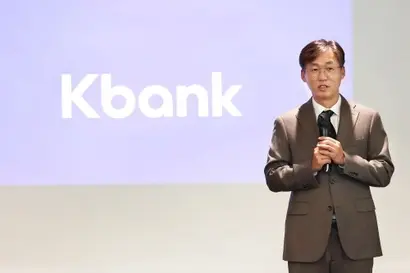
K-Bank has begun its management succession process ahead of the expiration of CEO Choi Woo-hyung’s term, which ends on December 31, 2025. Following best practices for bank governance, K-Bank initiated the succession process three months before the expiration of the CEO's term, and the Executive Recommendation Committee secured a pool of five candidates at the end of last year.
CEO Choi’s term is two years, which is relatively short compared to previous K-Bank CEOs. The first CEO, Shim Sung-hoon, took office in September 2016 and served a three-year term followed by a six-month extension. His successor, Lee Moon-hwan, took office in March 2020 but resigned in less than a year. Seo Ho-sung then served for approximately three years, from February 2021 to December 2023. The fourth CEO, Choi Woo-hyung, took office in January 2024 with a two-year term.
The market leans toward the possibility of CEO Choi’s reappointment, viewing him as the person to continue holding the reins to achieve K-Bank’s long-standing goal: the IPO. K-Bank, now on its third attempt at an IPO, previously applied for KOSPI listing preliminary reviews in June 2022 and June 2024, but withdrew both times. K-Bank is now preparing for a third attempt following an board resolution in March 2025. Although it selected NH Investment & Securities005940 and Samsung Securities016360 as underwriters last June, it has yet to submit a formal preliminary listing application.
CEO Choi’s performance during his term is not poor. In 2024, his first year, K-Bank recorded a net profit of 128.1 billion KRW, an all-time high. This is nearly a 10-fold increase compared to 2023 (12.8 billion KRW), when profits were squeezed by increased provisions for bad debts. The net profit for the first half of 2025 was 84.2 billion KRW, a slight decrease from 85.4 billion KRW during the same period last year. Despite a sharp drop in first-quarter profit to 16 billion KRW, the bank succeeded in narrowing the decline by generating a quarterly record net profit of 68.2 billion KRW in the second quarter.
The bank has also focused on expanding its size ahead of the IPO. On the 15th, K-Bank announced that it had surpassed 15 million customers. It reached the 10 million mark in March 2024, about five years after its launch, and the growth rate has accelerated since then. K-Bank stated that it has been attracting an average of 260,000 new customers per month since 2024. As the number of users grew, so did its asset size. As of the third quarter, K-Bank’s assets reached 33.4 trillion KRW.
K-Bank has been focusing on customer acquisition since announcing the strengthening of its corporate finance business earlier this year. As of September, K-Bank’s self-employed customers exceeded 2 million; compared to the end of 2023, the proportion of self-employed individuals among total customers increased from 9% to 14%. K-Bank was the first internet-only bank to launch a fully non-face-to-face real estate mortgage loan product for self-employed individuals.
However, looking at the paths of his predecessors, it is difficult to be certain about CEO Choi’s reappointment. The third CEO, Seo Ho-sung, achieved K-Bank’s first turnaround into profitability, yet he stepped down after completing his three-year term. It was also during CEO Seo’s tenure that K-Bank first attempted and withdrew its IPO.
Even if he is reappointed, there are many tasks to solve. First, the IPO must be achieved on time. Given that a preliminary listing review typically takes two to three months, the earliest K-Bank could list is the first half of next year. BC Card, K-Bank’s largest shareholder, signed a new share acquisition agreement with financial investors (FI) during a capital increase in June 2021, which included a condition to go public by 2026. If the deadline is not met, the FI can exercise its tag-along rights to sell even the stake held by the majority shareholder, BC Card.
Maintaining the No. 2 spot has also become difficult with the failure of a fourth internet-only bank to emerge. Looking at the Net Interest Margin (NIM), an indicator of a financial firm’s profitability, K-Bank’s NIM as of the first half of 2025 was 1.38%, lower than Kakao Bank (2.00%) and Toss Bank (2.57%). In particular, the "four-year-old" youngest competitor, Toss Bank, is in hot pursuit. Toss Bank achieved profitability in 2024 with a net profit of 45.7 billion KRW, and showed rapid growth by exceeding 40 billion KRW in net profit in the first half of this year alone. As of October, its customer count reached 13.75 million, closely trailing K-Bank (15 million).
Another challenge is the government's request for the financial sector to pivot toward "productive finance." Major financial holding companies are engaged in a "war of money," promising hundreds of trillions of won in investments toward productive and inclusive finance. Conversely, there are limitations for internet-only banks, which have relatively weak capital and are unable to engage in face-to-face or large-corporate business, to focus their productive finance on corporate investment.
K-Bank is responding by leading the expansion of non-face-to-face loan products for small and medium-sized enterprises (SMEs) and self-employed individuals. It is reportedly developing a fully non-face-to-face loan product for corporate entities. While corporate loans typically require face-to-face procedures for due diligence and document review, the goal is to develop a product where everything from document submission to loan execution is done non-face-to-face. During a press conference for its small business real estate mortgage loans in March, K-Bank stated, "We are preparing a 100% non-face-to-face corporate loan product for SMEs, aiming for a third-quarter 2027 launch."