

[비즈한국] There was a story that popped up frequently on social media at one point: the claim that we would be able to see the aurora in Korea this year. Every 11 years, the Sun enters a "solar maximum," a period of intense activity, and since this year happens to be that peak—and a particularly volatile one at that—many have been looking forward to seeing the aurora this summer. The aurora is a beautiful result of the interaction between the Sun and the Earth. Yet, while it may look beautiful on the surface, its backstory could be seen as the scars of a fierce, silent war waged between the two.

Earth's magnetic field is not merely an artist painting beautiful green neon works of art in the polar skies; it is, in fact, a lifesaver that allows life on Earth to survive. If not for the magnetic field, Earth would have already suffered the same fate as Mars. The solar wind particles pouring toward Earth would have reached the surface directly, stripping away the atmosphere and oceans into outer space. Fortunately, Earth's magnetic field does an excellent job of blocking these solar wind particles after their 150 million km journey. Thanks to this, life on Earth has been granted the time to evolve without being wiped out for about 4.5 billion years.
However, the magnetic field might not have been limited to the role of a mere protective shield. Intriguing evidence has been discovered suggesting it may have played a more active role. It is possible that Earth’s magnetic field even helped create the oxygen on Earth.
How did Earth become a world so full of life? One of the most important moments in the history of life on Earth is the "Great Oxygenation Event," where oxygen levels in the atmosphere began to rise rapidly. Starting about 2.8 billion years ago, oxygen in Earth's atmosphere surged. As plants began to emerge from the sea, large-scale photosynthesis occurred, and the oxygen produced filled the atmosphere, triggering a massive revolution in Earth's ecosystem.
How can we know how many plants were breathing in Earth’s skies in the past? There are several ways to look back at Earth's long-term memory. One way is to examine the "memory of charcoal." When trees burned in ancient wildfires, the oxygen left over after combustion was trapped in the ash, and by analyzing its composition, we can determine the atmospheric oxygen concentration at the time of the fire. Another method uses minerals like rock salt. By analyzing ancient atmospheric components trapped within salt crystals as they hardened, we can "remember" oxygen levels.
NASA scientists used these analyses to track how oxygen levels have changed from about 540 million years ago to the present. The blue line on the graph represents these changes in oxygen concentration. Interestingly, there is a very notable period between 350 million and 250 million years ago. During this time, oxygen levels suddenly skyrocketed to 40%. Afterward, they dipped slightly to reach current levels. Understanding why oxygen levels spiked and then dropped during this specific 100-million-year period has been difficult.
However, astronomers discovered an interesting fact in unexpected data: another phenomenon exhibited the exact same pattern. It was none other than Earth's magnetic field. The ancient magnetic field also left traces throughout the Earth. A prime example is the rock at divergent boundaries, where deep-sea oceanic crust split and spread apart. As the newly erupted magma cooled, the metallic components within it aligned with the direction of the magnetic field, acting as a kind of compass that tracks the ancient magnetic field. This allows us to understand the changes in the Earth's magnetic field.
In the graph below, the red line shows the change in the Virtual Geomagnetic Axial Dipole Moment (VGADM), which indicates how strongly the Earth's magnetic poles were aligned. Surprisingly, it shows a pattern similar to the blue graph of atmospheric oxygen concentration we saw earlier. Notably, both increased rapidly between 350 million and 250 million years ago.
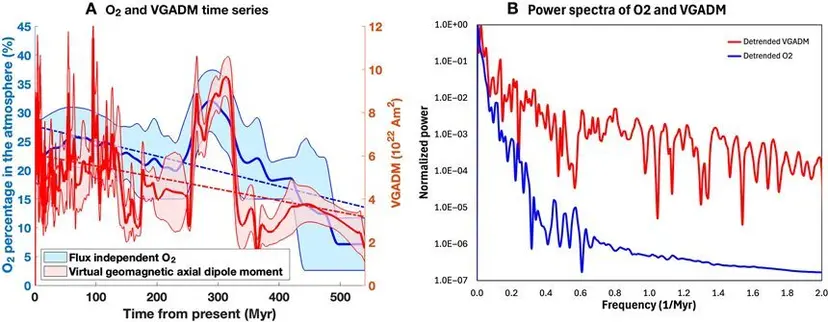
This suggests that changes in atmospheric oxygen and the Earth's magnetic field are closely linked. The correlation between the two is statistically too strong to be dismissed as a simple coincidence. So, what on earth was happening between them?
Unfortunately, this analysis only shows the correlation between the two, not a clear causal relationship. Therefore, we must consider three possibilities: changes in the magnetic field altered oxygen levels; changes in oxygen altered the magnetic field; or some other major change caused both to shift simultaneously.
First, let’s look at the possibility that magnetic field changes caused the shift in oxygen. It is well-known that the violent activity of a central star can destroy the atmospheres of nearby planets. Calculations show that near stars that are much smaller but more volatile than the Sun, atmospheric molecules equivalent to the entire mass of Earth's current atmosphere can disappear in just 25 million years. Therefore, it is possible that because the magnetic field strengthened, Earth's atmosphere was better able to withstand the solar wind, allowing more oxygen to remain.
However, this hypothesis is not yet perfect. The data shows changes in oxygen concentration, not the total amount of atmospheric molecules. If the growth of the magnetic field resulted in protecting the atmosphere, the total atmospheric volume should have increased along with the oxygen. Therefore, to prove this causality, one would need to calculate factors like ancient atmospheric pressure, not just oxygen levels. Unfortunately, there is no clear way to trace ancient atmospheric pressure yet. It is also possible that a stronger magnetic field allowed land plants to flourish longer, leading to higher oxygen levels. That could explain why oxygen concentration specifically spiked in the atmosphere. But there is not enough evidence to support this hypothesis yet.
Could there be causality in the opposite direction—from oxygen to the magnetic field? If oxygen levels in the atmosphere rise, some of it can be transmitted underground. As Earth's plates split and move, atmospheric oxygen permeates through the ocean into rocks and magma, eventually reaching the mantle. Through this large-scale cycle connecting the sky, ocean, and land, the chemical composition of the mantle changes to an oxygen-rich environment. In effect, the mantle is oxidized. It is possible that these changes influenced the mantle and the internal materials that generate the magnetic field. But again, there is no clear evidence to prove such a mechanism.
Interestingly, the period when both the magnetic field and oxygen levels increased explosively overlaps with another historically significant geological period: the time when Pangea, the supercontinent where all of Earth's land was once joined, began to split. The time when Pangea started to break apart in earnest is estimated to be 200 to 300 million years ago. Coincidentally, this is exactly the time when both the magnetic field and oxygen levels spiked. Such consecutive coincidences make us further consider the possibility that geological changes may have eventually reached the Earth's skies.
Of course, this discovery might be a meaningless coincidence. But if there is a close connection between Earth's magnetic field and oxygen, we can conclude that the magnetic field played a much more active role than just being a protective shield, enabling life to flourish and breathe. Thanks to the magnetic field, we could emerge from caves to avoid intense sunlight and walk proudly, and thanks to it, we can breathe.
In that sense, the fact that the aurora created by the magnetic field glows in a vivid green color is an exquisite coincidence. The reason the aurora that excited us this summer glowed so green is because of oxygen. Earth’s magnetic field causes charged particles blowing from the Sun to gather at the poles. These high-energy particles collide with oxygen molecules in the upper atmosphere of the polar regions, and the energized oxygen molecules emit light. Oxygen molecules primarily emit light in the green wavelength, which is why the aurora looks green.
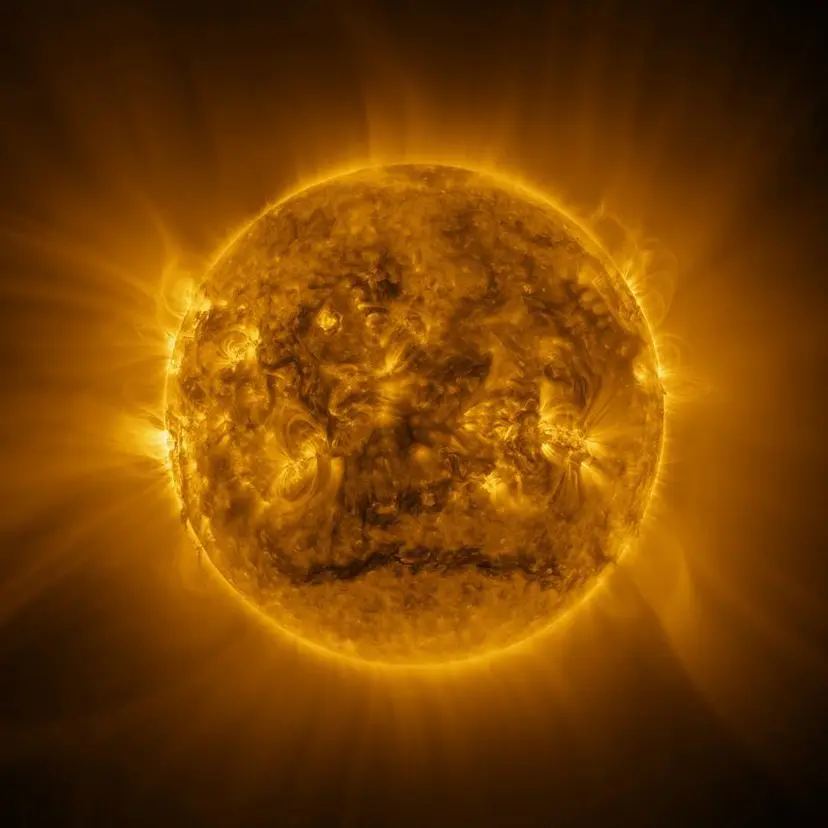
In fact, the Sun had been showing unusual signs since May of last year. It erupted with an X-class flare—the strongest level—after a long time, and a coronal mass ejection from the Sun swept past Earth. This led to auroras being sighted even in low-latitude regions where they are usually difficult to see. At that time, faint auroras were even captured in parts of Gangwon-do, Korea. That is why many media outlets raised expectations for the aurora this summer. Of course, we were never going to see a spectacular aurora like the ones in Norway in the Korean sky. Even on the clearest night, it would be difficult to spot with the naked eye.
Actually, a feast of spectacular auroras can be a nightmare for astronomers. It means the Sun is volatile, which can cause fatal problems for modern human civilization, which relies on electrical infrastructure. It is especially lethal for satellites orbiting outside the atmosphere. That is why the Korea Astronomy and Space Science Institute (KASI) monitors solar activity moment-by-moment and provides space weather forecasts. We now live in an era where we have to pay attention not only to the sky above Earth but also to the whims of the Sun 150 million kilometers away.
For those disappointed by the uneventful aurora display this summer, another major solar event is unfolding. The moment to see a total solar eclipse in Korea is approaching. On September 2, 2035, the shadow of the Moon, perfectly covering the Sun, will cross exactly over the Korean Peninsula. However, there is a minor(?) problem: most of the total solar eclipse path passes through North Korea. Fortunately, there is one spot that overlaps with South Korea: Goseong, at the northernmost tip of Gangwon-do.
Just as a massive crowd once gathered in parts of Sokcho, Gangwon-do, when "Pokémon GO" was playable there, won't a massive crowd flock to Goseong to see the total solar eclipse 10 years from now? As the only region in Korea where the total solar eclipse will be visible, it will be a great opportunity for Goseong County to host a local government event. September 2, 2035—I hope the weather is perfect then.
References
https://www.science.org/doi/10.1126/sciadv.adu8826
https://science.nasa.gov/earth/earth-oxygen-magnetic-field-linked/
About the author, Ung-Bae Ji? He loves cats and the universe. As a child, after watching 'Galaxy Express 999,' he dreamed of sharing the beauty of the universe. He is currently an assistant professor in the Faculty of Liberal Arts at Sejong University, engaging in various science communication activities including lectures and writing. He has authored books such as 'A Piece of the Universe Every Day,' 'Scientists of the Starry Universe,' 'Knowable Even if Unreachable,' and 'Strange Questions That Come to Mind When Looking at the Universe,' and translated books including 'The Hitchhiker's Guide to the Real Universe,' 'How I Killed Pluto,' 'Quantum Life,' and 'Cosmigraphics.'