

[비즈한국] Just two weeks after the government announced its October 15 real estate measures, public sentiment has deteriorated rapidly. While ostensibly put forward to "curb speculation" and "stabilize housing for the common people," the reality is producing the exact opposite results. The biggest problem is that the public's trust in the policies themselves has collapsed from the foundation as the hypocritical behavior of the policymakers has been exposed.
It has been confirmed that the so-called "Real Estate Five," who spearheaded these measures—Kim Yong-beom, Policy Chief at the Presidential Office; Koo Yoon-cheol, Deputy Prime Minister for Economy; Lee Eok-won, Chairman of the Financial Services Commission; Lee Chan-jin, Governor of the Financial Supervisory Service; and Lee Sang-kyung, former First Vice Minister of Land, Infrastructure and Transport—all own high-priced apartments worth billions of won in key regulated areas such as Gangnam in Seoul and Bundang in Gyeonggi-do.
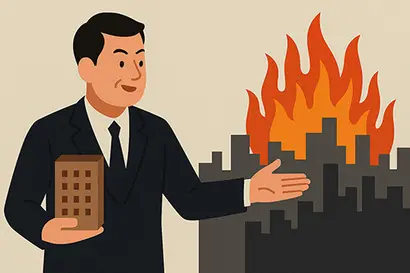
In particular, former Vice Minister Lee Sang-kyung was accused of "gap investing" by purchasing a 3.35 billion won apartment in Baekhyeon-dong, Seongnam-si, Gyeonggi-do, in July 2024, while utilizing 1.48 billion won in jeonse (lump-sum deposit) loans. Despite holding about 2.9 billion won in cash, he bought the house while burdened with a jeonse deposit. It is reported that he gained a market profit of 600 million won in just over a year.
Even more staggering is that Vice Minister Lee appeared on a YouTube broadcast and made remarks that seemed to mock those without homes, stating, "If house prices drop, that’s when you should buy." While lecturing the public that "loans are speculation," he himself has been building his wealth through loans and gap investments.
Policy Chief Kim Yong-beom acquired an apartment in Banpo-dong, Seoul, by purchasing a reconstruction membership right in 2000, and Deputy Prime Minister Koo Yoon-cheol made billions of won in market profits through trading reconstructed apartments during the Moon Jae-in administration. Financial Services Commission Chairman Lee Eok-won also bought an apartment in Gaepo-dong, Seoul, through gap investment. All of them purchased homes in regulated areas using loans or jeonse, and now they are receiving criticism for blocking ordinary citizens from buying homes by restricting loans.
The opposition People Power Party labeled them the "Four Real Estate Disasters" or the "Five Hypocrites," harshly criticizing them, saying, "It is a blatant 'Naeronambul' (if I do it, it's romance; if others do it, it's an affair) where they tell the public, 'It’s okay for me, but not for you.'" As the perception spreads that those who make the policies are a privileged class not subject to their own policies, trust in the policies themselves has already hit rock bottom.
What is more serious is that as side effects surged after the policy announcement, the Democratic Party began to disassociate itself from and distance itself from its existing policies. Consistency in policy has completely collapsed as they review the easing or abolition of the Reconstruction Excess Profit Recovery Act (Re-recovery Act) and distance themselves from policies like the 3.3.3 tenant policy by claiming they "never reviewed them."
Bok Ki-wang, the Democratic Party’s ranking member of the Land, Infrastructure and Transport Committee, stated, "If the housing market can be stabilized by significantly easing or abolishing the Re-recovery Act, we can decide to do so at any time." Moon Jin-seok, the party's senior deputy floor leader, also hinted at a policy retreat, saying, "The party and government have not discussed it, but we are reviewing two options at the Land Committee level: extending the grace period or abolition."
This is in direct opposition to the Democratic Party's long-standing stance against abolishing the Re-recovery Act. The abolition of the Re-recovery Act was not included in the last presidential election pledge, and Rep. Jin Sung-joon stated at a press conference in July 2025 that "the Re-recovery Act should fundamentally be maintained." They have changed their position 180 degrees in just three months.
Policy Committee Chair Han Jeung-ae drew a line on the discussion of raising holding taxes, stating, "We are not considering or reviewing any follow-up tax systems at all." Even though high-ranking government authorities mentioned the need to strengthen holding taxes, the party appeared to deny it. This is interpreted as a fear of losing votes from high-end homeowners ahead of the local elections next June.
Representative Jung Chung-rae urged members at a general meeting, saying, "Real estate policy is very sensitive and the public is watching closely, so please refrain from impulsive remarks by individual members as much as possible." This was in mind of Rep. Bok Ki-wang’s comment that "an apartment around 1.5 billion won is a commoner's apartment," illustrating the internal confusion within the party and the disconnect with the public.
The fact that they are reversing their positions and retreating as soon as side effects appeared immediately after the policy announcement proves that there were serious problems from the policy design stage. If there is no consistency and sustainability in policy, the market will not trust the government, and consequently, no policy can be effective.
The government designated the entire city of Seoul and 12 regions in Gyeonggi-do as speculative zones, adjustment target areas, and land transaction permit zones simultaneously, and reduced the Loan-to-Value (LTV) ratio to 40%. For homes exceeding 1.5 billion won but not more than 2.5 billion won, the loan limit was set to 400 million won, and for homes exceeding 2.5 billion won, it was limited to 200 million won. If someone acquires an apartment worth more than 300 million won in a regulated area while holding a jeonse loan, the jeonse loan is recovered, and those with credit loans exceeding 100 million won are prohibited from purchasing homes in speculative zones for one year.
Furthermore, if you purchase an apartment in a regulated area, you must reside in it for two years, and purchasing with a jeonse deposit is impossible. As a result, people trying to sell their homes are facing a situation where they must evict their existing jeonse tenants.
The problem is that despite these strong demand-curbing measures, there are no practical plans for supply expansion. The supply measures announced on September 7th claim to supply 1.35 million homes over the next five years, but the evaluation is that it is difficult to expect the quality of homes consumers want, as 80% is led by the public sector. Since reconstruction and redevelopment projects usually take 7–10 years, and even new apartment construction takes at least 3–4 years, it is difficult to produce supply effects in the short term.
Even more serious is the structural contradiction of suppressing demand while simultaneously blocking supply. Due to these measures, financing for reconstruction and redevelopment projects has become difficult, and the supply of non-apartments by private rental business operators has become virtually impossible. The strengthening of LTV regulations has made it difficult for reconstruction union members to secure initial investment capital, increasing the possibility that projects themselves will be delayed or derailed.
The most criticized point of these measures is that while they used "curbing speculation" as a pretext, in reality, they are further pressuring actual homebuyers and common people without homes. As jeonse loan regulations are strengthened, the supply of jeonse is decreasing rapidly. According to KB Real Estate statistics, as of October 23, the number of jeonse listings for Seoul apartments was 24,759, a 22% decrease compared to the beginning of the year. Since jeonse deposit loan limits were significantly reduced after June 27, landlords prefer to move in themselves, and with the October 15 measures, "gap investment" including jeonse is virtually banned, causing the supply in the jeonse market itself to shrink.
These October 15 measures are following in the footsteps of the Moon Jae-in administration's real estate policy failures. The Moon Jae-in administration announced 28 real estate measures, but Seoul apartment prices nearly doubled, and in the end, the failure of real estate policy became a major cause of the change in government.
Experts point to political calculations as the fundamental reason for why these measures are flimsy. They argue that President Lee Jae-myung and the Democratic Party are prioritizing next year's local elections over the stabilization of the housing market and the residential life of the common people.
The analysis is that they are afraid of struggling in next year's local elections due to the loss of votes from high-end homeowners if they take fundamental prescriptions for lower long-term investment returns, such as tax hikes and increasing the supply of existing homes. Indeed, the Democratic Party is trying to postpone discussions on raising holding taxes until after next year's elections.
Real estate policy should be based on economic rationality and market principles and should not be swayed by political interests. The current government is obsessed with populism conscious of the election and is pouring out unprincipled policies. The cost will be borne entirely by the common people and those without homes.
The reasons why the October 15 real estate measures are being criticized are clear. First, policy trust has collapsed from the foundation due to the hypocritical behavior of policymakers. Second, there is no consistency in policy, as they reverse their positions and retreat as soon as side effects appear immediately after the policy announcement. Third, demand suppression without supply expansion is structurally bound to fail. Fourth, it is causing a trading cliff while putting more pressure on actual homebuyers and the common people. Fifth, prescriptions such as raising holding taxes are being avoided due to political burdens. Sixth, they are repeating the same mistakes without learning from the failures of the Moon Jae-in administration.
The most serious problem is that the people who make policies are applying a double standard: "It’s okay for me, but not for the public." Seeing them buy multi-billion won high-end apartments through gap investment and then lecture the public that "loans are speculation," the public feels more than anger—they feel a sense of futility.
There is no government that can beat the market. You should not aim the blade meant for catching a cow at the common people and the middle class. The government must send consistent policy signals with a long-term view, such as expanding supply through deregulation and normalizing market functions. Above all, the people who make the policies must have moral legitimacy. Otherwise, no policy will gain the public's trust, and it will inevitably end in failure.
Kim Hak-ryeol, also known by his pen name "Pasion," is the head of the Smart Tube Real Estate Research Institute and a former team leader at the Korea Gallup Real Estate Research Division. He runs and hosts the Naver blog "Pasion's World Exploration" and the YouTube channel "StewTV." His books include "Revised South Korea Real Estate User Manual (2025)," "The Power of Gyeonggi Real Estate (2024)," "The Absolute Principles of Seoul Real Estate (2023)," "The Future of Incheon Real Estate (2022)," "Kim Hak-ryeol’s Absolute Principles of Real Estate Investment (2022)," "South Korea Real Estate Future Map (2021)," and "From Now On, Only Places That Will Rise Will Rise (2020)."