

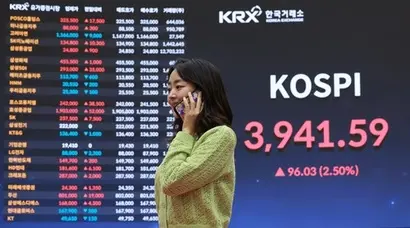
[비즈한국] The KOSPI has surpassed the 4000 mark for the first time in history. The number '4000' is more than just an index value; it is the culmination of a historic rally driven by the AI supercycle that began last year, the recovery of the semiconductor industry, and expanding liquidity. However, behind this heated rally, the eyes of the securities industry are already turning toward next year.
Experts unanimously forecast that next year will be "a year where expansion and adjustment coexist." While the AI and semiconductor-led supercycle that dominated from last year through this year remains valid, the market is beginning to feel "fatigue from the speed." The analysis suggests that while liquidity will be ample and interest rates will fall, the slope of profit growth and the temperature of expansion will cool. Ultimately, breaking the 4000 mark should be seen not as an end point, but as a turning point for a new cycle. Investors must now prepare for an "era of balance" rather than the "end" of a bull market.
Hanwha Investment & Securities003530 summarized next year’s global economy as "favorable for the U.S., moderate for non-U.S. regions." They project growth rates of 1.9% for the U.S., 1.9% for South Korea, and 4.3% for China. A gradual recovery is expected as manufacturing rebounds from its lows, coupled with expansionary fiscal policies and accommodative monetary policies from various governments. U.S. tax cuts and expanded fiscal spending in South Korea and Japan are supporting liquidity, while Europe and China are also pursuing active fiscal management. Accordingly, "fiscal-led growth" is emerging as a key keyword for the global economy.
SangSangin Securities001290 described this as a "process of mutual absorption between productivity and liquidity." The explanation is that productivity improvements generated by artificial intelligence (AI) and technological innovation are combining with abundant liquidity to create new growth momentum. However, they warned that a "bubble controversy" could arise if the gap between productivity expectations and delayed investment execution widens.
The U.S. Federal Reserve is highly likely to continue its gradual interest rate cut cycle into next year. Yuanta Securities003470 evaluated this as a "Quasi-Goldilocks" phase—an ideal scenario where inflation falls gradually and the real economy grows without entering a recession.
However, there is also the possibility that inflationary pressure will rise again in the second half of next year. Lee Jae-man, a researcher at Hana Securities, pointed out, "Global liquidity will peak in the third quarter of next year and shift to a decline," noting that rebounding oil prices and rising housing costs could restimulate inflation. In other words, while preference for risk assets will continue in the first half of next year amid an accommodative environment, a resurgence in inflation and interest rates could act as a variable in the second half.
The domestic stock market has solidified around the 3940 line, marking an all-time high. However, experts diagnose next year as the "final leg of the expansionary phase." Byun Jun-ho, a researcher at IBK Securities, predicted a market pause, stating, "The OECD composite leading indicator and domestic GDP growth will enter a phase of moderate slowdown, peaking in the first quarter of next year." Specifically, the analysis suggests that shrinking semiconductor margins and a slowdown in global trade may constrain net profit momentum.
Nevertheless, the downside of the KOSPI is firm. The liquidity environment is stable, and government policies aimed at vitalizing the capital market—such as the roadmap for promotion to the MSCI developed market index, mandatory treasury stock cancellation, and easing of dividend taxes—are expected to act positively.
While outlooks on the leading sectors for next year are divided, Hana Securities stated that "the core of a bull market is that the leading sectors do not change," and selected semiconductors, shipbuilding, machinery, secondary batteries, energy, healthcare, defense, and IT hardware as sectors to overweight.
However, IBK Securities warned of the possibility of semiconductor price declines after the first quarter of next year and advised preparing for a "profit peak-out." Consequently, they recommended investing in non-cyclical sectors such as defense, shipbuilding, bio, internet, and gaming, as well as long-neglected defensive stocks like food & beverage and utilities.
Next year's market is expected to be a year of rebalancing rather than rapid surges. While breaking the KOSPI 4000 mark is possible, it is highly likely that the speed of earnings growth will slow down, making it difficult to look much further beyond that level. Accordingly, gradual risk management will be necessary in the second half of the year following the expansion of risk assets in the first half. The three axes of AI, semiconductors, and fiscal expansion are still driving the market. However, the transition from a "market of speed" to a "market of balance" has begun. The market is still rising, but the days when everything rises are coming to an end; the key to success will now be determined by "who is left standing at the end."