

[비즈한국] The domestic stock market this week (October 27–31) is expected to see a combination of potential rebounds driven by undervalued attractiveness and volatility stemming from global variables. The Federal Reserve's interest rate policy, foreign exchange trends, and earnings announcements from major domestic companies are considered key factors that will determine the market's direction.
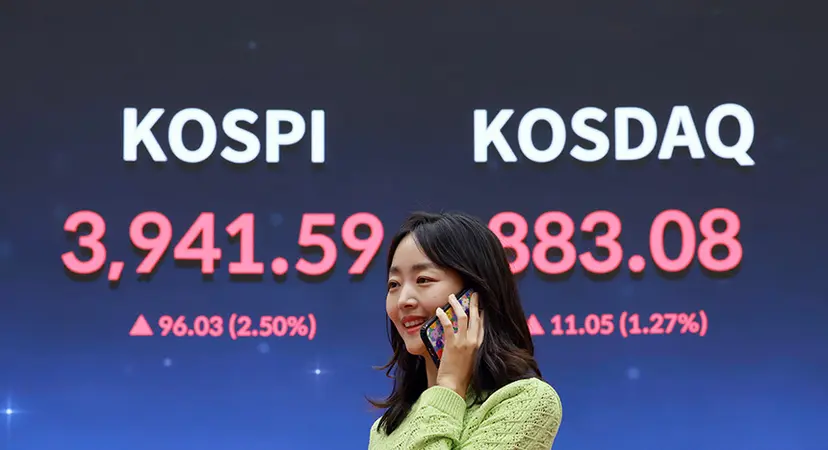
Recently, the KOSPI has shown a trend where gains and adjustments are intertwined, repeatedly fluctuating near record highs. On the previous trading day, October 24, the KOSPI closed at 3,941.59, hitting an all-time high. Among major emerging markets, the Korean stock market stands out for its valuation appeal, and the "Overweight" sentiment is spreading among global investment institutions. However, policy uncertainty, exchange rate volatility, and changes in the trade environment continue to act as burdens. The strength of the dollar is rising again, and market reactions to domestic policy expectations, such as corporate governance restructuring and tax reform, may vary depending on actual progress.
The variables that will influence the stock market this week can be summarized into three points. First is U.S. interest rates and the flow of the dollar. While funds have been flowing into emerging markets amid the recent weak dollar trend, the situation could change at any time depending on U.S.-led events. Second is the exchange rate. The won-dollar exchange rate closed in the 1,438–1,439 range as of the last week of October, and the market perceives the 1,440-won range as a psychological resistance level. If the exchange rate breaks through this range, the possibility of weakening foreign buying pressure is raised. Third is the earnings season. Major earnings announcements and conference calls are scheduled, focusing on leading sectors such as semiconductors, automobiles, and secondary batteries. The earnings results of top market cap stocks and remarks from management are highly likely to have a direct impact on the direction of the index.
The schedule for large-cap stocks is also packed. POSCO Holdings005490 will announce its third-quarter earnings on October 26 and hold a conference call on the 27th. On the 29th, SK Hynix000660 and Hyundai Motor Company005380 will disclose their earnings and hold their respective conference calls. On the 30th, Samsung Electronics005930 will hold a conference call, while LG Energy Solution373220 and LG Display will announce their earnings. LG Chem is also scheduled to release its earnings on the same day, with a conference call to follow on the 31st. Naver's earnings announcement is scheduled for the first week of November.
The points to watch by sector are also clear. In the semiconductor industry, market attention is expected to focus on SK Hynix's HBM capacity expansion, yields, and order guidelines. For Samsung Electronics, key areas include memory prices (ASP), inventory status, and foundry order trends. In the steel industry, POSCO's cost burdens, domestic demand in China, and sensitivity to exchange rates are cited as major issues. In the automobile and battery sectors, the keys are whether Hyundai Motor can improve its electrification margins, the effects of the U.S. Inflation Reduction Act (IRA), and the expansion of LG Energy Solution's Energy Storage System (ESS) business. LG Chem will have its fundraising and materials business growth strategy tested, while Naver will be tested for potential earnings recovery in its advertising and commerce divisions.
In terms of supply and demand, foreign buying is the key factor. Foreigners turned back to net buying in October, leading the index higher. In particular, inflows were notable in the semiconductor and electrical/electronics sectors. However, if the exchange rate breaks through the 1,440-won mark and the strong dollar trend solidifies, the possibility of foreign capital outflows cannot be ruled out. The prevailing market opinion is that the KOSPI will show a moderate rise within the 3,800–3,900 range this week, but there is also talk of a potential adjustment of around 3% if policy uncertainty and exchange rate volatility increase.
Ultimately, this week's stock market is likely to be a mixed market where upward momentum and risk factors conflict. While expectations for earnings improvement and valuation attractiveness act as driving forces for the index, exchange rates, global interest rates, and policy variables are expected to act as factors limiting upward elasticity. In terms of investment strategy, analysts suggest that while it is advantageous to respond to short-term events focusing on stocks with room for earnings upgrades, it is also beneficial to take some profit in segments with increased volatility.
In particular, since semiconductor, automobile, and materials sectors have a high contribution to the index, the tone of the entire market could change depending on their results. Whether the exchange rate is maintained stably around the 1,440-won line is also considered a key indicator to gauge foreign investor supply and demand and market flow. It is expected to be a week where precision in risk management becomes more important than timing the market to seize opportunities for gains.