

[비즈한국] Less than two months after launching its second-hand clothing resale service 'Used', Musinsa has overhauled its commission policy. The high commission rate—reaching up to 80% at launch—triggered a wave of user complaints, and with recent controversies over operational deficiencies, the company has ultimately moved to adjust its fees.
Controversy Over 80% Commission Leads to Adjustments
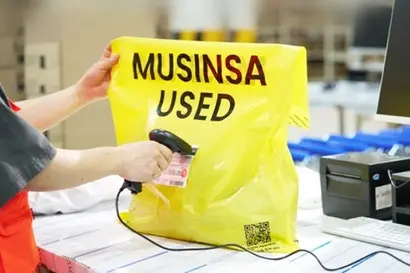
Musinsa officially launched its second-hand clothing resale service, 'Musinsa Used,' last August. The service operates by having users send in clothing they wish to sell, after which Musinsa handles the entire process, including inspection, laundry, photography, listing, and settlement. The service was touted for reducing the hassle of traditional resale, where sellers must photograph and register their own items.
However, the service sparked controversy early on due to its high commission fees. Musinsa applied a tiered commission structure ranging from 10% to as high as 80% based on the item price. For items priced at 300,000 KRW or more, the commission was 10–25% of the sale price, while items under 10,000 KRW incurred an 80% fee. For an item sold for 9,900 KRW, 7,920 KRW was deducted as a commission, leaving the seller with only 1,980 KRW.
Even compared to competing platforms, these commission rates are considered high. Bunjang's commission for general sellers is around 6%, and Kream’s sales commission is also known to be in the 5–6% range. Critics argue that even accounting for the agency-based structure that includes inspection and photography, the burden is too high. An industry official remarked, “These commissions are hard to justify. It’s a decision that feels inconsistent with the reasonable image Musinsa has maintained.”
Seemingly aware of the user burden, Musinsa ran a ‘commission cashback event’ for one month immediately after launch. The temporary promotion halved the fees, a move industry observers viewed as a measure to encourage early user adoption. As a result, the service surpassed 10,000 sales applicants and 60,000 registered items within two weeks of launch.

Perhaps due to the rapid influx of users, complaints about inadequate service operations emerged among Used users. Users pointed to poor management of core procedures such as inspection and brand verification. One user said, “I sent a high-end designer brand garment to be sold, but they misidentified the brand entirely and set an absurd price. I was told that while the price could be adjusted, the brand name could not. It ruins my trust in the service to see them charging high fees for inspection yet failing to even verify the brand name correctly.”
Another user complained, “I bought a T-shirt using Musinsa Used. It was listed as size 3XL, but when it arrived, it was a size M. The operation seems sloppy.”
Following the ongoing controversy, Musinsa appears to be re-evaluating its overall service operations. The company recently revamped its commission structure. According to the new guidelines, commissions now range from 7% to 38% depending on the sale price. For items between 3 million and 5 million KRW, the fee is 7%, while items under 20,000 KRW are charged 38%. This is lower overall compared to the previous rates (10–80%), with fees for low-priced items being reduced by more than half.
In exchange, a separate ‘productization fee’ of 5,000 KRW per item is now charged to cover the cost of inspecting, cleaning, photographing, and registering items. Because of this, some users argue that for low-priced items, the perceived reduction in cost is not significant.
Musinsa stated, “Unlike typical resale platforms, Used is a service that handles the entire process from logistics to sales, so there are inevitable operating costs. We tested the service during the initial launch phase using industry-standard commission rates. We recently adjusted these rates to create a structure that allows sellers to earn more profit.”
Regarding criticisms of poor operations, the company explained, “The volume of goods coming in is much higher than our current operational capacity. Many customers send more than 10 items at once. Since every item undergoes individual inspection, it takes a significant amount of time. We are working on stabilizing operations and expect to see improvements gradually.”

Neglecting Quality Control Could Impact Investor Confidence
Having started as an online fashion platform, Musinsa has been rapidly expanding its business scope into offline retail, beauty, kids' fashion, sportswear, and resale. This strategy is interpreted as an effort to increase corporate value through outward growth and revenue diversification ahead of its IPO.
The resale service 'Used' is a new business born from this expansion. However, ongoing controversies regarding service completeness and commission issues are being viewed as potential burdens on the brand’s image. Within the industry, there are concerns that if Musinsa focuses too much on outward growth while neglecting service quality control, it could impact investor confidence. For a company pursuing an IPO, service stability and brand reliability are just as important as growth potential when it comes to evaluation.
Seo Yong-gu, a professor of business administration at Sookmyung Women’s University, said, “While corporate growth is important, brand reliability and reputation are core values. Actions that damage brand value can also have a negative impact on the IPO process.”
Musinsa is pursuing an IPO with a target valuation of over 10 trillion KRW. It recently began the process of selecting underwriters from 11 domestic and international securities firms, and competitive presentations were held over three days from the 21st to the 23rd. Musinsa stated, “There is no specific schedule or confirmed detail regarding the selection of IPO underwriters yet.”