

[비즈한국] KT030200, which is pushing for a transition into an AI-centric technology company, has been found to have generated over 100 billion won in revenue from its AX (AI Transformation) B2B business this year. Performance in domestic public and financial sectors, as well as in global markets, is reportedly becoming tangible. The company is also accelerating a two-track strategy, following its proprietary model 'Mi:dm 2.0' with the release of 'SOTA K', developed in collaboration with Microsoft (MS), and the open-source-based 'Llama K'. Attention is focused on whether KT, which faced a setback in the national AI company selection process last August, can prove its competitiveness on the actual stage through its AI business.
Accelerating Structural Improvements in the 'First Year of AICT Company'
KT, having declared 2025 as the inaugural year of an 'AICT (Artificial Intelligence·Information and Communication Technology) company,' is increasing the weight of its AI and IT divisions. According to the industry, as of October this year, KT has secured a total of 100 billion won in revenue from its AX B2B business segment. It secured over 60 billion won in the financial sector, including banks and insurance companies, and recorded about 45 billion won in the public sector, including government agencies. Including global projects with companies like Viettel, the scale exceeds 100 billion won.
To date, the company appears to have recorded a growth rate of approximately 10% compared to the previous year. Last year, KT's AI/IT division revenue was 1.1058 trillion won. According to KT, revenue for the first half of this year for AI/IT was 598.3 billion won.
Regarding these contract achievements, the KT technology blog explained, "It is significant because KT's Technology Innovation Division led key projects that drive digital innovation from an AX perspective across various institutions and sectors."
AX, an abbreviation for AI Transformation, refers to a transition that innovates the entire way an organization or company works, centering on AI. The AX business is considered a revenue-generating AI business. Demand is growing faster than that for traditional IT system construction in the industrial sector, and it is a structure that can generate additional profit through continuous optimization even after the technology is introduced. As the IT industry strategically focuses on this area recently, telecommunications companies, which urgently need to escape low growth in the telecom sector, are also competitively jumping in.
CEO Kim Young-shub's commitment is also prominent. At the regular shareholders' meeting in March, CEO Kim Young-shub stated, "This year, we will achieve a complete transformation into an AICT company through innovation in B2B AX, AI-based CT (telecom), and media businesses." KT's target is a '300% growth' in AX revenue by 2028 compared to 2023. KT's AI/IT business revenue had been stagnant at 986.8 billion won in 2022 and 988.1 billion won in 2023.
From 'Mi:dm K' to 'SOTA K', AI Two-Track Strategy in Full Swing
This year, KT carried out IT Ops headquarters construction projects for NH Nonghyup Bank, Nonghyup Central Committee, and the Korean Teachers Credit Union, and took on tasks such as building an unstructured data platform for Shinhan Bank and developing an AI assistant agent for Meritz Fire & Marine Insurance. It also conducted major projects such as building a generative AI platform for the Gyeonggi Provincial Government, a digital platform for the Korea Water Resources Corporation, an AI platform to support trial work for the Supreme Court, and an AI human passenger guidance service for Incheon Airport.
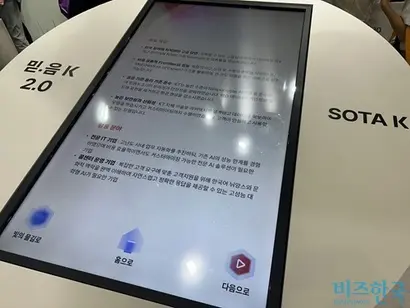
Although it was eliminated from the government's independent AI foundation model project, it is aiming to expand its presence by releasing its AI model lineup sequentially as planned. In the second half of this year, KT successively introduced its self-developed model Mi:dm K 2.0 (early July), SOTA K based on GPT-4o developed in cooperation with MS (late September), and the open-source model Llama K (late September).
Mi:dm K 2.0 is provided in 'Mini', 'Base', and 'Pro' versions to suit user environments. Among these, the Base and Mini models were released as open source; it is the first time among domestic independent models that a model with a scale of 10B or more has been released for commercial use beyond research and experimentation.
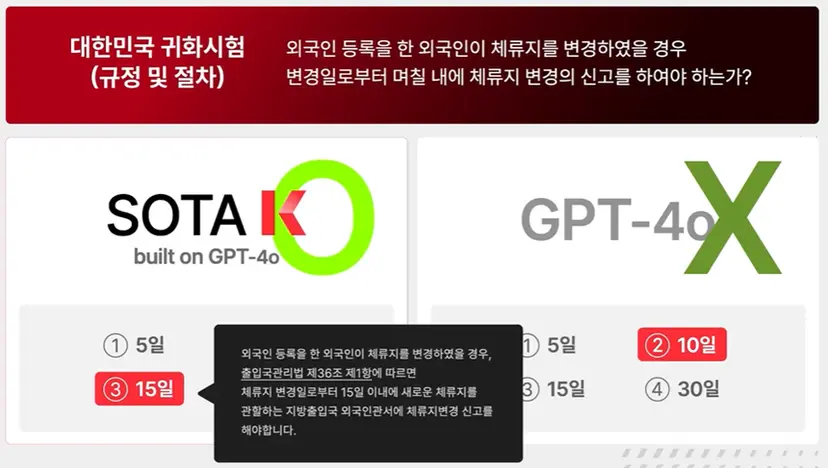
SOTA K attracted attention as a Korean-style AI developed in collaboration with MS. While there is still a debate over whether AI based on overseas models can be considered "Korean-style," KT chose a practical approach. It is a model specialized in the Korean language, history, culture, and sentiments by training KT's proprietary data on GPT-4o, which features world-class performance. KT explains that it can understand and generate Korean honorifics, dialects, and specialized terminology used in specific industries such as law, finance, and history.
For 'Llama K', a Korean-specialized model based on the open-source model 'Llama 3.3', a learning technique based on a Korean reward model was introduced. Complex logical reasoning based on Korean, such as coding and mathematics, has become possible, improving usability in AI agent environments.
KT is expanding its contact points with B2B customers by participating in major events such as the AI Festa, the largest AI event in Korea held recently. It also introduced the 'Intelligence Studio Platform', an AI orchestrator that allows organic integrated use of KT's AI models and related services. A KT field official explained, "If there is a model you are subscribing to, it is a structure where you can call and use it from that platform, or search for it with KT's own models according to your needs," adding, "There aren't many places in Korea where AI orchestration is systematized yet. For companies, it is a strategy to utilize AI with high efficiency and low cost."
In the securities industry, there is also an assessment that KT is performing structural improvements and B2B AI business expansion the best among the three major carriers. The fact that it has a wide pool of corporate clients with existing services such as communication networks, IDC (data centers), security, and cloud is also an advantageous condition. Kim Jung-chan, an analyst at Korea Investment & Securities, analyzed, "The performance of the collaboration with Microsoft will contribute to revenue in earnest from 2026," and added, "Public market expansion is expected, and the fact that it has secured additional financial sector references through the Nonghyup case is positive."