

[비즈한국] The Lee Jae-myung administration has announced a plan to ease regulations on agrivoltaics (agricultural photovoltaics), setting the stage for its full-scale implementation. Agrivoltaics is gaining attention as a renewable energy generation method that allows for simultaneous crop cultivation and electricity production. However, concerns have been raised regarding haphazard development driven by external capital and food security issues stemming from reduced crop yields. Experts and farmers emphasize that the policy must be pursued through the lens of a "just transition," ensuring agricultural sustainability and guaranteeing independent participation by farmers.
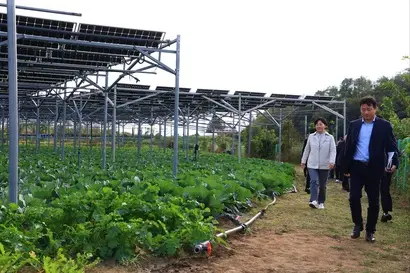
On October 16, the government held the "2nd Strategic Meeting for Rationalizing Core Regulations" at the Presidential Office in Yongsan, presided over by President Lee Jae-myung. During the meeting, a plan to ease regulations on agrivoltaics was announced. Key provisions include extending the farmland usage period for solar power projects from 8 to 23 years, allowing power generation projects in agricultural promotion areas when designated as renewable energy zones, permitting village cooperatives to act as project entities, and enacting legislation on minimum separation distances for solar panels.
Experts positively evaluated that the strategic meeting included core regulatory easing necessary for the commercialization of agrivoltaics. Oh Seon-ah, a researcher at the Institute for Green Transition, commented, "The need to extend the permit period to at least 20 years, considering the investment recovery period and the 20-25 year lifespan of panels, was proposed and has been reflected," adding, "Standardizing the separation distance, which currently varies by region, is also a positive factor."
Previously, on the 13th, the Ministry of Agriculture, Food and Rural Affairs announced that it would promote a pilot project for scaled-up and integrated agrivoltaics. The ministry plans to select target villages in December following an open call. It appears that agrivoltaics, a major project in the Lee Jae-myung administration's renewable energy supply policy, is poised for full-scale implementation.
Agrivoltaics is a system where solar power facilities are installed on farmland, sharing sunlight to allow farming underneath while generating electricity above. It has the advantage of producing both energy and food simultaneously by utilizing limited land. Farmers can earn additional income from power generation on top of their agricultural revenue.
However, there are many challenges to overcome. First, farmers are concerned about haphazard development fueled by the influx of external capital. While the new deregulation plan allows village cooperatives to become project owners, there are warnings that corporations or private developers could dominate the industry due to the high initial investment costs and low public awareness among farmers.
Hwang Soon-jin, secretary-general of the Muan Farmers' Association in South Jeolla Province, pointed out, "Large-scale farmland, where the potential for external capital influx is high, will likely become prime real estate for agrivoltaics," and added, "Clear regulations and structural safeguards are necessary to prevent uncontrolled development."
In fact, in Yangpyeong-gun, which applied for Gyeonggi Province's 'Sunshine Farm' agrivoltaics pilot project in 2024, conflict broke out among villagers over the installation of a solar facility covering approximately 3,800 pyeong. Some residents filed a lawsuit, citing a lack of guaranteed participation and procedural transparency in the decision-making process. The conflict deepened after it was revealed that the solar installation company was covering the legal fees for the residents who supported the project. Ultimately, Gyeonggi Province rejected the application.
In response, an official from the Ministry of Agriculture, Food and Rural Affairs stated, "We are aware of the problems seen in previous cases," adding, "We plan to minimize the involvement of external operators and proceed with projects centered on resident-led initiatives, such as village cooperatives."
Food security issues due to reduced crop yields are also being raised. Due to the nature of agrivoltaics, where panels are installed over farmland, crop yields are inevitably reduced due to lower light exposure. Various studies have shown that yields typically decrease by 10-20%. A 2023 demonstration test by the Gunsan Agricultural Technology Center in North Jeolla Province showed that rice yields decreased by 17.8% compared to regular paddies. Farmers must also endure the inconvenience of areas being inaccessible to agricultural machinery due to the solar equipment.
Farmers point to the loss of agricultural income from reduced yields and anxiety over food security. Kang Soon-jong, policy committee chair of the Korean Peasants League, emphasized, "While there will be income from power generation, the structure inevitably leads to lower agricultural yields," adding, "Food is a vital element for the nation's survival and development, so the equation of trading food for energy cannot hold."
The government plans to collect feedback through forums and discussions. An official from the Ministry of Agriculture, Food and Rural Affairs said, "Technological advances are steadily improving the transmittance of solar panels," and added, "Ensuring farm household income through power generation revenue is also a crucial engine for food security."
Guaranteeing the substantive rights of tenant farmers is another important task. As of 2024, the proportion of tenant farming households in Korea is 45%, with 47% of farmland being leased. If agrivoltaics are installed on leased land, the economic benefits may accrue to the landowner, while the burden of damage could fall entirely on the tenant farmer. This is why legal safety nets are required to protect the rights and interests of tenant farmers and prevent potential harm.
Researcher Oh Seon-ah advised, "Tenant farmers should also be allowed to participate as project entities to ensure the distribution of power generation profits," and "Lease agreements for farmland should take into account the reduction in yields, and tenant farmers must be included as recipients of direct agricultural subsidies."
Farmers are questioning why farmland is the priority target for renewable energy supply projects. They argue that starting solar projects in rural areas rather than in cities with high power demand is not right from the perspective of a "just transition." They particularly pointed out that allowing projects in agricultural promotion areas is a dangerous idea.
Policy Chair Kang Soon-jong criticized, "Farmland should not be a priority target simply because it is flat and convenient for solar panels," adding, "There is a feeling that rural areas are being exploited like a colony to produce the energy needed by cities, the capital region, and industrial complexes."