

[비즈한국] Human tissue skin boosters have emerged as a major topic at the National Assembly’s annual audit. The controversy stems from the recent use of human tissue grafts as skin boosters for cosmetic purposes, raising concerns over the management of human tissues.

On the morning of October 21, during the audit of the Health and Welfare Committee, Rep. Nam In-soon (Democratic Party of Korea) asked Minister Oh Yu-kyung of the Ministry of Food and Drug Safety (MFDS), “Have you heard of human tissue skin boosters?” When Minister Oh replied that she had, Rep. Nam questioned, “Isn’t there a problem? This market is growing rapidly, but we rely on imports for over 90% of our human tissue. Is skin graft material originally intended to be used for cosmetic purposes?”
Minister Oh avoided a direct answer, stating, “The MFDS manages the quality and safety of human tissues when they are imported, while the distribution of such tissues is the responsibility of the Ministry of Health and Welfare.” In response, Rep. Nam requested, “I believe monitoring is necessary. I will send you a formal inquiry, so please review it and provide a response.”
The point being raised is that in a situation where donated human tissue is in short supply, using it for cosmetic purposes is problematic.
A source from Rep. Nam’s office explained to Bizhankook, “Human tissue skin boosters are being used simply for skin aesthetics, yet there is no clear evidence that their collagen (cosmetic) effects are medically proven. This may be because there are no regulations forbidding the use of human tissue for skin aesthetics, and it is difficult to distinguish between cosmetic and medical purposes. We believe it is inappropriate for human skin tissue to be used for cosmetic rather than therapeutic purposes. There is a need to issue recommendations for ethical use.”
The audit continued in the afternoon, with questioning from Rep. Lee Su-jin (Democratic Party of Korea).
Rep. Lee stated, “ECM skin boosters are spreading rapidly in the skin aesthetic market,” and pointed out, “You mentioned that the issue of ECM skin boosters is an issue for the Ministry of Health and Welfare, not the MFDS. However, the Ministry of Health and Welfare’s role in distribution management is to allocate domestically harvested tissues according to medical priority, whereas the skin used in ECM boosters is imported and processed abroad by private tissue banks licensed by the MFDS and supplied to dermatology clinics.”
Rep. Lee further remarked, “The Human Tissue Act stipulates that parts of the body such as bone, ligaments, and skin must be transplanted for the purpose of treating diseases and must be transplanted in an ethically valid and recognized manner. Given these legal provisions, I believe that using ECM boosters—which involve harvesting cadaver skin, processing it into powder, mixing it with saline, and injecting it—for cosmetic purposes is a clear violation of the Human Tissue Act.” She added, “Until now, the MFDS has only handled the quality and safety management of grafts produced by private tissue banks, but since tissues are now being used in entirely new ways, countermeasures are needed.”
In response, MFDS Minister Oh replied, “Since the cosmetic market is growing, I agree that it needs to be managed at this point.”
Rep. Lee called for strengthened monitoring to ensure human tissue is not used for purposes other than treatment. “The MFDS receives reports once a year on the overall transplant results of grafts supplied through private tissue banks. I would like you to shorten the cycle and strengthen monitoring. It seems necessary to supplement the system to verify whether the intended use is for therapeutic purposes,” she noted.
She also demanded a review of human tissue transplantation methods. “There is a need to establish criteria for whether the method of grinding tissue into powder and mixing it with saline qualifies as 'tissue transplantation' as defined by the Human Tissue Safety Act,” Rep. Lee pointed out, adding, “(In the U.S. FDA), products must be minimally manipulated, intended for homologous use, and must not be combined with other products.”
Rep. Lee criticized the situation, saying, “(Human tissue) can be used under the Human Tissue Act without receiving separate approval as a drug or medical device. Otherwise, it should be approved as a drug or medical device, but currently, it is being used openly for cosmetic purposes under the name of 'tissue graft' without any regulation or clinical trials. This is a very serious problem.”
The reason for the lawmakers' questioning is that 'human tissue grafts' are recently being used as skin boosters for cosmetic purposes. Human tissue grafts undergo quality verification under the Human Tissue Act. The management of these grafts focuses on the sterilization of tissue bank facilities and the stability of raw human tissue materials.
However, safety concerns are being raised as human tissue is being used as a skin booster, similar to a medical device. While drugs and medical devices are subject to clinical approval and adverse event monitoring, human tissue falls outside this management system. Nevertheless, companies are promoting the MFDS license for their tissue banks as if it guarantees the functionality of a medical device, advertising that it is effective for pore reduction and other cosmetic benefits without ever having undergone clinical trials.
In principle, the use of products that are not drugs or medical devices as skin boosters is prohibited. In December 2022, the MFDS distributed a press release stating that products not classified as drugs or medical devices should not be injected into the skin.
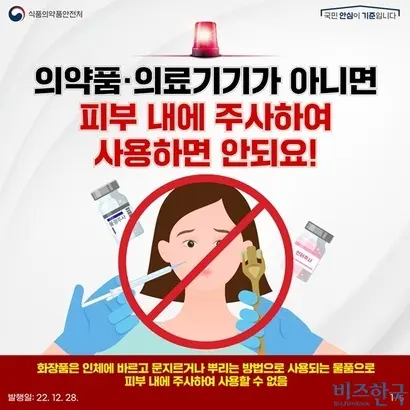
However, the MFDS maintains the position that matters related to human tissue are the responsibility of the Ministry of Health and Welfare. Ultimately, there is a lack of an agency to manage and supervise companies even if they promote and sell products licensed as human tissue grafts as if they were skin boosters (medical devices).
An industry official noted, “Because human tissue is not a product that receives clinical approval, there is insufficient clinical verification. While using it for the purpose of a tissue graft is not a problem, it is necessary to verify whether there are issues when used as a skin booster.”