

[비즈한국] LG Electronics066570 has begun the process of securing trademark rights for its RGB TV, which is scheduled for release in the first half of next year. Emerging as a key battleground in the next-generation TV market, RGB TV is referred to as the "final evolution" of LCD (Liquid Crystal Display) TVs. As Chinese manufacturers recently expanded their reach by unveiling lineups of RGB Mini LEDs, domestic companies, which lead the premium market centered on OLED (Organic Light-Emitting Diode), are also accelerating the commercialization of RGB TVs. Samsung Electronics005930 claimed the "first" title by introducing a 115-inch large-format "Micro RGB TV" this past August. With the competition for next-generation TV dominance intensifying, attention is focused on whether this will shift the landscape of the premium TV market.
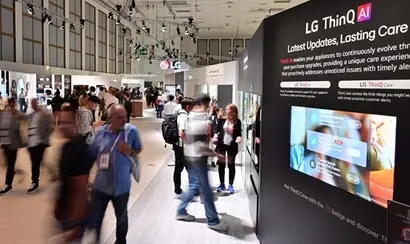
'Hyper Radiant RGB' application filed; are the outlines of next-gen TVs emerging?
On the 15th, LG Electronics filed a trademark application with the Korean Intellectual Property Office for "Hyper Radiant RGB." According to the patent office, LG Electronics stated that the trademark will be used on 14 product types, including LCDs, LED displays, TV monitors, digital signage, and electronic display panels.
Since the beginning of the year, LG Electronics has been conducting preparatory work for the launch of its RGB TV. Previously, in March, the company moved to acquire three RGB-related trademarks: "RGB evo," "Micro RGB," and "Micro RGB Matrix." Given that LCD TV was specified as a designated product this time and considering the planned public release in the first half of next year, analysts suggest the company has entered the final stages before launch. Samsung Electronics, for its part, filed for its Micro RGB TV trademark last January, about seven months before its release.
The name of the newly filed trademark translates roughly to "ultra-high brightness" RGB. It highlights the characteristics of RGB TVs, which excel in precise color expression. RGB TV is a next-generation TV based on red (R), green (G), and blue (B) backlight units, representing an evolution of the LCD TV. Instead of the traditional LCD method where light from a white LED passes through a color filter to create color, it uses red, green, and blue LEDs as the backlight source. Although based on an LCD panel, it is characterized by enhanced color reproduction by applying the three primary colors of light instead of white LEDs.
The industry expects LG Electronics to launch its RGB TV in the first half of next year. This is because LG Electronics CEO Cho Joo-wan mentioned a launch early next year to reporters while attending "IFA 2025" in Berlin, Germany, last September. CEO Cho explained, "RGB TV is a new technology with both pros and cons," but added, "We are preparing it with the goal of broadening the choices available to our customers."
In the home appliance industry, it is standard practice to preemptively file for trademarks to legally protect brand identity, proprietary technology, and product characteristics, and to distinguish them from competitors. Sometimes, multiple trademarks are registered at the planning stage for the purpose of securing market position.
Currently, all four trademarks are in the application state, pending review to determine registration. An LG Electronics official stated, "We are examining various future display technologies, and the filing was made to preemptively secure the relevant trademark rights."
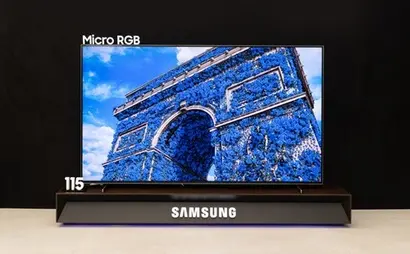
China eyeing 'premium' status; companies draw a line with high-end RGB
RGB TV is considered the "pinnacle" of LCD-based TVs. Among them, Samsung Electronics has formed a top-tier product category by launching "Micro RGB TVs," which have higher specifications than RGB TVs using Mini LEDs. As the name suggests, it boasts the ability to achieve more precise color and brightness control by reducing the size of the LED elements (chips) to a level of 90μm (micrometers, one-millionth of a meter).
As China builds a "middle ground" with RGB TVs, domestic companies appear to be choosing a strategy of drawing a line by relegating these to "entry-level" or lower-tier technology. Chinese manufacturers like Hisense and TCL are expanding their reach beyond the low-to-mid-range LCD TV market into large, high-end product lines based on Mini LEDs. Their strategy is to penetrate the middle of the premium market, led by RGB Mini LED TVs that are cheaper than OLED but offer improved picture quality, leveraging price competitiveness and sheer volume.
LG is also expected to unveil an RGB TV differentiated by its technical prowess. Although RGB TV is a non-self-emissive structure, it is evaluated as having caught up to OLED's strengths in color expression to a significant degree. Even relatively low-cost Chinese products are receiving ratings better than expected. Since OLED TVs, which have a structure where individual pixels emit their own light, do not require backlights, the displays are thinner and offer superior light control. As the technological gap remains significant, LG and Samsung continue to lead the premium market.
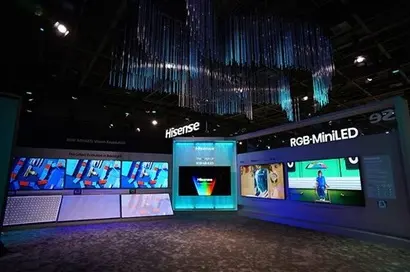
The retail price of Samsung's 115-inch RGB model is a high 44.9 million won, due to the high difficulty of the manufacturing process for ultra-small LED terminals. However, compared to the retail price of Samsung Electronics' ultra-high-end 114-inch Micro LED TV released last year (180 million won), it is about one-quarter the cost. Cheaper new products, such as 75-inch and 65-inch models, are also set to be released early next year. The retail prices for Hisense's 116-inch and 100-inch TVs are $29,999 (approximately 42 million won) and $19,999 (approximately 28 million won), respectively.
The outlook is that price competitiveness will improve as the lineup expands to include smaller sizes and the technology stabilizes. Lee Choong-hoon, CEO of UBI Research, noted at a display strategy seminar last month, "RGB Micro LED technology is advancing, and yields are improving. This will be a factor in narrowing the price gap with existing TVs," adding, "It will see its influence expand rapidly, especially in the over-100-inch super-large premium TV market."
Whether the strategies of domestic companies will prove effective in the market remains to be seen. Hwang Yong-sik, a professor of business administration at Sejong University, stated, "From a corporate perspective, companies can handle various segments and technology standards to keep competitors in check," adding, "The most important thing is technological leadership. It is crucial to maintain an edge in the premium lineup while balancing the market between product groups with a clear strategy."