

[비즈한국] Our galaxy is wrapped in a massive dark matter halo. When we imagine this halo, we often picture a single, giant, spherical cloud that simply becomes less dense from the center of the galaxy toward the edges, much like the Oort cloud surrounding our solar system. We also tend to think that this giant halo was formed all at once. But that is not the case.
Simulations reconstructing the evolution of the universe show the process of how dark matter halos are formed in detail. A large halo is not created all at once. Originally, there were much smaller "baby" halos. These gathered and merged during the process of forming the universe’s large-scale structures, eventually forming the massive halo we see today. These small baby halos are called sub-halos. They have much smaller mass compared to a single giant halo.
Naturally, it was expected that traces of these dark matter sub-halos, both large and small, would remain within the galactic space around our solar system, and recently, circumstances suggesting their existence have been detected. The signs of a dark matter clump, a sub-halo, have been detected 2,300 light-years away—not very far from our solar system.
A dark matter halo is not just one flat lump of dough. Dark matter sub-halos can be thought of as small chocolate chips scattered throughout it. This observation was an attempt to confirm the existence of these "chocolate chips." Though it sounds obvious now, dark matter cannot be seen with light. It reveals its presence only through gravity. If a sub-halo causes gravitational changes in the surrounding cosmic spacetime, we must detect them to infer its trace. Therefore, a detection device sensitive even to minute changes in spacetime is required.
Pulsars serve as a prime example of this role. Pulsars are neutron stars that have finished their evolution and collapsed; specifically, they are stars that rotate at high speeds while enveloped in extremely strong magnetic fields. Because the star’s own rotation axis is slightly tilted relative to its magnetic axis, the neutron star's energy beam, extending along the magnetic axis, is observed as blinking at regular intervals. It is a cosmic lighthouse blinking in a steady rhythm. Thus, pulsars act as accurate cosmic clocks and buoys that detect changes in cosmic spacetime down to a minute level.
In this analysis, researchers used not just a single pulsar, but a pair of pulsars—a pulsar binary. If a solitary pulsar shows a change in period, it is difficult to distinguish whether it is due to the star itself or external factors in the surrounding spacetime. However, if both pulsars in a binary system show the same periodic change, one can be certain it is due to an external factor outside the binary system. The probability that internal changes in two separate stars would cause the exact same level of periodic change is extremely low. This analysis utilized 27 pulsar binaries.
However, because a pulsar is such a sensitive and precise cosmic clock, meticulous preliminary work is needed to purely filter out effects caused by surrounding dark matter sub-halos. Effects from external factors other than dark matter sub-halos must be filtered out as much as possible. First, one must consider the effect of gravitational waves spread into the surrounding space as the two massive pulsars rotate closely around each other. Just as a pair of fish swimming in circles in the water creates ripples, a pulsar binary can lose energy and experience period changes while emitting gravitational waves.
There is also the effect of the pulsar binary cluster moving as a whole through space. Like any other ordinary star, binary pulsars drift through cosmic space, exhibiting what is called "proper motion." However, because they move while sending signals at a steady rhythm, subtle changes in the pulsar period we observe can occur, similar to the Doppler effect. This is called the Shklovskii effect. If, after excluding all these effects, another unexplained change in the pulsar period is still detected, it means that something else invisible is also influencing the surrounding spacetime.
Surprisingly, a clear change was detected in one specific pulsar binary pair. The changes in the pulsar periods of J1640+2224 and J1713+0747, which form a pair, are very similar. Both show deviations in almost identical patterns. This means that the same external factor is acting on the surrounding spacetime encompassing both pulsars. Based on the deviations shared by the two pulsars, calculations estimate that there is a massive dark matter sub-halo with a mass of approximately 24 million solar masses located about 2,300 light-years away from the Sun. A mass of this magnitude is at least six times heavier than Sagittarius A*, the black hole at the center of our galaxy!
Of course, the presence of a massive clump does not necessarily confirm it is dark matter. It could simply be that brightly shining stars are gathered there in unusually high density. However, even when scouring the sky where this dark matter sub-halo is estimated to be, no particularly bright light is visible.
Looking at the observations from the Gaia space telescope, which mapped the 3D positions of stars inside and outside our galaxy, the stars gathered in this region alone cannot account for the total estimated mass of this dark matter sub-halo. Nothing is visible there. Yet, a very heavy mass must be present. Even considering gas clouds instead of stars, it is still insufficient. The average density of visible, bright normal matter (baryons) observed in this region is only 0.084 solar masses per pc^2. On the other hand, the density of dark matter is 10 solar masses per pc^2. This means there exists a heavy clump filled almost entirely with dark matter, with a much higher density than that of baryons.
One might wonder if a giant black hole is hiding there, but that is highly unlikely. It is difficult to imagine a black hole six times heavier than the supermassive black hole at the center of our galaxy wandering in such an arbitrary location, far from the galactic center. Furthermore, if such a heavy black hole existed, it should have been consuming many stars and gas as it navigated through the galaxy, leaving clear traces of black hole jets, yet no such signs are observed. Given that no significant strong gravitational lensing is observed, it is more plausible that this is a sub-halo with dark matter spread out at high density over a wide area, rather than a black hole with 24 million solar masses concentrated at a single point.
If this discovery is correct, it marks the first direct confirmation of the existence of a dark matter sub-halo within our galaxy, and at a relatively close distance of only 2,300 light-years from the Sun. We have truly discovered a small clump of dark matter—one of the "chocolate chips" drifting through the galactic halo—that could previously only be seen in high-resolution supercomputer simulations.
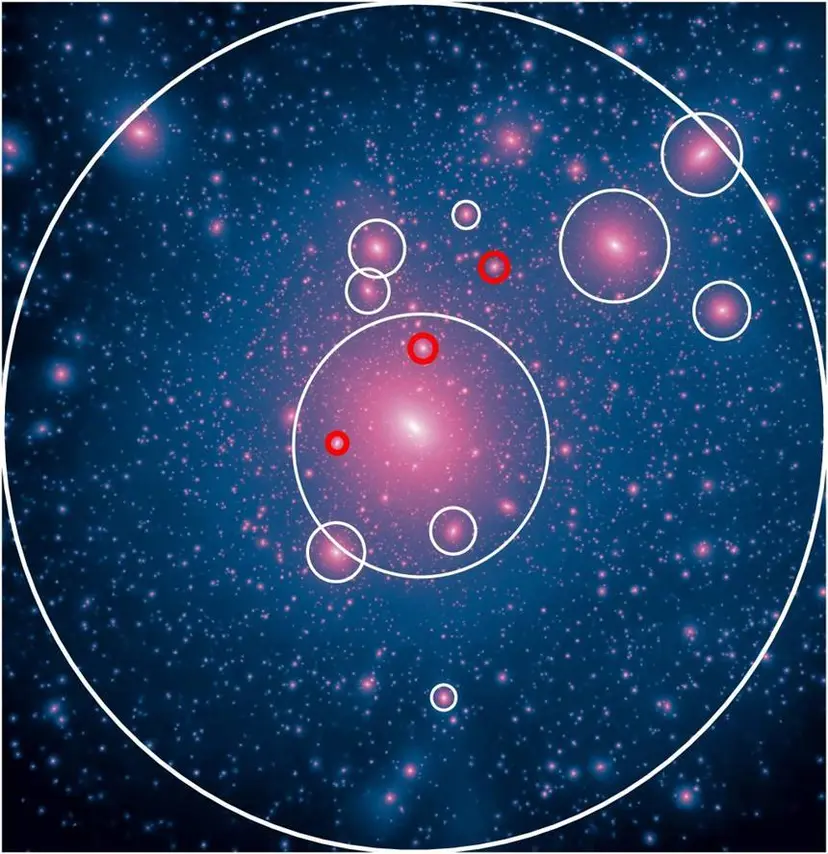
This discovery serves as further evidence for the existence of dark matter, which, although invisible and emitting no light, definitely exists and exerts gravity. Furthermore, we have identified not just the giant halo wrapping around our galaxy, but smaller, scattered clouds of dark matter drifting through our galactic space in detail.
While significant deviations were observed in only one pair of pulsars this time, further exploration will allow us to map out how many dark matter clouds of various sizes are floating around us, and we will be able to draw a much more detailed map of the dark matter halo surrounding our galaxy. We will be redrawing our map of the halo, not as a blurry, spread-out cloud, but as a structure "seeded" with dark matter sub-halos of all sizes, much like a cluster of grapes.
Reference
https://ui.adsabs.harvard.edu/abs/2025arXiv250716932C/abstract
About the author Ji Woong-bae: Loves cats and the universe. After watching 'Galaxy Express 999' as a child, he dreamed of sharing the beauty of the universe. He is currently an assistant professor in the Faculty of Liberal Arts at Sejong University, participating in various science communication activities such as lectures and writing. He has authored books such as 'A Piece of the Universe Every Day', 'Scientists of the Starry Universe', 'Things I Can Know Even If I Can't Go', and 'Strange Questions That Come to Mind When Looking at the Universe', and translated books including 'The Hitchhiker's Guide to the Real Universe', 'How I Killed Pluto', 'Quantum Life', and 'Cosmigraphics'.