

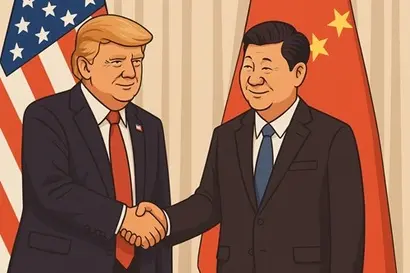
[비즈한국] The Asia-Pacific Economic Cooperation (APEC) Summit will be held in Gyeongju at the end of this month. Global attention is already focused on the Korean Peninsula. While leaders from 21 member nations will gather, the centerpiece of this summit is undeniably the meeting between U.S. President Donald Trump and Chinese President Xi Jinping. Their handshake is not merely a diplomatic event; it is highly likely to become a turning point that shapes the future of global trade order and capital flows. This political moment will likely shift global capital and impact the domestic stock market as well. After APEC, can the KOSPI cross the 4,000-point mark?
The impact of APEC on the market carries significance beyond a short-term event. During the 2005 Busan APEC, themes like terrorism-related stocks, WiBro, terrestrial DMB, and intelligent robots emerged, raising expectations for industrial and sector growth. As such, international conferences serve as catalysts that instill market sentiment with expectations, even without confirming concrete policies.
The biggest variable at this APEC is the meeting between Trump and Xi. The Trump administration has publicly declared a "tariff recalibration" since returning to power, considering industry-specific customized tariffs not only on China but also on allies. For South Korea, our flagship industries—semiconductors, automobiles, and batteries—are all on the negotiating table. If "tariff easing" or "strategic exceptions" are discussed leading up to or during the summit, an immediate momentum could form in the domestic market. Conversely, if the two leaders display conflict or deliver messages reinforcing "national priority" during the APEC, it could have a negative impact on the local stock market.
This year's APEC agenda is condensed into three key areas: supply chain stabilization, clean energy transition, and digital economic cooperation. These three areas are directly linked to the competitiveness of South Korean companies.
First is the semiconductor and AI supply chain. Boosted by the rebound in memory semiconductor prices and the surge in AI server demand, SK Hynix000660 is expected to join Samsung Electronics005930 in the "10 trillion won club" for third-quarter operating profit. Recently, South Korea's semiconductor exports hit all-time highs for two consecutive months. If discussions on easing trade regulations or expanding investment in semiconductor equipment and materials materialize through the APEC, the global standing of the Korean semiconductor industry will be further strengthened.
Second is the automotive and battery industry. While Trump's tariff adjustment proposal is an uncertainty, it could become a mid-to-long-term boon for domestic firms if it leads to discussions on expanding production within North America or local investment incentives.
Third is the energy and infrastructure industry. "Clean energy transition," one of the key APEC agendas, could open new opportunities across emerging industries such as hydrogen, nuclear power, offshore wind, and carbon capture.
Regarding this APEC, the market is focusing on "what kind of industrial structure will be strengthened" rather than "who will rise." After APEC concludes, one must look at policy roadmaps and industry-specific investment plans rather than short-term themes. Along with this, one must judge whether the handshake between Trump and Xi will actually lead to economic cooperation or become the prelude to further trade conflicts.
This summit is closer to a turning point for mid-to-long-term structural changes than a short-term theme-driven market. Global capital is already flowing into industries like AI, semiconductors, and clean energy on a large scale, and APEC will likely serve as an occasion for policy to provide momentum to these trends.
Foreign investors have net-purchased over 6 trillion won in Korean stocks this month. This is analyzed as a result of the convergence of expectations for Korea-U.S. negotiations and strong semiconductor exports. In short, it is not the actual outcome of the meeting that moves the market, but the anticipation surrounding it. Piercing through the capital movements hidden between the lines of politics and diplomacy is the most realistic way to win in an era of uncertainty.