

[비즈한국] Hanwha Aerospace's012450 'K-NIFV' will be unveiled for the first time at the 'Seoul International Aerospace & Defense Exhibition (ADEX 2025)' held at KINTEX, Ilsan, starting October 20. The K-NIFV is Hanwha Aerospace's next-generation armored vehicle targeting both export and domestic markets. With characteristics that differentiate it from existing armored vehicles in terms of performance, cost-efficiency, and combat capability, it is expected to become Hanwha Aerospace's next core export product.
The K-NIFV is an upgraded performance version of the AS21 Redback armored vehicle used by the Australian Army, and its initial designation was 'Redback-eX'. The AS21 Redback was recognized for having world-class defense capabilities, equipped with an active protection system and anti-tank missiles, which led to its victory in competition against the 'KF41 Lynx' from Germany, a traditional powerhouse in armored vehicles.
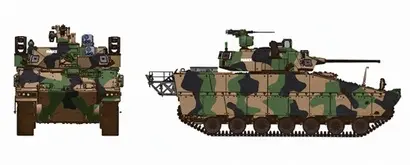
However, for Hanwha Aerospace, the Redback had several limitations that necessitated new improvements and changes. It had clear limitations in performance and price, and it could not meet the specific requirements of the South Korean military.
The first reason for the development of the K-NIFV is to resolve issues regarding price and operation/maintenance. While the Redback armored vehicle was completed through Hanwha Aerospace's own research and development for export purposes, it incorporated a massive amount of foreign components for rapid fielding. It is no exaggeration to say that almost everything except the chassis was imported, including the turret and sighting systems from Australia and Israel, remote weapon stations (RWS), Israeli anti-tank missiles and active protection systems (APS), and American autocannons, mine-protection armor, and comprehensive protective equipment.
Because most of the core components of the Redback were foreign-made, it suffered from a very low localization rate and was criticized as being "Korean in name only." Furthermore, securing price competitiveness was difficult, and the delivery schedules of imported equipment became problematic as partners in Israel and the U.S. struggled to keep up with the surge in orders following the war in Ukraine.
The second reason for the K-NIFV's development was to incorporate lessons learned from the war in Ukraine. While the Redback remains a world-class armored vehicle, it was a model that reflected lessons from the wars in Afghanistan and Iraq prior to the Ukraine conflict. Consequently, it lacked the ability to counter drone threats—which is now central to improving armored vehicle survivability—and required new features to address this.
The K-NIFV addresses these two issues. First, to increase the low localization rate, all core components were localized. Hanwha Systems272210 is localizing the turret sighting system and APS, while Hanwha Aerospace's LS division is handling the Remote Controlled Weapon System (RCWS), the Hanwha Aerospace PGM division is developing a new anti-tank missile based on the 'Cheongeom' (Sky Sword), and SNT Dynamics is localizing the autocannon and transmission. This not only reduces capital outflow due to foreign purchases but also eliminates export-controlled items, thereby reducing acquisition and operation/maintenance costs.
The K-NIFV does not just have a higher localization ratio. By adopting an unmanned turret, the internal space has been increased while maintaining the same chassis, allowing for 8 crew members and adding additional cargo space.
The most significant improvement of the K-NIFV is that it possesses "world-class drone defense capabilities." To achieve this, the K-NIFV can use a 30mm autocannon or a 40mm Cased Telescoped Armament (CTA) cannon to attack suicide drones or loitering munitions at a range of 3-4km. It is also equipped with a C-UAS drone detection radar for fire control. AI is applied to the gunner and commander's sighting systems to automatically track enemy drones.
When a drone approaches within 1km, a newly developed 'intelligent RCWS' engages it. This RCWS also utilizes AI and drone detection radar, enabling automatic tracking and engagement of even micro-drones equivalent to DJI-class drones. Finally, if an enemy drone approaches within 300m, the last line of defense—the APS—launches interception rounds to neutralize the threat. In short, the K-NIFV is the only armored vehicle in the world equipped with a 'multi-layered drone defense system.'
The K-NIFV started development in October 2024 with a budget of 34.5 billion won as part of a weapon system modification and development project. It is reported that it has currently passed the Critical Design Review. All development will conclude in March 2028, and the manufacturer, Hanwha Aerospace, is proposing it for the project to replace the K200A1 armored vehicles currently operated by the South Korean Army's armored reconnaissance units. It also plans to proceed with consultations and local performance demonstrations for potential exports to countries including Romania, Italy, Norway, the UAE, and Saudi Arabia.
Following the successful completion of the K-NIFV, a successor vehicle, 'K-NIFV Block-2,' will be developed to replace the South Korean Army's K21 armored vehicle. In addition to the K-NIFV Block-1 features, the next-generation armored vehicle Block-2 is expected to introduce a series hybrid propulsion system, active suspension, composite active protection equipment, and a full-range situational awareness system.