

[비즈한국] The government has transferred the lead authority for the "Special Act on Offshore Wind Power," the key legislation for the deployment of offshore wind, from the Ministry of Trade, Industry and Energy to the newly established Ministry of Climate, Energy and Environment. While some express hope for synergy between environmental and energy policies, there are concurrent concerns that environmental impact assessments could become a mere formality in the name of simplifying the licensing process.
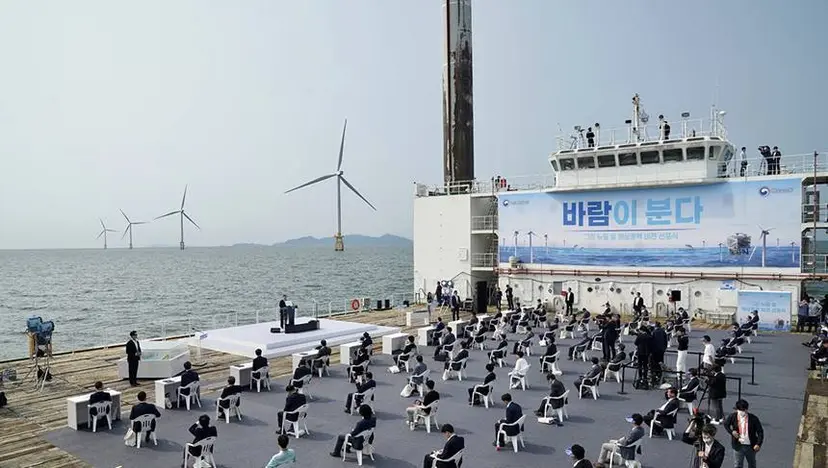
The Special Act on the Promotion of Offshore Wind Power Deployment and Industry Development (Special Act on Offshore Wind Power) was enacted to shorten the complex and time-consuming licensing process for offshore wind projects under government leadership and to foster related industries. It is scheduled to take effect on March 26 next year.
Following the launch of the Ministry of Climate on October 1, the lead authority for the Special Act on Offshore Wind Power shifted from the Ministry of Industry to the Ministry of Climate. The Ministry of Climate stated that it is currently preparing a draft of the enforcement decree ahead of next year's implementation.
The core of the act is for the government to intervene in site selection—previously driven by the private sector—to lead the processes of site discovery, designation of power generation districts, and operator selection, thereby preventing haphazard development.
Licensing procedures will also be simplified. Mandatory environmental impact assessments and marine use assessments will be replaced by a single "environmental suitability assessment" through special provisions. The act also includes a "deemed approval" clause, whereby once a developer receives approval for a development implementation plan from the Offshore Wind Power Committee, they are considered to have obtained approximately 30 legal permits simultaneously. This aims to shorten the licensing process required to carry out offshore wind power projects.
Environmental groups worry that the simplification of licensing procedures will ironically lead to haphazard development. They argue that the environmental suitability assessment could be operated poorly, effectively neutralizing the original environmental impact and marine use assessments. Critics point out that the upcoming enforcement decree must be structured to ensure that evaluation standards are not relaxed.
Environmental groups also raised their voices against the act, noting that while the licensing period is reduced from 71 months to 63 months, this mere 8-month reduction comes at the cost of nullifying about 30 different legal procedures. They argue that applying deemed approval to processes involving safety, environmental protection, and cultural heritage preservation constitutes excessive favoritism and demand the removal of the deemed approval clause. In Denmark, a country benchmarked during the law's creation, there is no deemed approval; instead, the Energy Agency coordinates permits with each relevant ministry.
Park Hang-ju, an expert commissioner at Green Korea United, emphasized, "The Offshore Wind Power Committee is bound to lack the expertise and manpower compared to the existing licensing system, which involves experts from various fields," adding, "Deemed approval through the Offshore Wind Power Committee is a serious issue."
In response, an official from the Ministry of Climate stated, "Deemed approval actually reduces the risk of developers missing requirements by having the government integrate the permits that were previously handled individually," adding, "The Ministry of Climate and relevant ministries will review the permits using the same documentation as before." Regarding concerns over the environmental suitability assessment, the official countered, "The government conducts a marine environment impact survey at the stage of site development, and since the environmental suitability assessment is performed for changes made after an operator is selected, the standards will not be relaxed."
Environmental experts assert that the energy industry must be developed in the public interest to secure energy security and price stability, and that the Special Act on Offshore Wind Power should be viewed through the lens of ensuring public interest. Han Jae-gak, an executive committee member of the Climate Justice Alliance, urged, "The Special Act on Offshore Wind Power appears to be a law supporting private developers," adding, "Since offshore wind should be developed as a public good, I hope that provisions such as deemed approval will be corrected."