

[비즈한국] As the U.S.-China trade conflict reignites, China has tightened its control over rare earth exports. This has triggered warning lights for South Korea's high-tech industries, including semiconductors and secondary batteries. While the government and industry are working to secure stockpiles and diversify supply chains, finding fundamental solutions remains difficult given China's overwhelming market dominance.
China Specifies 'Extraterritorial Control,' Targeting Global Supply Chains
On October 9, China's Ministry of Commerce announced a "Decision on the Export Control of Rare Earth Materials Outside (Overseas) Jurisdictions." A total of 12 types of rare earth metals, alloys, and oxides were designated as dual-use goods for both civilian and military purposes, making export permits mandatory. Notably, exports to overseas military contractors were banned in principle. This measure will be implemented sequentially starting November 8.
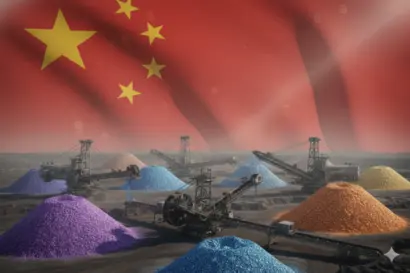
Rare earths are essential materials used in almost all high-tech industries, including semiconductors, secondary batteries, permanent magnets, electric motors, displays, and optical equipment. They are such critical resources that they are often called the "rice of high-tech industry."
An official from the Ministry of Trade, Industry and Energy stated, "The scope of China's control is very broad, so several departments are currently analyzing it. We will prepare a response strategy after evaluating the impact on domestic industries and companies, and then engage in consultations with China."
The impact is significant because this measure specifies "extraterritorial control," which applies to products manufactured overseas. Overseas manufactured goods containing more than 0.1% Chinese rare earths must now receive export permits from the Chinese Ministry of Commerce. Furthermore, products utilizing Chinese extraction, refining, or magnetic material technologies are also subject to control. It is interpreted as an intention to essentially block even indirect exports through third countries.
Park So-young, a senior researcher at the Korea International Trade Association (KITA) Institute for International Trade, analyzed, "Specifying extraterritorial control is a strategy to further strengthen China's absolute position in the rare earth supply chain, which will have a substantial ripple effect on the global industrial ecosystem."
"No Major Problem in the Short Term," But... Attention Shifts to Alternative Materials
China effectively dominates the global rare earth supply chain. As of 2024, it accounts for 48.9% of global rare earth reserves and 69.2% of production. South Korea is also highly dependent on China, importing approximately 80% of its rare earth metals and about 60% of its rare earth compounds from the country.
The rare earth permanent magnet sector, in particular, exhibits a clear Chinese monopoly. According to the International Energy Agency (IEA), over 90% of neodymium permanent magnets are produced in China, and 92.1% of rare earths for permanent magnets are refined there.
An official from a domestic permanent magnet company lamented, "Since most of the technology and production base is in China, it is difficult to diversify the supply chain in the short term."
In this measure, China also tightened controls on semiconductor items. System semiconductors (logic chips) below 14 nanometers (nm) and memory semiconductors with 256 layers or more have been designated for individual review. However, the semiconductor industry expects that the short-term impact will not be significant, as companies have been aware of rare earth risks for several years and have already begun stockpiling and securing alternative supply chains.
An industry official stated, "If this control is prolonged, there could be setbacks in some processes, but there will be no major problems in the short term."
Experts point out that this situation should serve as an opportunity to reorganize supply chains from a mid-to-long-term perspective. Researcher Park advised, "It is realistically difficult to reduce dependency on China in the short term. We must diversify supply chains by cooperating with resource-rich countries like the U.S. and Australia, while also exploring room for cooperation with China."
Meanwhile, alternative materials and the recycling industry are emerging as alternatives. Ferrite permanent magnets are being considered as a substitute for the neodymium permanent magnets monopolized by China. In fact, Union Materials, which produces ferrite magnets, hit the daily price limit immediately after China's announcement.047400
The rare earth recycling industry, known as "urban mining," is also receiving attention. This involves extracting rare earths from waste motors, turbines, and electronic products; while there are still challenges regarding economic feasibility and production efficiency, it is considered to have high strategic value in terms of supply chain security.