

[비즈한국] It has been confirmed that tissue banks that import human tissues have received a total of 17 administrative penalties for violating the Human Tissue Safety and Management Act over the past five years. Some tissue banks were repeatedly caught for the same offenses or reported to authorities for conducting operations without obtaining renewal permits. With the number of human tissue imports from overseas on the rise, critics are calling for strengthened management of imported human tissues.
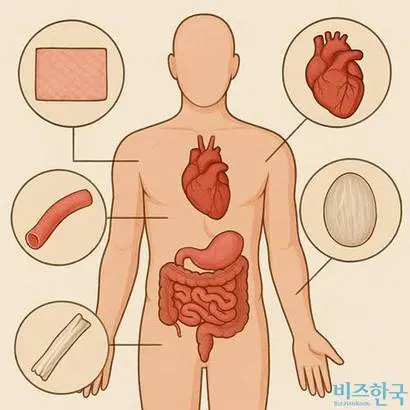
Some Facilities Penalized Multiple Times
According to data submitted by the Ministry of Food and Drug Safety (MFDS) to the office of Rep. Nam In-soon of the Democratic Party of Korea, a member of the National Assembly's Health and Welfare Committee, the MFDS issued a total of 17 administrative penalties to importing tissue banks that violated the Human Tissue Act between 2020 and 2024. A total of 12 importing tissue banks were penalized by the MFDS over the five-year period. By year, there was 1 case in 2020, 6 in 2021, 7 in 2022, 2 in 2023, and 1 in 2024. The types of violations included failure to comply with standard operating procedures, unauthorized operations, failure to register manufacturing sources in exporting countries, failure to complete mandatory training, missing attached documents, and distribution to non-medical institutions. The most frequent violation was the failure to comply with standard operating procedures, accounting for 6 cases.
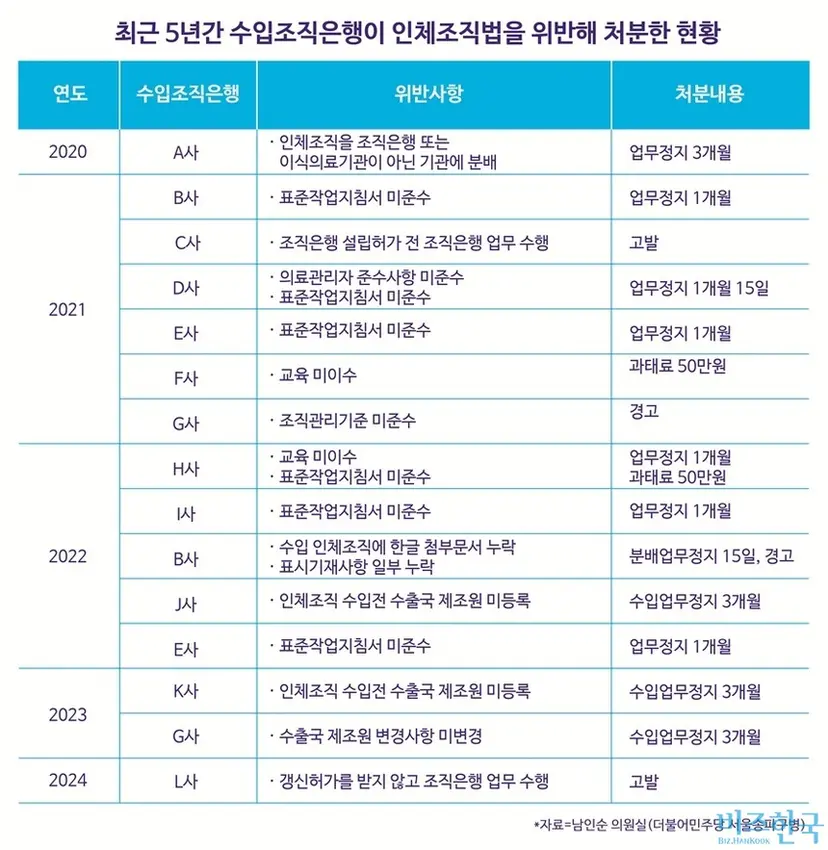
There were also instances where tissue banks operated before receiving official authorization or continued operations without securing renewal permits. The MFDS filed criminal complaints against these tissue banks.
Some tissue banks received multiple administrative penalties. Company B received a one-month business suspension in 2021 for failure to comply with standard operating procedures, and a 15-day distribution suspension along with a warning in 2022 for missing Korean-language attached documents and incomplete labeling on imported tissues. Company E received a one-month business suspension in both 2021 and 2022 for failure to comply with standard operating procedures. Company G was issued a warning in 2021 for failing to comply with tissue management standards and received a three-month import business suspension in 2023 for failing to report changes in the manufacturing source in the exporting country.
Increasing Trend in Human Tissue Imports
While violations of the Human Tissue Act by importing tissue banks continue, the scale of human tissue imports is on the rise. According to the MFDS, imports of human tissues, including raw materials and finished products, have increased over the last three years from 759,374 units in 2021 to 799,352 in 2022, and 942,908 in 2023.
Although the MFDS is responsible for conducting inspections of institutions that process imported human tissues and approving those imports, it was found that the agency does not maintain data on these activities itself. The explanation provided is that, under relevant laws, the tissue banks that import the tissues are responsible for managing the data, and the MFDS does not store it independently.
An official from Rep. Nam In-soon’s office emphasized, “The safety management of human tissues is a critical issue. As the import of human tissues is increasing, there appears to be a need for thorough management and supervision regarding safety and quality.”