

[비즈한국] The number of people visiting Korea due to K-content is increasing rapidly. According to a survey by the Corea Image Communication Institute (CICI), the thing that foreigners most readily associated with "Korean-ness" was the "Hallyu (Korean Wave) Style" (93.10%, multiple responses allowed). Hallyu style refers to K-Pop, dramas, movies, fashion, beauty, and more. Additionally, 95.07% of foreign respondents said that the global success of Korean dramas and movies contributed to an improvement in Korea's image. In a Netflix survey, the intention to visit Korea among K-content viewers reached 72%, nearly double that of non-viewers.
In fact, according to the Korea Tourism Organization, 1,820,199 foreigners visited Korea this past August, a 16.4% increase from 1,563,221 in August of last year. The cumulative number of foreign visitors for this year is expected to exceed 20 million. The positive image of Korean content lies at the heart of this surge in visitors. However, there is still a high possibility that they will return home feeling disappointed after actually visiting Korea. This is due to the disconnect between the image and reality, with price gouging being a prime example.
For BTS member Jin's encore fan concert held on October 31 and November 1, instances were discovered where accommodation prices, normally around 50,000 won, soared up to 2 million won. The cost for two nights reached 4 million won. It is suspected that some operators unilaterally canceled existing reservations to re-book at higher rates, as they could earn much more even after paying a penalty fee. When the BTS concert was held to support the bid for the 2030 Busan World Expo in 2022, hotel rates near Busan also reached 500,000 to 600,000 won per night, with some as high as 1.5 million won.
It is not just hotel rates. Taxi price gouging is also known to persist. Some drivers demand several times the fare, while others take circuitous routes on purpose to inflate the price. They intentionally target foreigners for overcharging. Refusing to use the meter or provide receipts remains common. If visitors are hit with price gouging as soon as they enter Korea, they are unlikely to have a favorable impression.
Of course, this is not just our problem. As overtourism has become a global issue since the end of the COVID-19 pandemic, price gouging has also become a dark trend. In response, various countries are coming up with countermeasures. In Istanbul, Turkey, taxi drivers can have their licenses revoked if they overcharge customers. In Taiwan, lodging businesses like hotels face fines of up to 50,000 New Taiwan dollars (2.3 million won) for price gouging. The U.S. and Singapore impose strict fines or license revocations. In May, Taiwan's Legislative Yuan also passed an amendment to the "Cultural Ticket Management Act," which imposes fines of up to 50 times the original ticket price. Korea also needs to consider not just simple fines, but the revocation of licenses or permits.
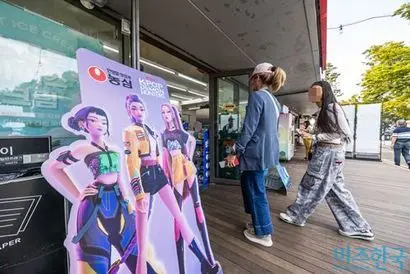
The "KDH Snack Set" at the Everland "K-Pop Demon Hunters (KDH) Theme Zone" presented a new challenge. With K-food gaining attention, the set was composed of menu items eaten by the KDH protagonists, but it faced criticism for low value for money. The "Huntrix Set," consisting of tteokbokki, gimbap, sundae, dakgangjeong (sweet and sour chicken), and a Nongshim 004370 mini cup ramen, is 38,000 won, while the "Saja Boys Set," consisting of sriracha mayo tteokbokki, fish cakes, dakgangjeong, and rice balls, is 36,000 won. While the menu appeared diverse and substantial, reviews indicated that the quality was poor as the food was mostly reheated frozen products.
These incidents can do more than damage the image and brand value of individual companies; they can deal a greater blow to the image of Korea itself. This is because these products and services are not consumed as individual items, but as K-content and K-brands. As the number of side events, derivative content, collaborations, and secondary products or services related to K-content like KDH increases, so does the need for quality control and value management. What is important is not to hurt the hearts of fans. In 2022, there was a controversy regarding the price of pajamas designed by a BTS member. They were priced at 119,000 won per set—about 120,000 won—which left not only fans but the member himself taken aback. Being sincere in activities for fans is more important than anything else. Measures for fans need to be expanded further.
In this context, the recent rise in "Huangniu" (professional ticket scalpers) activity must also be met with vigilance. The case of NCT WISH merchandise is a prime example. These scalpers buy thousands or tens of thousands of albums to enter fan signing events, only to resell them. As visa-free entry for Chinese citizens to Korea becomes available, this is expected to become even more controversial. Such behavior deprives fans of the opportunity to purchase and creates unnecessary costs. As the number of K-content fans grows, there is an even greater need to ensure meticulous management of K-brand value. I hope that political circles will demonstrate leadership so that content companies and those involved in related industrial sectors can respond comprehensively.
The author, Kim Heon-sik, has walked through the forest of pop culture phenomena since his 20s, driven by the hope that there is a way to make the world a better place through culture. He continues on the same path in the 21st century, where AI and quantum computers are active, with the same belief.