

[비즈한국] Kim Sung-hwan, CEO of Korea Investment & Securities, is approaching the end of his term. While the company has seen a dramatic improvement in performance since he took office, it has also been embroiled in controversies this year regarding accounting errors and misselling. As most of these unfortunate incidents occurred before CEO Kim took office, it is difficult to hold him fully accountable. Nevertheless, analysts suggest that for CEO Kim to become a long-serving leader, he must focus on strengthening internal controls moving forward.
The term of the CEO of Korea Investment & Securities is one year. Success or failure to renew the term is decided annually based on performance evaluations. Being evaluated every year makes it difficult to escape the pressure of hitting targets. Ironically, Korea Investment & Securities is known for producing many long-serving CEOs. For example, Yoo Sang-ho, the former CEO (currently Vice Chairman), held the position for 12 years from 2007 to 2019.
Surpassing 1 Trillion Won in Semi-Annual Net Profit, Record-High Performance
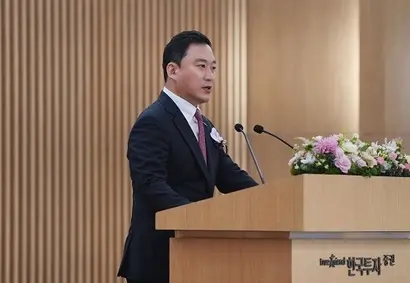
CEO Kim Sung-hwan took office last year and succeeded in his reappointment this past March. Since his inauguration, the company’s performance has risen dramatically. Profits increased by 87.56% from 596.6 billion won in 2023 to 1.1189 trillion won in 2024. This growth trajectory has continued this year. The net profit for the first half of last year was 710.9 billion won, but in the first half of this year, it reached 1.0252 trillion won, a 44.22% increase. Korea Investment & Securities is the first brokerage firm to exceed 1 trillion won in net profit on a semi-annual basis.
Korea Investment & Securities is also pursuing an Investment Management Account (IMA) business. The IMA is a principal-protected financial product offered by brokerage firms that provides higher interest rates than bank savings accounts. Once approved for the IMA business, a brokerage can use funds received from customers to engage in aggressive investments. It is reported that Korea Investment & Securities has already applied for regulatory approval for the IMA business.
Once the IMA business is launched, it is expected to have a positive impact on future earnings. Woo Do-hyung, a researcher at Yuanta Securities003470, stated, "(Korea Investment & Securities') approval for the IMA will be a profit-boosting factor. Since the limit is 300% combined with issued notes, the IMA procurement scale is expected to be around 10 trillion won." He added, "If we conservatively assume a margin of 100bp (1%), we can expect a profit increase of 100 billion won."
Shortcomings in Internal Control
Korea Investment & Securities has shown impeccable performance this year. However, the evaluation of the company is not entirely positive. While performance has risen, there is growing criticism regarding internal controls.
This year, Korea Investment & Securities faced scrutiny from financial authorities over accounting errors and misselling. In March, it issued corrected financial statements for business reports from 2019 to 2023. This was due to an overstatement of revenue by approximately 5.7 trillion won, which occurred during the process of reflecting gains and losses from internal currency exchange transactions between the retail and foreign exchange departments. While suspicions of 'revenue padding' were raised in the financial sector at the time, the Financial Supervisory Service (FSS) only issued a 'caution' to the company.
The FSS also issued an 'institutional warning' to Korea Investment & Securities this April due to misselling. The regulator stated that some employees at certain branches violated their duty to comply with suitability principles while selling private equity funds. However, since this incident occurred between June 2018 and January 2020—before CEO Kim took office—it is difficult to hold him responsible.
Nevertheless, CEO Kim Sung-hwan must focus on internal control management to prevent future controversies. Seemingly aware of this, CEO Kim noted in his New Year's address this January: "We are already well aware that a single mistake or moment of negligence can lead to losses of an unbearable scale," adding, "We must now build processes capable of covering risks lurking in wider areas."
CEO Kim Sung-hwan's term ends in March next year. If he succeeds in being reappointed, experts suggest that he will need to focus more on internal controls than on just performance. Having already delivered strong results, the CEO must now prioritize internal management to aim for a long-term tenure. Even with excellent performance, failing to maintain public trust will inevitably lead to difficulties in CEO operations.