

[비즈한국] In 2022, the Hubble Space Telescope discovered a single star shining alone at the furthest distance ever recorded. The star's redshift was measured at z=5.926, representing the universe as it appeared when it was only 900 million years old. It is a star from the most distant past, existing in the early universe during its very infancy, less than a billion years old. It is located 28 billion light-years away from Earth. To capture the light of a single star—not a galaxy containing hundreds of billions or trillions of stars—at such a vast distance was unprecedented! This discovery was possible only because a very extreme and exquisite gravitational lensing event happened to occur near this star. Thanks to the gravitational lens created by the massive galaxy cluster WHL0137-08 directly in front, the faint light hiding at the edge of the universe was amplified and revealed.
In the Hubble image, a faint but very elongated shape is visible, which is the host galaxy containing this star. Astronomers named this galaxy the "Sunrise Arc," because it resembles a red arc of light rising over the horizon of the universe. The candidate for the most distant single star ever discovered was named "Earendel," which means "morning star." It signifies that this star was shining brightly during the dawn of the universe, shortly after the Big Bang.
However, a new interpretation of Earendel's identity has recently emerged. Unfortunately, Earendel may not be the most distant single star discovered after all. The possibility that it is a star cluster crowded with many stars, rather than just one, has been newly proposed. It appears that Earendel was not a single star shining alone at the edge of the universe, but a very young star cluster that had just been born at the cosmic frontier.
Stars and star clusters are on a completely different scale. A star cluster is a massive group containing hundreds of thousands to millions of stars. It might sound funny that there is confusion over whether the image shows just one star or a cluster of many, but in Earendel's case, it is understandable. It is because the object is so far away and appears so faint. Gravitational lensing, which bends light paths along curved spacetime, not only distorts the background universe’s image but also has the effect of magnifying faint, distant objects when distorted light rays happen to converge. However, it is uncertain exactly how many times the brightness is amplified by the gravitational lens at Earendel's location. The margin of error is still too large.
To determine the actual brightness of this object, one must know how much the brightness has been "inflated" by the gravitational lens. However, according to estimates so far, one theory suggests it was a much dimmer star amplified 4,000 to 40,000 times due to an extreme coincidence, while another theory contends that it wasn't that extreme, and that it was an originally brighter star cluster whose light was moderately amplified.
Later, the James Webb Space Telescope (JWST) also targeted Earendel. In the initial analysis, astronomers only performed image and photometric analysis. Based on estimates of how much the gravitational lens had amplified the star's brightness, they estimated Earendel's potential size to be about 4,000 AU. This means it is 4,000 times larger than the distance between the Sun and Earth. While very massive, that would still just be a very large single star.
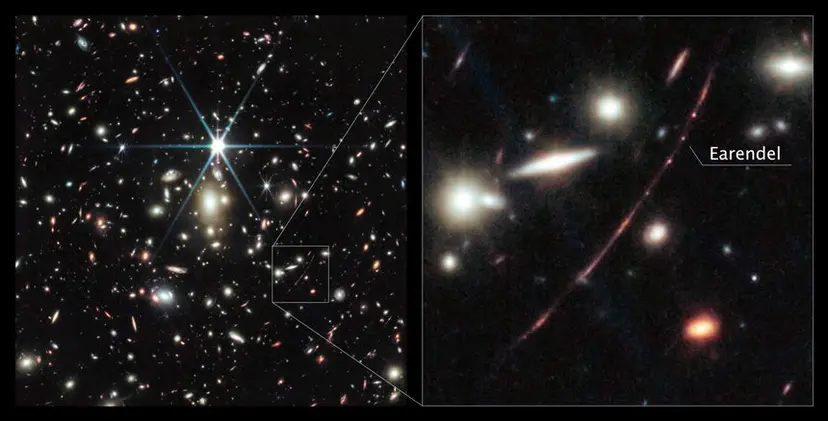
Observations by the James Webb telescope also showed the possibility that Earendel is a very massive and bright B-type star. It could be a very bright, heavy star that was newly formed in the primordial universe, essentially close to a Population III (first generation) star. However, because the estimated mass and brightness were so high, the possibility of it being a binary system with two stars stuck together was also discussed.
But recently, more detailed spectral analysis from the James Webb telescope has revealed an entirely different possibility: it is neither a single star nor a dazzling binary, but a primordial star cluster containing many more stars. Earendel looks more like a globular cluster formed in the primordial universe.
The spectrum of a star is different when it is alone versus when many are gathered together. When stars with slightly different temperatures congregate, the individual spectra emitted by each star blend together to create a new "spectral cocktail." This analysis utilized infrared spectroscopic data from the James Webb's NIRSpec. It was confirmed that the shape of the spectrum deviates significantly from the characteristics that a simple single star should exhibit.
Along with Earendel, there are small spots filling the long, distorted Sunrise Arc galaxy. These spots were classified as star clusters from the first analysis, and in this recent analysis, directly comparing the spectra of Earendel and these spots shows a very similar pattern. Earendel is not a single star, but a star cluster. Both Earendel and these spots are best explained by the observed spectra if we assume they are clusters crowded with stars that have a metal content of less than 10% of the Sun’s and are over 30 million years old.
When the dark matter halo, which was not considered in the initial analysis, was added to the calculations, Earendel's potential size also changed significantly. Compared to the idea that it was a star about 4,000 AU in size, this analysis suggests the possibility that Earendel is a larger star cluster reaching 6.5 light-years in diameter. If Earendel was a globular cluster from the start, it means it is a brighter object than a single star. According to this analysis, the previously estimated gravitational lensing effect seems somewhat exaggerated. Earendel's brightness does not appear to have been amplified by thousands or tens of thousands of times, but rather by about 43 to 67 times. And this is much more realistic.
This additional analysis adjusted Earendel's redshift to around 5.926; if this is correct, Earendel is located about 27.3 billion light-years away, slightly closer than the previously known 28 billion. Of course, it is still at the far edge of the universe, but it has become slightly nearer.
You might be a little disappointed that it turned out to be a star cluster rather than the most distant star. However, from an astronomical perspective, it is not at all disappointing. On the contrary, it becomes an important clue for tracking the evolution of galaxies and the universe. Astronomers believe that globular clusters are the seeds of galaxies and fossils of galactic evolution. During the process of galaxy formation in the early universe, globular clusters are the first to be created. A globular cluster is a fossil that perfectly preserves the chemical memories of the time when the galaxy was just being born. Just as we explore comets and asteroids at the edge of the solar system to learn about its birth and origin, globular clusters are clues to the birth and origin of galaxies.
Furthermore, Earendel retains the appearance of the distant past of the universe, less than a billion years after the Big Bang. Earendel proves that in the era when the first galaxies were being created in cosmic history, very dense globular clusters already existed within them. The various characteristics of Earendel estimated this time match the appearance of infant star clusters predicted by simulations exactly.
Unfortunately, if Earendel is ultimately concluded to be something other than a single star, the title of the most distant star discovered by humanity to date might be taken by "Godzilla." Really. The star's name is Godzilla. Godzilla is a star about 10.9 billion light-years away, discovered similarly through a dramatic gravitational lens created by the galaxy cluster PSZ1 G311.65-18.48. A distinctly distorted galaxy image is visible around this galaxy, and astronomers discovered a particularly bright star there. It was 50 million times brighter than our Sun. Astronomers named this overwhelming star after the monster Godzilla. The distant galaxy where this star shines is called the Sunburst Galaxy.
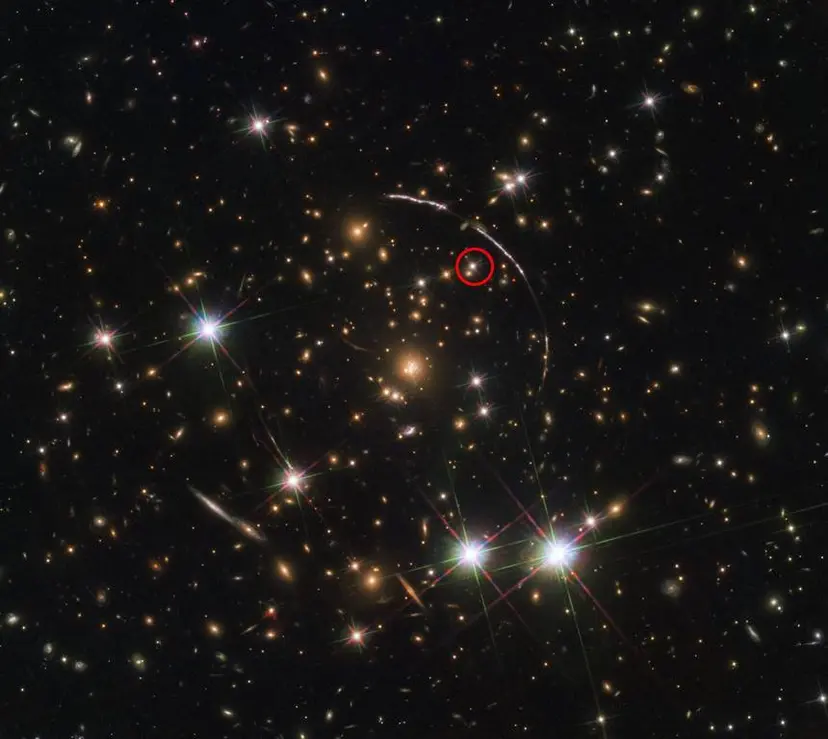
However, recently, the possibility that Godzilla, like Earendel, is not a single star but a star cluster has been raised. Recent VLT observations show the possibility that Godzilla is actually a very young star cluster about 4 to 6 million years old, with a mass several million times that of the Sun. It contains high levels of helium, as well as heavy elements created by supernova explosions such as oxygen and nitrogen, which is too much for a simple single star. Therefore, astronomers are trending toward the possibility that Godzilla is also a cluster where many stars live together.
In the end, it can be said that we have not yet discovered an undeniable, certain single star in the distant universe beyond 10 billion light-years. We have captured existences that were mimicking single stars in the darkness of the distant universe with the help of dramatic, coincidental gravitational lenses—including Earendel and Godzilla—but after persistent analysis, one by one, the fact is being revealed that they were star clusters, not single stars. Of course, the presence of a star cluster implies there are stars that make up that cluster. But because the distance is so great, we cannot distinguish and see the individual stars that form those clusters. While star clusters in the early universe are, of course, interesting targets, they are too far away, forcing us to view the cluster as a whole. Ultimately, the characteristics of each individual star are all blended together, making it impossible to distinguish and see the precise features of individual early universe stars.
That is precisely why astronomers continue to search for a single star that might be shining brilliantly at the edge of the universe, revealing its presence. The real Earendel, the true morning star of the universe, has yet to show itself to us.
Reference
https://iopscience.iop.org/article/10.3847/2041-8213/aded93
Who is the author Woong-Bae Ji? He loves cats and the universe. After watching 'Galaxy Express 999' as a child, he dreamed of spreading the beauty of the universe. Currently an assistant professor at Sejong University's College of Liberal Arts, he is involved in various science communication activities such as lectures and writing. He has authored books including 'A Piece of the Universe Every Day', 'Scientists of the Starry Universe', 'Things You Can Know Though You Cannot Go', and 'Strange Questions That Come to Mind When Looking at the Universe', and translated books such as 'The Hitchhiker's Guide to the Real Universe', 'How I Killed Pluto', 'Quantum Life', and 'Cosmigraphics'.