

[비즈한국] This year's Nobel Prize in Economics was jointly awarded to Joel Mokyr, Philippe Aghion, and Peter Howitt for their contributions to research on innovation-led sustainable growth.
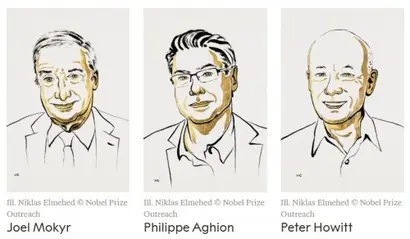
On October 13 (local time), the Royal Swedish Academy of Sciences announced the winners of the 2025 Nobel Prize in Economics: Dutch-born American Joel Mokyr (professor at Northwestern University, USA), French-born Philippe Aghion (professor at Collège de France, INSEAD, and the London School of Economics (LSE)), and Canadian-born Peter Howitt (professor at Brown University, USA). They were recognized for their pioneering contributions in explaining innovation-led sustainable economic growth.
The Royal Academy stated, "Their research has identified the operating principles of technological progress and innovation, which are the core drivers of sustained economic growth that have led to human prosperity." The committee particularly noted that the three scholars established the theoretical foundations of 'creative destruction' and 'sustainable growth through technological innovation,' clearly demonstrating that economic growth is sustained not by simple capital accumulation, but by innovation and competition.
As an economic historian, Professor Mokyr has garnered attention for his research into the historical origins of the knowledge economy. In his seminal book, "A Culture of Growth: The Intellectual Origins of the Modern Economy," he emphasized that economic growth is not merely a result of capital accumulation or geographical factors, but is heavily dependent on cultural and intellectual environments. Mokyr defined the factors that enabled the Industrial Revolution in Europe as "the accumulation of knowledge and social openness," explaining that progress in science and technology can only be sustained on a foundation of institutional trust and cultural values. The Royal Academy stated that he was recognized for "identifying the preconditions for sustainable growth through technological progress."
Professors Philippe Aghion and Peter Howitt built a growth theory that mathematically explains 'creative destruction' through their collaborative research. 'Creative destruction' refers to the process where existing industries decline as new technologies or products emerge, acting as a core mechanism of economic growth. In 1992, the two scholars published "A Model of Growth through Creative Destruction" in the journal Econometrica, establishing endogenous growth theory.
The Royal Academy assessed that their research "provided policy insights into how creative destruction, while causing conflict, can be directed in a productive way."
John Hassler, Chair of the Nobel Committee for Economic Sciences, said, "The research of these three scholars shows that economic growth is never a guaranteed process," adding, "To prevent the economy from falling back into stagnation, we must maintain institutions and competitive mechanisms that sustain innovation."
The fact that this year's Nobel Prize in Economics was awarded to the theory of innovation-led growth suggests that the academic solution to the structural problems of low growth and stagnant productivity facing the global economy still lies in 'creative destruction.' In terms of industrial policy, this award is interpreted as a symbolic decision indicating that we should aim for sustainable growth through open innovation and technological competition, rather than protectionism or a return to manufacturing.
In particular, this is noteworthy because U.S. President Donald Trump's "Make America Great Again" policy represents a shift away from a knowledge- and technology-centered economy back toward traditional manufacturing, making this award a message in the opposite direction. In a global economy where low growth and economic stagnation have become the norm, the laureates' research emphasizes that only innovation through 'openness,' not 'protection,' can enable sustainable growth.
At the press conference, Professor Philippe Aghion stated, "I do not welcome American protectionism," adding, "Securing a single global market with trade and openness is crucial." He also noted, "AI and green growth are modern forms of creative destruction," explaining that while technological change can cause inequality and unemployment, it leads to job creation in the long term through productivity improvements. He added, "There were concerns about massive unemployment during the steam engine, electricity, and IT revolutions, but more jobs were actually created due to productivity gains. The introduction of AI and IT will work on the same principle."
He also emphasized the importance of green growth. "Companies do not voluntarily pursue eco-friendly innovation," he said, adding, "It is necessary to induce investment in eco-friendly technology through policies such as carbon pricing and carbon taxes." Professor Aghion concluded by emphasizing, "The government should not block the market's creative destruction, but rather guide it in a sustainable direction."