

[비즈한국] This week is expected to be a major turning point for the conclusion of tariff negotiations between South Korea and the United States. Deputy Prime Minister for Economy and Minister of Economy and Finance Koo Yoon-cheol is pursuing a bilateral meeting with US Treasury Secretary Scott Bessent. Attention is focused on whether he can reverse the situation, where formal documentation remains stagnant despite a dramatic tentative agreement on tariffs reached at the end of July.
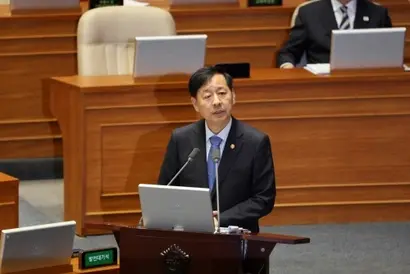
According to the Ministry of Economy and Finance and other sources on the 12th, Deputy Prime Minister Koo will depart on the 15th to attend the G20 Finance Ministers and Central Bank Governors Meeting and the International Monetary Fund (IMF) and World Bank (WB) Annual Meetings in Washington, D.C. It is reported that Deputy Prime Minister Koo will meet with Secretary Bessent to discuss financial issues between the two countries, and there is an expectation that negotiations regarding the funding method for the $350 billion (502.25 trillion won) investment—a prerequisite for concluding the Korea-US tariff deal—will also take place.
On the 25th of last month, US President Donald Trump referred to the $350 billion investment fund for the US, finalized during the Korea-US tariff negotiations, as an "upfront" payment, pressuring for direct cash investment. In response, the South Korean government is standing firm, proposing that the fund be structured around loans and guarantees rather than direct investment, similar to the US-Japan tariff agreement. South Korea is demanding: unlimited Korea-US currency swaps, a reasonable proportion of direct investment, and guarantees of rights to participate in the selection of investment destinations based on "commercial rationality." President Lee Jae-myung also recently expressed concern in an interview with Reuters, stating, "If South Korea invests the entire $350 billion in cash into the US as demanded without a Korea-US currency swap, the Korean economy could face a severe shock, leading to a crisis like the 1997 Asian financial crisis."
While Korea-US tariff negotiations remain deadlocked, export-oriented industries such as automobiles are facing significant difficulties. Last month, President Trump officially signed an executive order implementing the tariff agreement with Japan, lowering the tariff rate on automobiles produced in that country from 25% to 15%. However, domestic companies continue to face a 25% tariff rate, which has been in effect since April 3rd.
The same applies to industries such as steel, copper, and aluminum.
Since June 4th, a 50% tariff has been imposed on steel and aluminum products, and since August 1st, the same rate has been applied to copper products.
The pharmaceutical and biotech industry is also in crisis. President Trump announced that starting from the 1st of this month, a 100% item-specific tariff would be imposed on brand-name and patented drugs unless their manufacturing plants in the US are already under construction or completed. He also stated that he intends to raise the tariff rate to 150–200% in the future.
While no tariffs have been imposed on semiconductors yet, there is a high possibility that a high tariff rate of 100% or more will be applied, similar to pharmaceuticals. Furthermore, as trade conflicts between the US and China intensify, the supply of rare earth elements, which are essential for high-tech industries including semiconductors, is likely to become difficult. According to the IEA (International Energy Agency), China accounted for a 60% share of rare earth mining as of May. In processing areas such as separation and refining, China holds a share of over 90%.