

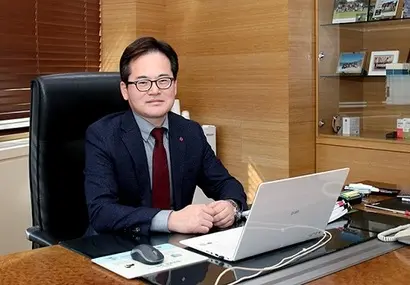
[비즈한국] Lotte Chilsung005300 Beverage (Lotte Chilsung) appointed Park Yoon-ki, then head of the management strategy division (senior executive director), as CEO in March 2021. It was the first time a senior executive director-level official had taken office as CEO at Lotte Chilsung. After taking office, CEO Park achieved results in expanding the company's scale and pioneering overseas markets, successfully securing consecutive reappointments in 2023 and 2025.
However, CEO Park is faced with the challenge of improving the company's financial structure. Since he took office, Lotte Chilsung’s debt has steadily increased, and the company is also seeing sluggish performance this year.
According to electronic disclosures from the Financial Supervisory Service, Lotte Chilsung’s total debt was: 2.1612 trillion won at the end of 2020; 2.1518 trillion won at the end of 2021; 2.2838 trillion won at the end of 2022; 2.7208 trillion won at the end of 2023; 2.7941 trillion won at the end of 2024; and 2.7820 trillion won as of the end of June 2025.
Coincidentally, Lotte Chilsung’s debt has been on an upward trend since March 2021, when CEO Park Yoon-ki took office. Although total debt has decreased slightly recently, it remains high compared to the early 2020s. This is partly due to the increase in debt following the incorporation of the Philippine entity PCPPI as a subsidiary in 2023.
Lotte Chilsung recently announced plans to issue 250 billion won in corporate bonds. The plan is to secure cash and use the entire amount for debt repayment. This is interpreted as a move to address corporate bonds or commercial paper that are reaching maturity in the near future.
Given Lotte Chilsung’s real estate holdings and the possibility of support from Lotte Group, a short-term financial crisis for the company is unlikely. However, if the current financial situation persists, the company will have to issue more corporate bonds when the next maturity dates arrive. For the company, continuous issuance of corporate bonds is not a desirable situation.
Hwang Jong, a lead analyst at NICE Investors Service, analyzed: "As of the end of June this year, Lotte Chilsung’s short-term borrowings on a consolidated basis totaled 811.2 billion won, which accounts for approximately 46% of total borrowings." He added, "Short-term borrowings maturing within one year consist of 180 billion won in commercial paper, 355.8 billion won in short-term loans, 49.5 billion won in current portion of long-term debt, 369.9 billion won in current bonds, and 36 billion won in lease liabilities. This exceeds Lotte Chilsung’s cash and cash equivalents of 175.6 billion won, indicating a short-term repayment burden."
Despite this, Lotte Chilsung is actively investing. In September of this year, the company announced an investment of 121 billion won to build a logistics hub center in Yongin. Last year, it also expanded its production lines in Myanmar.
The problem is that Lotte Chilsung’s recent performance has been poor. Revenue decreased by 1.89% from 2.0361 trillion won in the first half of last year to 1.9976 trillion won in the first half of this year, and operating profit fell by 9.91% from 97 billion won to 87.4 billion won during the same period.
If performance improves in the second half and cash flows in, financial concerns could be eased. However, the outlook is not positive. Shim Eun-joo, an analyst at Hana Securities, stated regarding Lotte Chilsung: "Domestic performance was weaker than expected due to the sluggish domestic economy and unfavorable weather." She added, "While overall consumer sentiment is expected to improve due to the issuance of consumption coupons, it is somewhat doubtful whether a trickle-down effect will reach the beverage and liquor sectors."
CEO Park Yoon-ki appears to be looking for a breakthrough overseas. At the general shareholders' meeting in March this year, CEO Park said, "Despite the difficulties, we will focus our efforts on strengthening brand competitiveness, discovering future businesses, and pioneering overseas markets."
Lotte Chilsung’s goal is to expand its overseas revenue share to 45% by 2028. Out of the 1.9976 trillion won in revenue for the first half of this year, 782 billion won, or 39.15%, was generated overseas. It is encouraging that overseas revenue increased to 782 billion won in the first half of this year from 694.3 billion won in the first half of last year.
However, the slump continues domestically. This is the reason for the overall weak performance this year. Ultimately, improvements in the domestic market are necessary.
Regarding its financial improvement plan, a Lotte Chilsung official stated, "Market interest rates are currently on a downward trend," and added, "We are refinancing borrowings that had high interest rates in the past with lower rates, so we expect interest expenses to decrease this year."