

[비즈한국] ‘DroneHunter 700’ by Fortem Technologies, a company invested in by Hanwha Aerospace012450 in 2023, is set to be integrated into ‘Sanctum™,’ the counter-drone system of global defense giant Lockheed Martin. Following Hanwha Systems272210, Lockheed Martin becomes the second company in the world to incorporate Fortem’s technology into its own counter-drone system. This adoption is expected to further accelerate the growth of Fortem Technologies. Additionally, Hanwha Systems’ own counter-drone system, which also utilizes the ‘DroneHunter,’ is expected to gain significant attention.
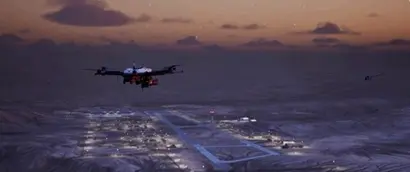
On October 8, the world's largest defense contractor, Lockheed Martin, unveiled its new counter-drone defense system, ‘Sanctum,’ via its website and YouTube channel. According to the released information, Sanctum is composed of a multi-layered defense system. First, an AI algorithm-based command and control system at a command post, integrated with existing air defense systems, detects enemy drones and classifies threats.
Once engagement begins, the first stage involves the deployment of drones equipped with HPM (High-Power Microwave) weapons, which radiate high-power electromagnetic waves to neutralize enemy swarm drones. After this initial defense, Fortem Technologies’ ‘DroneHunter 700’ is launched. The DroneHunter approaches target drones and fires a net (NetGuns™) to capture them. Drones caught in the net lose flight capability and are safely guided to the ground by a parachute attached to the net. Finally, any drones that penetrate these two layers are intercepted by a third-stage tactical laser weapon.
Fortem Technologies provides the DroneHunter 700 capture drones and TrueView® drone detection radar for the Sanctum system. Through this contract, Fortem Technologies is expected to further solidify its position as a startup specializing in counter-drone systems backed by Hanwha Aerospace. The counter-drone market is a sector projected to grow rapidly from $685 million in 2019 to $4.7 billion by 2027, with dozens of companies worldwide already competing fiercely.
In such an intensely competitive market, the fact that it has been selected as a core solution for the first counter-drone system from the world's largest defense contractor, Lockheed Martin, will serve as a major catalyst for Fortem's future exports and market expansion. In particular, the DroneHunter 700’s net-capture method holds significant competitive advantages. Compared to methods involving guns or missiles, it minimizes collateral damage. Furthermore, the debris of the captured drone is preserved within the net, which is advantageous for analyzing enemy technology or securing legal evidence to trace its origin. These benefits are expected to attract significant interest from many customers.
However, Lockheed Martin’s adoption of the DroneHunter for its system is not entirely surprising. In February 2023, Hanwha Aerospace, along with Lockheed Martin and others, co-invested a total of $17.8 million (approximately KRW 22.5 billion) in Fortem Technologies. Given that Hanwha integrated the technology into its own counter-drone system immediately following the joint investment, Lockheed Martin’s adoption of the DroneHunter could actually be seen as somewhat overdue.
Furthermore, the terms of the investment made by both companies were based on a Simple Agreement for Future Equity (SAFE), a type of "preemptive" investment where the company valuation is not fixed at the time of investment but is determined by future funding rounds. Therefore, as the corporate value of Fortem Technologies increases, early investors Hanwha Aerospace and Lockheed Martin can expect high investment returns driven by future sales growth.
Beyond investment gains, Hanwha Systems is also expected to benefit indirectly from Lockheed Martin’s application of the DroneHunter 700. Hanwha Systems has a track record of applying the DroneHunter 700 to its counter-drone system ahead of Lockheed Martin. It successfully demonstrated drone capture at a Korean military testing site in March 2023 and has already unveiled a ‘mobile anti-drone system’ that integrates detectors, laser launchers, and capture drones onto small tactical vehicles.
The author notes that Hanwha Systems has the experience of integrating the DroneHunter 700 into its own system before Lockheed Martin. This signifies that it has secured know-how in integration and operational experience, which suggests the potential for future technical cooperation with Lockheed Martin.