

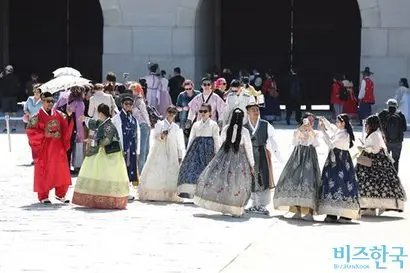
[비즈한국] During the Chuseok holiday, one could encounter a great number of foreigners around the four major palaces including Gyeongbokgung, as well as in Anguk-dong, Samcheong-dong, and Bukchon. It felt almost hard to believe you were still in Korea. Furthermore, while Koreans themselves rarely wear Hanbok, it is quite striking to see foreigners—especially the younger generation—strolling around in traditional Korean attire. Thanks to the "K-De-Heon" (a reference to popular K-pop cultural influence), Korean traditional culture is being frequently mentioned, and the news that "Magpie and Tiger" merchandise has sold out is truly welcome. While K-content has heightened interest in Korean culture, there is also a sense of concern. One cannot help but worry that we might repeat the disappointing path of Taekwondo and the Kukkiwon.
Taekwondo, which previously enjoyed global popularity as an early pillar of the Korean Wave, produced countless fans and practitioners worldwide, yet it failed to meet expectations and ultimately caused disappointment. In the roughly 50 years since the first overseas Taekwondo gym opened in the U.S. in 1972, the number of countries with Taekwondo facilities has reached 203. This is significantly more than the 191 countries with which South Korea maintains official diplomatic ties. The global population of Taekwondo practitioners is estimated at 200 million, with over 10 million holding official Kukkiwon dan certifications. Consequently, countless Taekwondo fans and practitioners visit Korea as if on a pilgrimage. However, the fact that they end up disappointed after visiting is no longer surprising, nor does it make the news.
For one, it does not fit its international stature. While Japan’s Kokugikan, the headquarters of sumo, and the Nippon Budokan for judo can accommodate 10,000 people, Korea's Kukkiwon only has about 800 seats. It cannot host international competitions, and the building itself is shabby and dilapidated. The World Taekwondo Hanmadang, considered the Kukkiwon's signature event, is held in the U.S. rather than in Korea. Even North Korea possesses a dedicated stadium with over 2,300 seats and auxiliary facilities.
It is even more disappointing that there is almost no high-quality content related to the philosophy and spirit of Taekwondo. One cannot even find a theme park to experience and enjoy Taekwondo. There is no permanent space to collectively engage with the many organizations, teams, and groups that tour the world performing Taekwondo. The few places that promote themselves with such a concept rarely rise above the level of children’s entertainment. Above all, the accumulation and establishment of Taekwondo philosophy, spirit, and content—necessary for such activities and space composition—are indispensable for the development of the sport. This is necessary not only for the national brand but also for economic impact.
Now, let us look at the Hallyu (Korean Wave) fandom. As of December 2023, the number of Hallyu fans (club members) worldwide surpassed 200 million for the first time, recently reaching 225 million. Since club memberships are centered on in-person activities, the figure could be two to three times higher if non-face-to-face participants are included. The number of fans surged especially during the COVID-19 pandemic. They wish to visit Korea, the home of the K-Culture they have experienced virtually. The "K-De-Heon" effect has only added to this.
However, there is a lack of spaces where one can comprehensively experience K-Culture. For example, K-pop fandoms are often limited to visiting the office buildings of their favorite idol groups or filming locations for music videos. While there was once an "SM Town," it was limited to an individual agency. Although world tours often begin in Korea, there are no proper music-specialized venues. Furthermore, it has been frequently pointed out that these locations are not connected to surrounding tourism and shopping infrastructure. "Enter-tour-ment," which combines culture and tourism, is currently unimaginable. Fans who had high aspirations for their visit may end up greatly disappointed.
It is not just about the external aspects. "K-Pop-ness" has yet to be defined. While the "Golden" era of K-De-Heon is recognized as K-pop, the concept itself has not been concretely analyzed or established. Similar work is needed for globally popular songs, as well as dramas and films. This work is critical because if concepts are not properly analyzed and defined, it becomes difficult to expand, create, or develop further.

The same applies to traditional culture. It is not enough to simply be encouraged by the increasing number of foreign visitors to the National Museum of Korea. We have moved past the stage of creating K-content based solely on images and concepts. We must produce more content that communicates and shares the identity and essence of Korean culture, or attempt a wider variety of special exhibitions. Furthermore, we must document and share instances where K-content has been attempted in various ways and received positive responses. Only then can we actively propose collaborations to other countries and companies and secure our own "IP." We should not become too obsessed with things that are "excessively Korean." While the "Magpie and Tiger" became a big hit due to its hip characteristics, other traditional Korean ornaments and weapons went unnoticed. We must pay attention to and learn from the fact that the "hip" features of a character are what the younger generation accepts.
The prerequisites for this are universality and established foundations. BTS actively embraced American retro-pop, and K-De-Heon incorporated universal genres like occult musicals. It is important to systematize the Korean cultural philosophy and identity that will differentiate our content, on top of these universal cultural codes. At the very least, a K-Culture theme park should be built in an area like Yeongjongdo. For this to happen, collaboration between K-pop agencies, broadcasting stations, production companies, and creators is essential, and the government must demonstrate leadership. A policy of simply distributing budgets to individual companies will only halve the synergy effect. We must also take pride in K-pop ourselves and internalize it. Now is the time to gather national consensus on K-content.
Finally, there must be no leadership risks. The fact that the Kukkiwon disappointed its fans stemmed from leadership risks. K-content is currently in a similar situation. Only by eliminating "owner risks" more than ever can we ensure that the Kukkiwon's precedent is not repeated.
The author, Kim Heon-sik, has spent his time exploring and navigating the forests of popular cultural phenomena since his 20s, driven by the belief that there is a way to make the world a better place through culture. He continues on this path in the 21st century—an era of artificial intelligence and quantum computing—with that same faith.
※ Columns by external contributors may differ from the editorial direction of this publication.