

[비즈한국] There is a perennial topic that always comes up when discussing the Korean economy: "Korean households pour over 70% of their assets into real estate. That is why the stock market cannot grow."
On the surface, this seems to make sense. However, this argument confuses cause and effect. It is not that stocks are sluggish because of a high real estate weighting; it is that the public has fled to real estate because the stock market has lost its credibility.
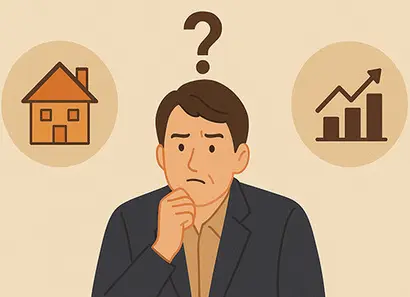
Those who blame real estate should look at the essence of the problem
There is also an old analysis that suggests a preference for real estate is due to "genetics." However, people do not buy homes because they instinctively love bricks and cement. They do it because that is the only remaining safe asset that will protect their money.
Korea's financial market has experienced how deposits, funds, and stocks can all be shaken by just a single crisis. On the other hand, real estate remains a tangible asset, even when hit by taxes or regulations.
Distrust in the stock market is structural. Companies have yet to escape their opaque, controlling-shareholder-centered governance, and the government has used stock prices only as a "policy tool" during economic downturns. Dividends are stingy, stock buyback cancellations are rare, and the shareholder return ratio is half the OECD average. Who would willingly engage in long-term investment in such a market?
The illusion of "Reducing real estate weighting like the U.S."
We often hear, "We should increase financial assets over real estate, like in advanced countries." However, this is also a superficial comparison that only copies surface-level figures. The reason the U.S. has a structure centered on financial assets is not merely a "shift in consciousness." They have long-term pension systems like 401(k) and IRA, corporate matching investment systems, low dividend tax rates, transparent accounting systems, and reliable market infrastructure.
What about Korea? Even the National Pension Service is reducing its share of domestic stocks and increasing its share of U.S. stocks to over 60%. How do you explain the reality where the very experts of the pension fund are buying U.S. stocks while telling people to "invest in Korean stocks for the sake of the Korean economy"? This is the real contradiction. The phrase "let's do what the U.S. does" only has meaning when the institutional foundation is the same. Korea lacks that foundation. Yet, forcing the public to "trust and invest" while blaming them is an administrative evasion of responsibility.
"Sell your house and buy stocks"? Do not drive your retirement into danger
Recently, some have argued that "retirement stability comes from financial investment" and have even suggested that "even one-home owners should reduce their real estate weighting." It sounds sophisticated, but in reality, it is a dangerous idea that ignores the anxieties of retirement.
The reason the elderly in Korea own homes is not for speculation. In a society where monthly rent and *jeonse* (lump-sum housing deposit) are unstable, one's own home is the only shield against housing cost inflation. Telling them to sell that one home to invest in stocks is telling them to turn stable fixed costs into variable costs.
When inflation hits, rents rise, but stock dividends remain the same. In the end, they are left to bear the volatility of the market in the midst of uncertainty. One's "smart home" is not greed; it is survival. Telling them to sell it is no different from telling them to get rid of the last safety net for their old age.
Pure real estate investment funds have already mostly exited due to regulations on multi-home owners
Over the past few years, the government has suppressed real estate speculation through regulations on multi-home owners, heavy taxation on capital gains, and loan restrictions. According to the logic, that money should have flowed into the stock market. But that did not happen. That capital moved to U.S. stocks, dollar deposits, gold ETFs, and foreign bonds. In other words, it moved not to "domestic assets" but to "trustworthy assets."
In the end, the essence of the problem is not the "asset weight," but the "absence of trust." No matter how much the government shouts slogans, the market does not believe in falsehoods.
The selective standard that "only Korean real estate is a bubble"
The logic that "real estate is a bubble and stocks are undervalued" is also frequently heard. However, the two markets have different characteristics. Real estate is under direct government control, while stocks are under government indifference. Both are distorted. When they try to suppress real estate, transactions are paralyzed, and when they try to boost stocks, the market becomes unstable. Ultimately, policy makes people distrust both markets. Policy should focus not on "who to punish" but on "what to make trustworthy."
The cold reality shown by the National Pension Service
There is only one reason the National Pension Service is reducing its weight in domestic stocks: the risk-adjusted return is low. They do not manage funds out of patriotism. They judge strictly by return rates and stability. In this situation, telling individuals to "long-term invest in Korean stocks" is duplicitous. With pension funds buying the U.S. and institutions buying dollars, telling ordinary people to "sell your house and buy KOSPI" is not investment advice; it is a confession of faith.
Asset allocation is not a belief, but a matter of probability
Asset allocation must vary according to each individual's life structure and income level. A young, single person in their 20s and a retiree in their 60s cannot have the same portfolio. However, the statement that "you must reduce real estate" forces a single formula on all generations.
Investment is a matter of probability. To increase the odds, one must reduce information asymmetry, make taxes and systems fair, and strengthen corporate transparency. In other words, the market structure must be changed. That is what truly "saving the stock market" means.
But right now, all that reform has been omitted, and only the simplistic slogan "you must reduce real estate" remains. This is not reform; it is psychological warfare.
The "hope circuit" that "funds will flow in if stock prices rise"
Policy authorities and some experts say, "If stocks go up, money will naturally flow in." But that is hope, not a strategy. For stock prices to rise, there must be growth industries, companies must invest in innovation, policies must be consistent, and taxes must be predictable. Currently, Korea lacks all four. That is why stocks are swayed by short-term themes and long-term investors are decreasing. Ultimately, "blaming real estate" is an avoidance of reality.
The real problem is not "real estate excess" but "stock market weakness." Trying to change investment sentiment without fixing the market's fundamental health is just forcing yet another risk onto citizens who have no homes.
What it takes for Korean stocks to revive
For the Korean stock market to truly revive, three things are needed. First, the restoration of trust. Corporate accounting transparency, consistency in government policy, and market predictability must be restored. Second, infrastructure for long-term investment. Tax benefits centered on domestic blue-chip stocks should be strengthened for pensions and retirement accounts. Third, a fair market order. The arbitrary exercise of power by controlling shareholders must be prevented, and the rights of minority shareholders must be practically protected.
Unless these three things come first, the public will never move their money. People do not move their assets; they move their trust.
Investment advice without trust is violence
The current debate is not merely a matter of asset portfolios. It is a matter of "whom to trust." For the Korean middle class, that "one home" is not speculation, but the final means of self-defense. Forcing them to sell that one home is like cutting off the final safety net of their lives.
If you want the stock market to revive, you must start by reducing people's anxieties and building trust. That is the most realistic way to reduce real estate weight. Funds do not move through force. They move only through trust.
The reason Korean stocks do not revive is not because the public loves real estate, but because the stock market has lost the public's trust. Before telling people to sell their real estate, the stock market must first return their trust.
Kim Hak-ryul, head of the Smart Tube Real Estate Research Institute, known by his pen name "Pashong," previously served as the team leader of the Real Estate Research Division at Gallup Korea. He operates and hosts the Naver blog "Pashong's World Exploration" and the YouTube channel "Stew TV." He is the author of books including "Rewriting the Republic of Korea Real Estate User Guide (2025)," "The Power of Gyeonggi Real Estate (2024)," "Absolute Principles of Seoul Real Estate (2023)," "Future of Incheon Real Estate (2022)," "Kim Hak-ryul's Absolute Principles of Real Estate Investment (2022)," "Republic of Korea Real Estate Future Map (2021)," and "From Now On, Only Places That Will Rise, Rise (2020)."