

[비즈한국] An unprecedented scene has unfolded in Japanese political history. In the Liberal Democratic Party (LDP) presidential election held on the 4th, Sanae Takaichi was elected as the new president following a runoff vote, making the ascension of Japan's first female prime minister a reality.
In the runoff, Takaichi defeated Minister of Agriculture, Forestry and Fisheries Shinjiro Koizumi with 185 votes to 156. Since the LDP still holds the status of the largest party in the House of Representatives, the election of the new president effectively signifies her appointment as prime minister. This significantly increases the likelihood that Japan will welcome its first female prime minister since the post-war Constitution was enacted in 1947.
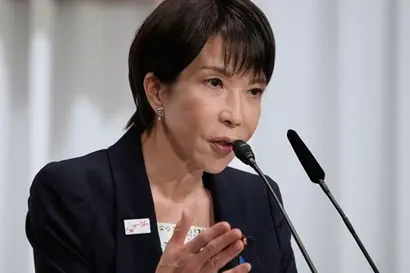
Whether Takaichi’s election will lead to stable governance remains uncertain. The LDP recently lost key seats in the general election and failed to secure an outright majority. Consequently, cooperation with the coalition partner, Komeito, is essential, and negotiations with opposition parties are also inevitable. With powerful factional politics still at play within the LDP, analysts suggest it will take time for Takaichi to exercise stable leadership as the new president. While it is considered an unwritten rule for the LDP president to assume the premiership, procedural variables remain as a parliamentary confirmation vote is still required.
In terms of political ideology, Takaichi is classified as a prominent hardline conservative within the LDP. She has consistently emphasized strengthening Japan's national security, upholding traditional values, and amending the constitution. In economic policy, she has stressed both fiscal soundness and crisis response, advocating for large-scale investments in strategic industries such as semiconductors, AI, and biotechnology.
At the same time, she has maintained a conservative stance on institutional changes related to gender equality that have been consistently raised in Japanese society. She has expressed negative views on issues such as allowing married couples to have separate surnames or female imperial succession, leading some to believe that the "arrival of a female prime minister" may not immediately translate into progress for gender equality.
This presidential election appears to be an event signaling a rapid shift in Japan's political landscape. Before Takaichi’s victory, the LDP had several female presidential candidates, but they were repeatedly frustrated in the final competition. This victory demonstrates that internal political dynamics are changing, while also reflecting the diversifying demands of voters. The runoff against Agriculture Minister Shinjiro Koizumi proceeded under the theme of "generational change versus hardline conservatism," and it is analyzed that the traditional conservative forces within the party ultimately secured the win.
Following this, a prime ministerial nomination election is scheduled to take place in the Diet. Procedurally, the prime minister is elected by a vote in both houses of the Diet, and the candidate who secures a majority in the House of Representatives ultimately ascends to the premiership. As the LDP remains the largest party in the House of Representatives and can secure a majority together with the coalition partner Komeito, it is highly likely that Takaichi will be officially inaugurated as the 102nd prime minister and Japan's first female prime minister. Her actual inauguration will take place after the prime ministerial nomination vote and the cabinet formation process, with some projections suggesting a new cabinet could be launched within this month if the confirmation is expedited.
Meanwhile, during the presidential election process, Takaichi stated that if any parts of agreements recently reached in U.S.-Japan trade negotiations are found to be inconsistent with Japan's national interests, she would be open to renegotiation. In particular, she has stated on several occasions that if there are any unfair elements in the $550 billion investment package promised by Japan to the U.S., she would review the agreement once she becomes prime minister. This is interpreted as Takaichi leaving room to adjust Japan’s stance in negotiations with the U.S. to be more assertive. Consequently, attention is also focused on how Takaichi’s election will affect the ongoing U.S.-Korea trade negotiations.