

[비즈한국] The court has issued a ruling in a second trial upholding the requirement to disclose information on the occurrence of major industrial accidents. This verdict has once again reaffirmed the necessity of transparency regarding major industrial accident data. Civil society groups have emphasized that the ruling legally recognizes the public's right to know about safe workplaces.
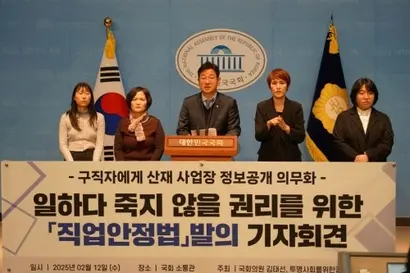
On October 2, the Seoul High Court (9-3 Administrative Division) ruled in favor of the plaintiff in a lawsuit filed by the Center for Freedom of Information and Transparent Society (the Center) against the Ministry of Employment and Labor, seeking to cancel the ministry's refusal to disclose information regarding major industrial accidents. This follows a previous ruling in favor of the plaintiff by the Seoul Administrative Court on October 17, 2024.
On March 22, 2023, the Center requested that the Ministry of Employment and Labor disclose information on the "Status of Major Industrial Accidents in 2022." However, the ministry refused, citing that information such as the names of primary and subcontracting companies, the assigned inspectors, administrative measures taken, and referral opinions constituted "information that could affect investigations and trials." Disagreeing with this refusal, the Center filed a lawsuit with the Seoul Administrative Court on October 16, 2023, seeking to overturn the decision.
The first-instance court ruled that even if information on major industrial accidents were disclosed, it would only reveal which companies experienced such incidents, not specific criminal details or the progress and methods of investigations; therefore, it was difficult to see how this would hinder the investigative activities of authorities.
Furthermore, the court noted that while a system for announcing major industrial accidents already exists, its purpose differs from the information disclosure request, and thus the prior system could not justify withholding information. The current announcement system, mandated by the Severe Accidents Punishment Act, only publicly names businesses after criminal convictions are finalized. Civil society has long pointed out that this system is ineffective due to significant delays. To ensure the disclosure has real meaning, they have demanded that information be released at the time of occurrence.
The second-instance court upheld the entirety of the first-instance ruling. Kim Ye-chan, an activist at the Center, stated, "The court has now twice confirmed the legitimacy of information disclosure, and the Ministry of Employment and Labor itself has announced it would regularly disclose the list of companies where major accidents occur," adding, "If the ministry delays disclosure through an appeal, it would directly contradict its own comprehensive labor safety measures and face criticism for ignoring the public's right to know."
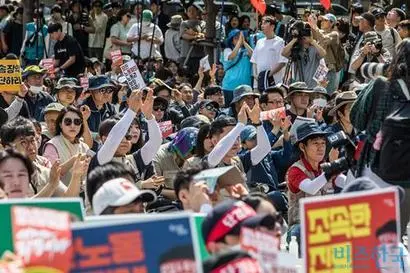
The Ministry of Employment and Labor stated it would review whether to appeal. However, separate from this ruling, the ministry is pursuing an expansion of industrial accident information disclosure. According to the "Comprehensive Labor Safety Measures" announced by the government on September 15, there are plans to regularly disclose the names of companies where major accidents occur. To prevent the recurrence of accidents, the ministry also intends to disclose accident investigation reports under the Occupational Safety and Health Act.
Lee Kyung-jae, head of the Major Industrial Accident Investigation Division at the Ministry, stated, "We are currently reviewing the timing and specific details for disclosing the names of companies involved in major accidents," and added, "We are considering this as a separate matter from the public announcements made by the government, as the scope of disclosure differs."
Civil society advocates for the construction of a system that provides easy access to data on major industrial accidents. Overseas, major accident information is already organized into databases and disclosed. The U.S. Occupational Safety and Health Administration (OSHA) decides within six months whether to impose fines following a major workplace accident and publishes information including the company name, address, details of the accident, legal violations, and penalty amounts for cases where fines were levied. Once the investigation is complete, the public can view information such as the date of occurrence, company name, and investigation findings through their website database.
The U.K. Health and Safety Executive (HSE) also maintains a public database of companies that have violated health and safety laws, allowing the public to search for information such as company names and their history of legal violations.
In contrast, in South Korea, critics have repeatedly pointed out that major industrial accident disclosures are provided only as PDF files and are limited to a one-year posting period, making data analysis difficult.