

[비즈한국] “Just as there are Koreans working hard abroad, there are migrant workers struggling in Korea. We must put ourselves in their shoes.” The arrest of a Korean worker at the Hyundai Motor005380 and LG Energy Solution373220 Metaplant America (HMGMA) battery plant in Georgia, USA, came as a major shock to Korean society. There is now a growing call to reflect on the treatment and human rights of migrant workers in Korea with that same sense of empathy.
In Korea, migrant workers are restricted from changing their workplaces. This constitutes forced labor, which is prohibited by the ILO (International Labour Organization). Consequently, civil society points out that institutional improvements are necessary to prevent the exploitation of migrant workers.
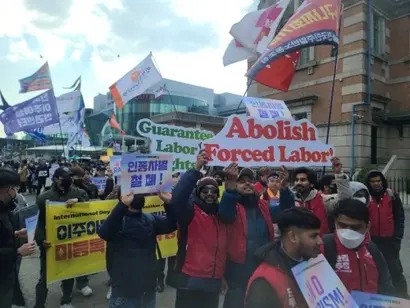
On September 26, the Anti-Corruption and Civil Rights Commission (ACRC) expressed an opinion to the Ministry of Justice that it should permit a change of workplace for 'A', a migrant shipyard welder who had been subjected to unfair treatment by his employer. It also recommended that concrete criteria for the reasons for permitting such changes be established.
From February 2024, A worked at Business B in Nam-gu, Ulsan, a subcontractor for HD Hyundai Mipo010620. Business B had A work under a private contract that differed from the standard labor contract submitted to the authorities. His wages were reduced from 2.5 million won per month to 9,900 won per hour, and his labor contract period was shortened from 12 months to 8 months and 25 days. The work location was also changed from 'non-changeable' to 'changeable,' and his job shifted from ship block welding to securing hull blocks for welding. While working, A suffered an injury requiring over 3 weeks of treatment, but was unable to claim industrial accident compensation due to his employer's dissuasion.
Eventually, in March this year, A applied for a change to a D-10-1 visa—a stay status for job-seeking activities—to change his workplace, but was denied. The reason given was that there was a disagreement regarding whether the fault lay with A. The guidelines for the shipyard welder visa (E-7-3) only allow for a change of workplace when there is no fault on the part of the migrant worker. In response, A filed a civil complaint with the ACRC in April demanding permission to change his workplace.
The ACRC determined that this case fell under the category of a workplace change where the migrant worker is not at fault. Lee Jae-sung, an administrative officer at the ACRC, pointed out, "The Ministry of Justice considered that there was a disagreement on the fault simply because a resignation letter had been submitted. However, proactive administration is needed to comprehensively judge factors such as forced private contracts and unfair treatment that prevents the filing of industrial accident claims."
Regarding the ACRC's opinion, A stated, "There are still many procedures to go through before I am actually relieved and granted legal status. Since the Ministry of Justice has not taken action yet, I do not feel any real change."
The ACRC also recommended that the Ministry of Justice establish concrete criteria for reasons to permit a change of workplace without fault on the part of the migrant worker. Currently, the guidelines related to workplace changes for the E-7 visa, which is a visa for skilled foreign workers, only contain a clause that limits reasons to "inevitable cases such as business suspension, closure, or worsening business conditions, or cases where there is no fault on the part of the foreigner."
Jung Young-seop, an activist at the Migrants Trade Union, noted, "The Ministry of Justice's immigration office judges whether to grant permission arbitrarily, making changing workplaces virtually impossible. This ACRC recommendation is significant in that it requires the establishment of detailed standards for permitting workplace changes, even if only at the level of the Employment Permit System notification."
Civil society argues that the migrant worker system itself, which restricts changing workplaces, must be improved. For migrant workers employed via the E-7 visa and the Employment Permit System, changing workplaces is restricted in principle. For the E-9 visa, which is for non-professional labor, a change of workplace is only permitted if the employer is at fault, such as by terminating the contract or closing the business, or if the worker is not at fault due to unfair treatment. This violates the ILO core conventions on forced labor, which South Korea ratified in 2021. Convention No. 29 prohibits all forms of forced labor provided involuntarily.
Furthermore, it drives migrant workers into poor working conditions. Kim Hyun-joo, head of the Ulsan Migrant Center, pointed out, "Restricting workplace changes forces migrant workers to keep working even amidst low wages and unfair treatment. There have been cases of abuse where employers hid the fact that E-7-3 visa holders cannot change workplaces, and then took resignation letters under the pretext of introducing them to other workplaces, thereby terminating their labor contracts."
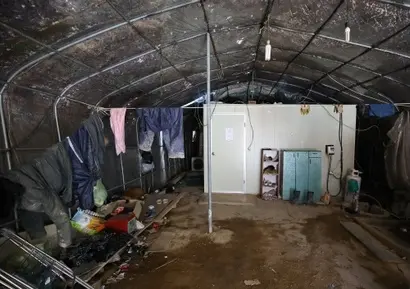
Civil society is calling for the public sector to manage the entire skilled foreign worker system. Unlike the Employment Permit System, which is managed by the Ministry of Employment and Labor under the Act on Foreign Workers' Employment, the skilled foreign worker system under the E-7 visa relies on private entities for recruitment and dispatch. Consequently, local agencies and brokers intervene in the process. It is known that migrant workers usually pay brokers between 15 million and 20 million won. Kim Hyun-joo said, "We see firsthand the fields where underground industries like brokers flourish. Migrant workers usually need to work for two years to pay off their debt, but when their contracts end after one year, many end up becoming undocumented migrants."
The only areas handled by the public sector are visa issuance and workplace change permits by the Ministry of Justice. Organizations related to migrant workers point out that because only the Ministry of Justice is involved in the system, the labor perspective is missing. Activist Jung Young-seop argued, "The Ministry of Justice does not listen to the issues raised by related organizations. At the very least, like the Employment Permit System, the Ministry of Employment and Labor should be the primary overseeing authority to manage the recruitment and dispatch process for migrant workers."