

[비즈한국] Woori Financial Group has announced plans to shift its business structure toward corporate finance. To this end, the group will invest 80 trillion won into "productive finance" and inclusive finance over the next five years. Productive finance refers to channeling financial resources into areas capable of economic growth, such as ventures, and is a key financial agenda of the Lee Jae-myung administration. As Woori Financial actively aligns itself with the new government's policy direction, it is also notable that Chairman Im Jong-yong is approaching the end of his term.
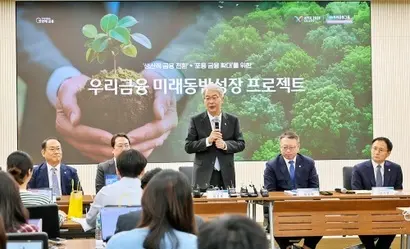
Woori Financial is injecting a large-scale capital into productive finance. On September 29, Chairman Im Jong-yong held a "Woori Financial Future Shared Growth Project CEO Joint Briefing" and announced that 73 trillion won would be invested in productive finance and 7 trillion won in inclusive finance by 2030.
The briefing was attended by the heads of seven subsidiaries—Jeong Jin-wan (Woori Bank), Nam Ki-cheon (Woori Investment & Securities), Kwak Hee-pil (ABL Life Insurance), Lee Seok-tae (Woori Financial Savings Bank), Choi Seung-jae (Woori Asset Management), Kim Chang-gyu (Woori Venture Partners), and Kang Shin-kook (Woori Private Equity Asset Management)—demonstrating the group-wide commitment to the initiative. Woori Bank will establish a new department dedicated to productive finance to act as a control tower.
The productive finance support plan consists of 17 trillion won in investments and 56 trillion won in loans. The investments are divided into 10 trillion won for the "National Growth Fund" and 7 trillion won in internal group investments. The National Growth Fund is a major policy promoted by the Lee Jae-myung administration, a large-scale investment fund created jointly by the government and the private sector to foster high-tech strategic industries such as AI, semiconductors, future vehicles, and bio-health. It also serves as the foundation for the productive finance emphasized by President Lee.
The National Growth Fund was originally 100 trillion won, but it was expanded to 150 trillion won at the National Report Conference on September 10. On that day, President Lee urged the financial sector to "transition from a business model centered on collateral-backed loans to productive finance." He further emphasized that private capital should flow into high-tech strategic industries and the venture ecosystem, rather than being concentrated on interest income or real estate investment. In effect, this put a direct brake on the financial sector's "interest-based profiteering."
Woori Financial's participation is the first move by the private sector following the expansion to 150 trillion won, with Woori Financial planning to invest 2 trillion won annually starting in 2026 for five years. Internal investments consist of group joint investment funds, venture capital investments, and productive finance funds. For the group joint investment fund, 1 trillion won raised by banks, securities, insurance, cards, and capital firms will be managed by asset managers to invest in high-tech strategic industries. Venture capital investments will target early-stage startups in these high-tech sectors, led by Woori Investment & Securities, while productive finance funds will focus on asset management affiliates.
The 56 trillion won in loans (corporate loans) aims to supply funds across the high-tech strategic industry ecosystem, including large corporations, SMEs, regional companies, venture firms, and national core industry exporters. Among these, the "K-Tech" program will connect large companies, mid-sized firms, SMEs, and ventures, with 19 trillion won in funding allocated over five years.
For inclusive finance, the focus is on supplying 7 trillion won in liquidity to expand lending for low-income households. The beneficiaries are expected to reach 550,000 in total, at 110,000 per year. The group will also provide interest rate reduction benefits to lower financial costs for those with low credit ratings and faithful repayers. Woori Financial has also allocated 100 billion won to support the "Bad Bank" program promoted by the Lee Jae-myung administration. A bad bank is a system that clears non-performing assets and debt to provide long-term debtors with a chance at rehabilitation. The Financial Services Commission and the Korea Asset Management Corporation (KAMCO) launched the bad bank under the name "New Leap Fund" on the 1st.
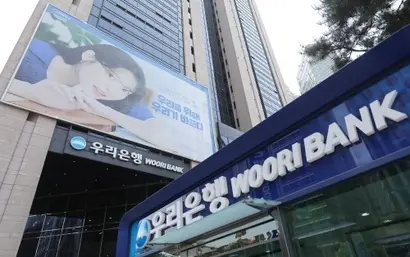
Through this project, Woori Financial plans to pivot its business structure away from household and mortgage loans toward corporate finance. The group has set a goal to increase the proportion of corporate loans from 50% to 60% and boost the corporate loan growth rate, which had been at 4%, to the 10% range over five years using the 56 trillion won in loans.
However, concerns about worsening financial soundness due to increased capital investment have been raised. The 17 trillion won in investment is double the amount invested over the past five years, and the funds for inclusive finance represent a roughly 40% increase (from 5 trillion won to 7 trillion won) compared to before.
In response, Woori Financial has proposed countermeasures such as asset rebalancing, upgrading the group's credit evaluation models, and monitoring for investment duplication across the same companies. The group also plans to enhance risk management using AI. It intends to first introduce AI agents in the corporate credit sector to be used for selecting support targets, verifying documents, and managing post-loan risks.
Woori Financial appears to be actively following the Lee Jae-myung administration's policy direction through this large-scale investment. The day Woori Financial announced the Future Shared Growth Project was the same day new Financial Services Commission Chairman Lee Bok-hyun held his first meeting with 20 bank presidents since taking office, where he encouraged the banks to transition to productive finance and participate in the funds.
It is also noteworthy that Chairman Im Jong-yong announced a long-term project aligned with government policy as his term nears its end. Typically, the appointments of financial holding company chairmen are influenced by changes in administration. There have been many cases where chairmen resigned from "self-reappointment" under pressure from financial authorities. Chairman Im Jong-yong himself took office in March 2023 following a reshuffle under the previous administration. While a reappointment after his three-year term was expected, the early change of government due to the martial law situation has made his reappointment uncertain.
Although he successfully completed the transition to a comprehensive financial group by acquiring securities and insurance firms during his tenure, the "negative factors" such as financial accidents and unfair loan incidents remain a point of contention. During the briefing, Chairman Im Jong-yong expressed his determination, stating, "Woori Financial Group, which has led the modernization and industrialization of Korea for 126 years, will push this project forward with a sense of duty and sincerity to contribute to the recovery and growth of the Korean economy."