

[비즈한국] At the 77th Armed Forces Day ceremony, the Ministry of National Defense unveiled seven types of ground robots and unmanned aerial vehicles (drones) for the first time. However, with the exception of small drones and robots, most were represented by mock-ups. Substituting actual equipment with models—typically seen at defense exhibitions—is a letdown that highlights how far the Ministry’s goal of a "new-concept, AI-powered military with manned-unmanned teaming" still has to go.
Unlike last year’s Armed Forces Day, which focused on a large-scale military parade in downtown Seoul, this year’s event was held at Gyeryongdae without a separate parade. This move is interpreted as a measure to avoid the significant criticism directed at last year's parade.
Nevertheless, seven new types of robots and drones were showcased to emphasize the current administration’s defense policy of "military application of manned-unmanned composite assets and AI." This can be interpreted as a venue to show off South Korea's military robot and drone capabilities, in line with President Lee Jae-myung’s pledge to address the declining military population and strengthen independent defense capabilities through AI, drones, and robotics.
Among them, three types of robots—an explosive ordnance disposal (EOD) robot, a collaborative autonomous reconnaissance robot, and a multi-robot cooperative autonomous system—focus on high-risk tasks where human casualties are likely, symbolically demonstrating how robot and AI technologies address personnel shortages. The EOD robot, like similar international products, can perform remote-controlled detection and disposal of explosives. Furthermore, by changing attachments, it can also be deployed for landmine detection, protecting lives in dangerous operations.
The collaborative autonomous reconnaissance robot, often called a "tunnel search robot," is equipped with multiple LiDAR sensors—commonly used in autonomous vehicles—to enter underground facilities or caves, navigate, and create precise maps. Since North Korea hides aircraft hangars, long-range artillery, and weapons of mass destruction in underground tunnels, this robot can be deployed ahead of humans to reduce casualties during tunnel search missions.
Unlike the other two non-combat robots, the multi-robot cooperative autonomous system is a type of combat robot equipped with a Remote Controlled Weapon Station (RCWS) capable of engaging in battle. One set consists of three robots, helping to ensure the survivability of combatants while enabling safe and swift search and reconnaissance operations.
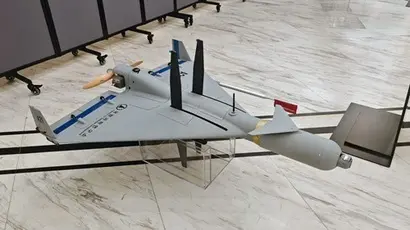
The issue lies with the four types of unmanned aerial vehicles that were promised to be unveiled for the first time. They all share the commonality of being developed under the leadership of the Agency for Defense Development (ADD) with the participation of Korean Air003490 in production. However, with the exception of two small drones, the others were all replaced with mock-ups, making it difficult to avoid criticism that it was an "all show, no substance" event.
First, the small UAVs displayed in their actual form at this Armed Forces Day exhibition were mainly two types. The small and medium-sized suicide drones can be considered "Korean Harpies" or "Korean Shaheds," capable of striking North Korean anti-aircraft radar and ground armored equipment from a distance. In fact, both models are single-engine propeller aircraft with delta wings and canards, similar in layout and composition to the Shahed drones Russia uses in its attacks on Ukraine.
However, the suicide drones from the ADD and Korean Air differ significantly in internal equipment and performance compared to the Shahed drones. They are designed for mass production by utilizing civilian technology to lower costs while maintaining optimal performance, and the nose section is modular, allowing for the replacement of warheads and seekers to engage various targets. To this end, the ADD and Korean Air have developed several test drones, ranging from the 21kg-class S1 to the S2 and S2AB. The small suicide drone revealed this time was developed under the designation V2A, and the medium-sized one as M1.
The small suicide drone is divided into reconnaissance and strike types; the reconnaissance drone infiltrates enemy lines to acquire a target, and the strike drone is then launched to complete the attack. The medium-sized suicide drone uses AI-based Automatic Target Recognition (ATR) and low-orbit satellite communication technology to autonomously identify and strike targets.
Another weapon unveiled by Korean Air is the Low-Observable Unmanned System (LOWUS), which had its rollout ceremony at the Korean Air Tech Center on February 25. It is a technical demonstrator intended to verify manned-unmanned teaming (MUM-T) combat technology, where it performs missions alongside manned fighters like the KF-21 or FA-50 light attack aircraft. It is equipped with a turbofan engine imported from Ukraine and is scheduled to demonstrate formation flight with a KA-1 tactical control aircraft by 2027.
Finally, the most anticipated equipment is the multi-purpose stealth UAV. Previously known as "Gao-ri X" or "KUS-FC," this UAV fully applies stealth technology and features AI-based autonomous mission execution capabilities to infiltrate enemy lines, such as in North Korea, to conduct reconnaissance and strike missions.
The problem is that because the LOWUS and the multi-purpose stealth UAV were represented by mock-ups, it does not align with the purpose of an Armed Forces Day event, which is to showcase South Korea’s military power and the latest weapons ready for field deployment. It is rare to see mock-ups instead of real hardware at a military parade, rather than a defense exhibition, unless development is incomplete. Usually, only training equipment without warheads—such as in the case of missiles—is considered an exception due to safety concerns.
Therefore, the inclusion of "mock-up UAVs" among the ground equipment at this year's Armed Forces Day leaves a bitter taste. While the limitations of the Gyeryongdae venue make it impossible to mobilize assets like medium-altitude UAVs, it is also true that our defense R&D is playing catch-up in the development of unmanned and drone assets. For example, in the case of the multi-purpose stealth UAV, a full-scale mock-up was produced, but development was reportedly suspended due to R&D budget cuts from the previous administration, only to be restarted after the new administration took office.
In his commemorative address at this year's Armed Forces Day, President Lee Jae-myung declared that he would transform our military into a "smart, elite force equipped with AI combat robots, autonomous drones, and ultra-precision, high-performance missiles." We hope for the restoration of the defense R&D budget cut by the previous administration and massive support for various manned-unmanned composite weapon systems that have not yet reached the system development stage.