

[비즈한국] The Ninth Planet is one of the hottest topics in solar system astronomy. Astronomers suspect that another massive gas giant, roughly the size of Neptune, is hidden at a very distant point beyond Neptune and Pluto. Recently, many astronomers have been hopeful that the Ninth Planet would soon be captured, especially with the Vera C. Rubin Observatory beginning its observations.
Even now, there are those who scour images of the night sky in search of the Ninth Planet. However, its existence has yet to be confirmed. Instead, smaller dwarf planets are being discovered. In March 2023, another new celestial body was found. While it isn’t the large Ninth Planet we’ve been looking for, it isn’t entirely unrelated either. Even the discovery of a single small rock like this can completely change the fate of the Ninth Planet.
The newly discovered object has been nicknamed "Ammonite." Because of Ammonite, the possibility of the Ninth Planet's existence is once again under significant doubt. Even if it does exist, it would likely have to follow a much larger orbit than originally expected. The more we look for the Ninth Planet, the more it feels like a mischievous entity fleeing into deeper darkness. Is it really hiding further away? Or does it even exist at all? Why does this newly discovered Ammonite pose such a major threat to the existence of the Ninth Planet?
Once you venture beyond Neptune's orbit, an entirely different world of celestial bodies unfolds. These objects do not particularly approach the Sun; they remain at great distances, following highly elongated elliptical orbits. They stray so far from Neptune's path that they are barely affected by its gravity throughout their journey. Instead, they are more likely to be influenced by other passing stars or the cumulative gravity of the Milky Way. Sedna, first discovered in 2003, is the representative of this type of object. Hence, these bodies that loop around the far edges, well beyond Neptune's orbit, are called "Sednoids." They are strictly different from Trans-Neptunian Objects (TNOs) that cross into Neptune's orbit.
The recently discovered Ammonite is also a Sednoid. It is the fourth Sednoid ever found. Astronomers have been conducting a massive hunt to find these primitive objects drifting at the edge of the solar system. The project, using the Subaru Telescope, is called "Formation of the Outer Solar System: an Icy Legacy," or "FOSSIL" for short. The name signifies the search for cosmic fossils that harbor the materials and memories from the moment of the solar system's birth. Thus, the object was given the nickname of a representative fossil: Ammonite. Its official designation is 2023 KQ14.
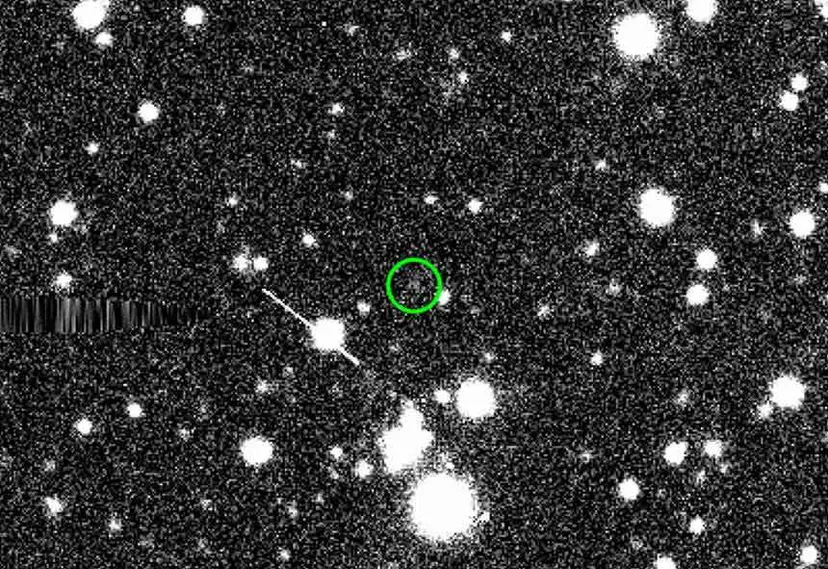
Ammonite was captured by the Subaru Telescope in March, May, and August of 2023. However, this alone was not enough to determine its precise orbit. Astronomers conducted follow-up observations in July 2024 using the Canada-France-Hawaii Telescope. They also scoured past observation records. After digging through 19 years of data, they found a chance capture of Ammonite from long ago. By analyzing these 19 years of observational data, they inferred its orbit. Ammonite has an average distance of over 250 AU from the Sun, and its perihelion—the point closest to the Sun—is 66 AU. Even at its closest, it is 66 times the distance between the Earth and the Sun.
In this way, objects roaming near the Sun from beyond Neptune are effectively unaffected by the gravity of objects inside the solar system. Consequently, it is assumed that they have maintained stable orbits without major changes for 4.5 billion years, ever since the solar system formed. But how could they maintain such highly elongated orbits from so far away? The unique orbits of Sednoids cannot be fully explained yet. Being only the fourth discovered, there is still a lack of data.
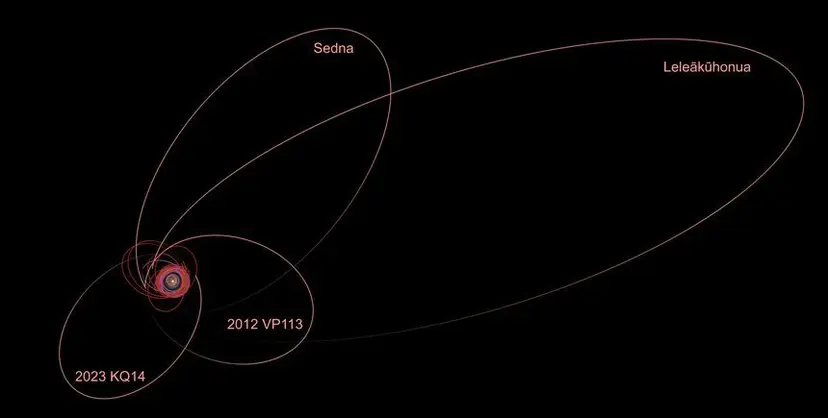
However, there are a few hypotheses. If a rogue planet or a star as heavy as the Sun had passed near the inner solar system long ago, the orbits of these outer objects could have shifted into the current Sednoid configurations. Alternatively, the Sun might have originally resided in a crowded star cluster; as it was pushed out of the cluster, the gravity of other nearby stars could have drastically altered the orbits of objects at the edge of the solar system. Another possibility is that a lighter star with its own small celestial bodies once existed near the Sun, and the Sun’s stronger gravity captured those bodies—what we now see as Sednoids.
And then there is the hypothesis that interests most people: the existence of the Ninth Planet, an unknown world whose gravity shaped these Sednoids.
In particular, the hypothesis that there might be a Ninth Planet stemmed from the orbits of TNOs that swing between the inside and outside of Neptune's orbit, following highly elongated paths.
Most of the TNOs discovered until recently had orbits skewed significantly in one direction. This is highly unnatural. Under normal circumstances, the orbits of celestial bodies circling the Sun should be randomly distributed in all directions. The fact that they are skewed suggests some dynamic mechanism is at work. Based on this, some astronomers hypothesized that a large gas giant must be hiding in the opposite direction to balance the skew of these TNO orbits.
When this hypothesis first emerged, it was cited as compelling evidence for the Ninth Planet. However, as more small objects at the edge of the solar system have been discovered, the possibility of the Ninth Planet has begun to waver.
Notably, another recently discovered TNO with an extreme orbit, 2017 OF201, directly contradicts the Ninth Planet hypothesis. This is because 2017 OF201 follows an orbit skewed in the exact opposite direction of the other TNOs. In fact, if the Ninth Planet existed, the conclusion is that 2017 OF201 could not have maintained its current orbit for long under that gravity.
The discovery of Ammonite tells a similar story. Astronomers conducted simulations reflecting the orbits of all four Sednoids discovered so far. In most cases, the result was that all Sednoids have maintained stable orbits for 4.5 billion years since the solar system's formation. Ammonite, in particular, is unique because it was found in a region where no other objects had previously been detected.
Small and large objects circling the Sun follow orbits of various sizes, but there is a notable absence of objects in specific orbital ranges. This region is called the semi-major axis gap or "q-gap," and Ammonite was discovered exactly in this empty space. Ammonite also follows an orbit distinctly different from other Sednoids.
Through simulations, astronomers confirmed the possibility that about 300 million years after the solar system formed (about 4.2 billion years ago), the four Sednoids might have passed near each other, causing their orbits to shift significantly. This is presumed to be the reason why their orbits are so distinct now. Furthermore, they tested the possibility of the Ninth Planet, which has so many fans. They found that if the Ninth Planet were to follow an orbit of the size previously expected, it would not be possible for Ammonite's orbit to have remained stable. If the Ninth Planet is indeed hiding somewhere, its orbit must be much larger than originally estimated to avoid significantly impacting the Sednoids.
As such, every new discovery at the edge of the solar system adds constraints rather than support for the Ninth Planet's existence. These results lead to doubts about the planet itself, or suggest that if it does exist, it must be in an even more distant orbit, pushing the search deeper into the elusive darkness. This deepens the dramatic divergence in the fate of both the Ninth Planet and the astronomers who wish to find it. One could follow the destiny of accepting that the Ninth Planet never existed and giving up early. Or, conversely, one could follow the path of clinging to the search, comforted by the idea that it is merely hiding in some deep, dark place that is even harder to reach.
I believe that the controversy surrounding the Ninth Planet will never truly end unless its existence is confirmed. Even if we search and find nothing, we may not be able to bring ourselves to accept that it is simply because the Ninth Planet does not exist. We are destined to continue observing until its existence is finally revealed. In the end, our fate is set: to eventually find it, or to search for it forever.
Reference
https://www.nature.com/articles/s41550-025-02595-7#Abs1
About the author, Ji Woong-bae: He loves cats and the universe. After watching "Galaxy Express 999" as a child, he dreamed of sharing the beauty of the cosmos. He is currently an assistant professor in the Faculty of Liberal Arts at Sejong University, engaged in various science communication activities including lectures and writing. He is the author of books such as "Everyday Pieces of the Universe," "Scientists of the Starry Universe," "Known but Unreachable," and "Strange Questions That Arise When Looking at the Universe," and has translated works including "The Hitchhiker's Guide to the Real Universe," "How I Killed Pluto," "Quantum Life," and "Cosmigraphics."