

[비즈한국] There is growing pressure within the pharmaceutical and biotech industry to remove botulinum toxin strains from the list of "National Core Technologies." Proponents argue this is necessary to expand exports of botulinum toxin products, a key driver of domestic pharmaceutical exports; however, some parties have expressed opposition.

Lee Jae-guk, Vice Chairman of the Korea Pharmaceutical and Bio-Pharma Manufacturers Association, stated at a forum held at the National Assembly on the 29th, titled ‘Measures to Improve the National Core Technology Protection System to Strengthen K-Bio’s Global Competitiveness,’ that “a bold decision to lift the National Core Technology designation is needed so that our companies, which have secured competitiveness in botulinum toxin products, can challenge themselves aggressively in the global market.”
He argued that while the industrial landscape has changed significantly since it was first designated as a National Core Technology in 2010, the continued classification has led to widespread complaints from the industry regarding operational difficulties. Botulinum toxin strains are currently held by over 30 institutions and companies in 15 countries worldwide, with commercialization and marketing occurring not only in the U.S. and Europe but also in developing nations like Russia, India, and Iran.
Vice Chairman Lee emphasized the need for a government decision to resolve the regulation. He claimed, “Since 2023, the Association has continuously petitioned the Ministry of Economy and Finance and the Ministry of Trade, Industry and Energy, and explained to the Korea Chamber of Commerce and Industry that this could act as a shackle on national wealth creation in the global market, but no improvements have been made.” He further argued, “While regulations may be necessary due to the needs of the era, if experts and the industry raise reasonable objections after 5 to 10 years, there must be a paradigm shift where the Industrial Technology Protection Committee itself must prove why the strain needs to remain a National Core Technology.”
According to a survey conducted by the Korea Citizens’ Education Association’s K-Bio Expert Advisory Committee between the 12th and 24th, 14 out of 18 domestic pharmaceutical companies (82.4%)—including Daewoong Pharmaceutical069620, Chong Kun Dang185750, Huons Biopharma243070, PharmaResearch Bio214450, and ATGC—voted in favor of lifting the designation. The primary reason is that overseas partners perceive the designation as an excessive regulation, hindering global expansion and exports. They also argue that since core manufacturing processes are already public and the strains are not difficult to acquire, it would be more effective to protect specific proprietary processes via patents rather than a blanket National Core Technology designation.
National Core Technologies refer to technologies with high scarcity and strategic importance that, if leaked overseas, could have a significant impact on national security, the economy, and public health. Currently, about 80 technologies across 13 fields—including semiconductors, displays, machinery, automotive/rail, metal, nuclear energy, space, and bio—are designated as National Core Technologies. Exporting products related to these technologies requires approval from the Minister of Trade, Industry and Energy. Companies holding such technologies must also undergo prior review by the Industrial Technology Protection Committee for joint ventures, foreign investment, or M&As.
Critics also point out that the designation delays global product launches, causing companies to miss opportunities to capture markets. Industry estimates suggest that the approval process takes an average of 74 days, and in some cases up to 12 months, resulting in annual losses of approximately 90 to 100 billion won.
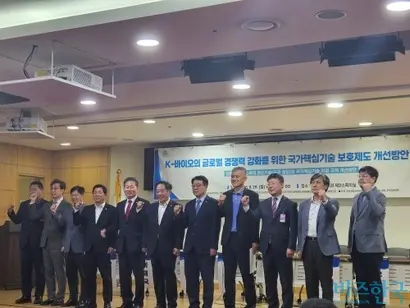
Lee Seung-hyun, a professor at Konkuk University School of Medicine’s Department of Microbiology, pointed out, “Rather than encouraging overseas exports, this is actively suppressing them. Botulinum toxin is a simple and easy technology that can hardly be called innovative, and even the ITC (U.S. International Trade Commission) did not recognize the trade secret status of botulinum toxin strains, deeming it unworthy of protection.” He added, “It is imposing unnecessary burdens, such as administrative compliance tasks, on smaller companies.”
Last year, exports of Daewoong Pharmaceutical’s botulinum toxin product, Nabota, reached 156 billion won, showing rapid growth with a 33% increase from the previous year. According to the Ministry of Food and Drug Safety, domestic exports of toxins and antitoxins—including botulinum toxin products—totaled $150.75 million (211.5 billion won) last year, ranking third among bio-pharmaceuticals after recombinant drugs ($2.8 billion) and plasma-derived products ($182.36 million). This highlights the pivotal role botulinum toxin plays in pharmaceutical exports.
On the other hand, some maintain that the designation should be kept. Three companies—Medytox086900, its subsidiary Numeco, and Hugel—cite the potential for overseas leakage of core technologies, national security, public safety, and the prevention of technological subordination to foreign firms and unfair competition as reasons to maintain the status quo.
An industry insider cautiously noted, “While there are few global players who developed their own botulinum toxin products, such as AbbVie, Ipsen, and Merz, nearly 20 companies in Korea have launched products; I believe this was only possible because the technology was strictly protected and managed as a National Core Technology.” They added, “Even if the strains are easy to find, only a very small fraction are viable for commercialization, so the technology remains highly valuable.” Park Jung-soo, a lawyer at Bae, Kim & Lee (BKL) representing Medytox, spoke at the end of the forum, stating, “It appears that companies currently involved in lawsuits over botulinum toxin strains and production technology are arguing that the designation is flawed to mitigate their own liability. I am concerned that such discussions might influence investigations and trials.”
The Ministry of Trade, Industry and Energy remains cautious about lifting the designation. Choi Kwang-joon, Director of the Bio-Convergence Industry Division who attended the forum, stated, “We plan to listen to the opinions of producers and experts in a balanced manner from the perspectives of national security and the national economy, and will review whether to maintain or lift the National Core Technology designation in accordance with the procedures and standards of the Industrial Technology Protection Act.”