

[비즈한국] Doosan Corporation000150 has officially renounced its status as a holding company. The Korea Fair Trade Commission (KFTC) recently approved Doosan’s application for “exclusion from holding company status,” with the decision applied retroactively as of June 30. With this move, Doosan is now exempt from holding company regulations, allowing it greater freedom in business expansion and investment.
Doosan Released from Holding Company Shackles
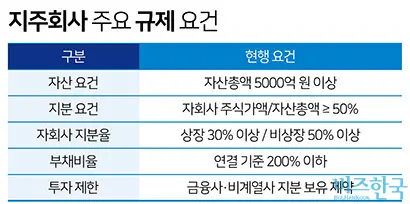
Under the current Fair Trade Act, a holding company must meet two primary criteria: a total asset value of at least 500 billion KRW, and a subsidiary shareholding ratio of 50% or more of total assets. Furthermore, holding companies are required to maintain a minimum stake of 30% in listed subsidiaries and 50% in unlisted ones, while keeping their debt-to-equity ratio below 200%. They are also restricted from holding stakes in financial firms or investing in non-affiliated companies.
However, in June, Doosan borrowed approximately 550 billion KRW using shares of its subsidiary, Doosan Robotics454910, as collateral, which caused its total assets to surge. As a result, the ratio of subsidiary share value dropped below 50%, causing it to fall out of the holding company requirements. Doosan immediately applied to the KFTC for exclusion, which the commission accepted.
Industry insiders interpret Doosan’s decision as a "break from regulation." Maintaining holding company status meant that various regulations—such as those on debt-to-equity ratios and mandatory shareholding thresholds—could have hindered business expansion. Through this decision, Doosan has secured a significantly wider range of options for fundraising and equity management.
In particular, Doosan is expanding investments in new growth areas such as robotics, energy, and construction machinery. Consequently, analysts suggest that by shedding these regulatory shackles, the company can accelerate aggressive M&A activity, corporate restructuring, and partnerships with external firms. Some in the securities industry also speculate that a new approach to the previously aborted merger between Doosan Bobcat241560 and Doosan Robotics could re-emerge.
A Strategic Choice: “Flexibility Over Regulation”
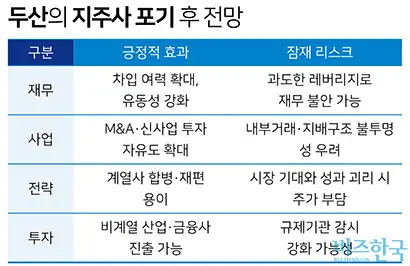
As the shackles of holding company status have been removed, Doosan faces both new opportunities and risks. Above all, the removal of debt-to-equity ratio restrictions enables more aggressive investment and capital management using leverage. However, excessive borrowing could lead to financial risks, making stronger internal controls inevitable.
There are also market concerns regarding the potential weakening of governance transparency. As subsidiary share transfers and internal transactions become more flexible outside the holding company structure, maintaining market trust will require an even higher level of compliance and shareholder-friendly policies.
Market attention is now focused on what move Doosan will make next. Various scenarios are being discussed, including strengthening synergies through subsidiary mergers and reorganization, expanding acquisitions and investments in new growth sectors, entering non-affiliated industries, and acquiring stakes in financial institutions. At the same time, experts point out that the company must simultaneously pursue shareholder return policies, such as dividend increases or share buybacks, and efforts to enhance governance transparency.
A business industry official remarked, “Doosan’s renunciation of its holding company status is not merely a structural change, but the starting point for a new growth strategy. The group’s stature will depend on how it directs future investments and manages its subsidiaries.”
All eyes are on what new growth engines Doosan will cultivate now that it has stepped outside the “regulatory fence.”