

[비즈한국] Last week, I visited Taiwan to attend the defense exhibition ‘Taipei Aerospace & Defense Technology Exhibition (TADTE) 2025’ and conducted interviews with local military experts. While I typically cover and analyze domestic security and defense industry issues, I decided to conduct this overseas report because I felt firsthand that Taiwan's military crisis and tension significantly impact South Korea's security and defense industry as well.
Indeed, after visiting the Taiwanese defense exhibition, it was clear that Taiwan's military experts and officials view the ‘2027 Chinese invasion of Taiwan theory’ as a tangible threat. TADTE 2025 focused heavily on defensive weapons designed to acquire new capabilities quickly, mass-produce and deploy them as soon as possible, and preemptively thwart enemy attacks.
For example, the Liebào (Leopard) D3 light tank, which means ‘Cheetah’ in Taiwanese, features a lower profile than existing wheeled armored vehicles, reducing the surface area exposed to enemy fire. Equipped with a 105mm tank gun featuring a new fire-control system, it is capable of firing on the move and is designed to counter Chinese armored vehicles and tanks landing in Taiwan.
Taiwan’s newly unveiled indigenous Qianggong (Strong Bow) anti-aircraft missile is another defensive weapon created to counter Chinese missile attacks, drawing focused attention from both Taiwanese and international media. The Qianggong missile is an improved version of the domestically developed Tien Kung (Sky Bow) 3 missile, comparable in level to South Korea's L-SAM anti-aircraft missile. With an interception altitude of about 70km, it forms a ‘multi-layered missile defense’ system alongside the Patriot and Tien Kung 3 systems already in operation. While the L-SAM incorporates numerous new technologies, putting it on par with the 'Korean THAAD,' the Qianggong missile is characterized by a development approach that saves time and cost, such as modifying the Tien Kung 3 rocket into a two-stage design, increasing the seeker size, and upgrading the detection radar antenna to an Active Electronically Scanned Array (AESA).
Furthermore, many new weapons appearing at the TADTE exhibition were the result of Taiwan-US joint efforts. Anduril, a US defense startup recently gaining attention alongside Palantir, did not have a dedicated exhibition booth but aggressively promoted its products by signing several MOUs with Taiwan’s National Chung-Shan Institute of Science and Technology (NCSIST) and displaying its products at the joint booth of the Taiwanese Ministry of National Defense and the NCSIST. It was agreed that Anduril’s Ghost-X unmanned helicopter and coastal surveillance system would be developed into ‘Taiwanese military versions.’ Anduril also announced that its Dive-LD unmanned underwater vehicle and Copperhead C-100 intelligent autonomous mine are being pursued for local production in Taiwan.
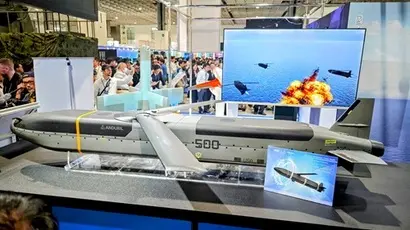
Additionally, Anduril and NCSIST agreed to jointly develop a Taiwanese version of Anduril’s latest product, the Barracuda-500M missile. This involves modifying the air-launched Barracuda missile into a ground-launched variant, allowing it to be fired from launchers disguised as civilian trucks. Through this, the Taiwanese military is expected to secure intelligent autonomous mines capable of precisely striking Chinese naval landing craft during wartime, as well as low-cost, autonomous flight cruise missiles capable of penetrating enemy air defense networks. Given that both are essential for neutralizing the landing fleet critical for a Chinese invasion and Chinese naval bases on the mainland, I received the impression that Taiwan is staking everything on its collaboration with the US defense firm Anduril.
From that perspective, the TADTE defense exhibition held in Taiwan served as a testament to the country's sincerity in preparing for the ‘2027 Chinese invasion theory.’ In the process of my reporting, Taiwanese military experts and officials, including a former minister, pointed out that the core issue is the hegemony between the US and China. They noted that unlike past crises where tensions arose from Chinese reactions to Taiwanese independence declarations, the situation has shifted to one where China is now openly declaring its intent for unification or issuing direct threats. Regardless of whether Xi Jinping and the Chinese Communist Party are truly preparing for a 2027 invasion, they argued that if Taiwan neglects to strengthen its defense capabilities despite the rumors of an invasion, it could inadvertently induce a Chinese miscalculation.
If so, can these war preparations by Taiwan actually deter China’s ambition to invade? As someone who reported from the ground in Taiwan, I expect that Taiwan’s strong will for resistance and its investments in defense technology will have a significant effect. First, no matter how advanced technology becomes, it seems unable to negate the tremendous impact that terrain and climate have on the outcome of war. Taiwan’s terrain has few sandy beaches; cliffs or mountains often meet the coast, leaving very few beaches suitable for landings. In particular, the capital, Taipei, is surrounded by mountains, meaning that by blocking just a few small rivers and mountain passes, all access routes to Taipei can be defended.
The climate is also not favorable to China. The northwestern coast of Taiwan, where there are almost no plains and mountains meet the sea, is not only rugged, but also experiences rapid wind speeds and sudden shifts in wind direction. The Taiwan Strait is heavily influenced by the monsoon climate and experiences over six typhoons annually, leaving only about four months in a year suitable for landing operations. Moreover, unlike the Ukraine-Russia war fought in plains, the use of drones and unmanned ground vehicles (UGVs) will be extremely difficult due to the rugged terrain and strong winds.
However, local Taiwanese military experts and officials expressed strong concern about how to overcome a potential ‘blockade strategy’ by China. They noted that if China chooses not to attack the Taiwanese mainland directly but instead uses its air and naval power to cut off Taiwan’s supply lines, Taiwan could wither due to energy and food crises, and it is difficult to be certain whether the US would fully rescue Taiwan through an all-out war.
As globalization has progressed since the 19th century, the nature of human warfare has evolved, with regional wars expanding into international conflicts or sparks of conflict emerging elsewhere once a regional dispute ends. Once the war in Ukraine concludes, tension and crises could return to Northeast Asia. We must watch carefully whether the conflict between Taiwan and China, and the ‘2027 Chinese invasion of Taiwan theory,’ will truly become reality.