

[비즈한국] It has been confirmed that the Korea Asset Management Corporation (KAMCO), which manages state-owned property, recently won a lawsuit filed against Yeonsu-gu, Incheon, seeking the cancellation of an order for a detailed soil investigation. After pollutants were discovered on a site near the former Songdo Resort, Yeonsu-gu ordered KAMCO, as the land manager, to conduct a detailed soil investigation. KAMCO countered, arguing that it merely acts as an agent assisting in the possession of the land for leasing purposes and holds no responsibility for soil contamination or cleanup.
The Incheon District Court’s 2nd Administrative Division (Presiding Judge Song Jong-seon) ruled in favor of the plaintiff on the 5th in a lawsuit filed by KAMCO against Yeonsu-gu, Incheon, to cancel the detailed soil investigation order. The court determined, "There is no perspective from which the plaintiff can be seen as having an obligation to conduct a detailed soil investigation on the land in question under the Soil Environment Conservation Act; therefore, the disposition in this case, which stands on a premise to the contrary, is unlawful."
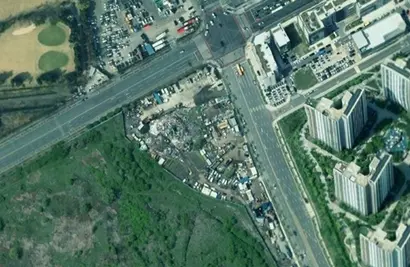
The land in question is a plot adjacent to the former Songdo Resort in Yeonsu-gu, Incheon. The government acquired this 1,957㎡ site in December 1983. KAMCO has managed the land since December 2005, having been entrusted by the Ministry of Economy and Finance with the administration and disposal of the property. A portion of the land (350㎡) was leased to a private party from July 2018 to June 2023. The tenant operated a scrap yard there and piled up waste.
However, after the lease contract ended, pollutants exceeding environmental standards were discovered on the site. In October 2023, Yeonsu-gu conducted a soil contamination survey, citing concerns that the site near the former Songdo Resort had been polluted by vehicle dismantling work and long-term waste storage. In November of the same year, an investigation by the Incheon Institute of Health and Environment found pollutants exceeding the standard limit by up to 28 times (Total Petroleum Hydrocarbons, TPH).
Yeonsu-gu ordered KAMCO to conduct a detailed soil investigation last August, on the grounds that the previous survey results exceeded the soil contamination concern thresholds. Yeonsu-gu determined that the land was contaminated by waste accumulated by the tenant, and argued that since the address of the tenant—the primary party responsible for cleanup—was unclear, KAMCO, as the land manager, should bear the cleanup responsibility.
In November last year, KAMCO filed a lawsuit seeking to cancel the order, arguing that it had no obligation to conduct the investigation. The position of KAMCO is that it holds no liability for soil contamination or cleanup. Under the Soil Environment Conservation Act, the responsibility for cleanup primarily lies with the party who caused the pollution. KAMCO argued that as an entity assisting in possession, it does not qualify as a party responsible for cleanup, and even if the contamination occurred during its management period, it would only be a secondary responsible party at most.
The court sided with KAMCO, ruling that Yeonsu-gu's order for a detailed soil investigation was unlawful. The court's reasoning is that even if the site was contaminated by the tenant's waste, the tenant is the primary party responsible for cleanup, and there is no legal basis to shift this responsibility to KAMCO, the secondary party. The court noted that documents for other ongoing lawsuits were successfully delivered to the tenant of the former Songdo Resort site, suggesting it is difficult to consider the primary responsible party as unreachable or unidentified.
The cause of the soil contamination was also deemed unclear. The area in question is land reclaimed from the sea, and circumstances were discovered suggesting that waste might have been used during the original reclamation process. Furthermore, the same pollutants were detected in adjacent areas not used by the tenant, and the TPH, which exceeded the standard limit by the largest margin, was analyzed to be unrelated to waste synthetic resins, the primary component of the tenant's waste. These circumstances make it difficult to conclude that the contamination of the former Songdo Resort site was caused by the tenant's waste.
The court stated, "The evidence submitted by Yeonsu-gu is insufficient to recognize that the land was contaminated by waste accumulated by the tenant. Conversely, it cannot be ruled out that the pollution occurred before the Republic of Korea acquired the land or before KAMCO was entrusted with the management and disposal of the site. There are no circumstances to suggest that KAMCO knew or could have known about the soil contamination, and it appears highly likely that KAMCO does not fall under the category of a party responsible for cleanup as defined by the Soil Environment Conservation Act."
The ruling was finalized on the 23rd as Yeonsu-gu did not appeal. A KAMCO official stated, "We filed the lawsuit to cancel the detailed soil investigation order because the primary responsibility for land contamination does not lie with our corporation. We understand that Yeonsu-gu did not appeal after our victory in the first trial." The official added, "We are currently considering the sale of the site in question. We are prioritizing plans to dispose of it to Yeonsu-gu, which has expressed interest in purchasing the land."