

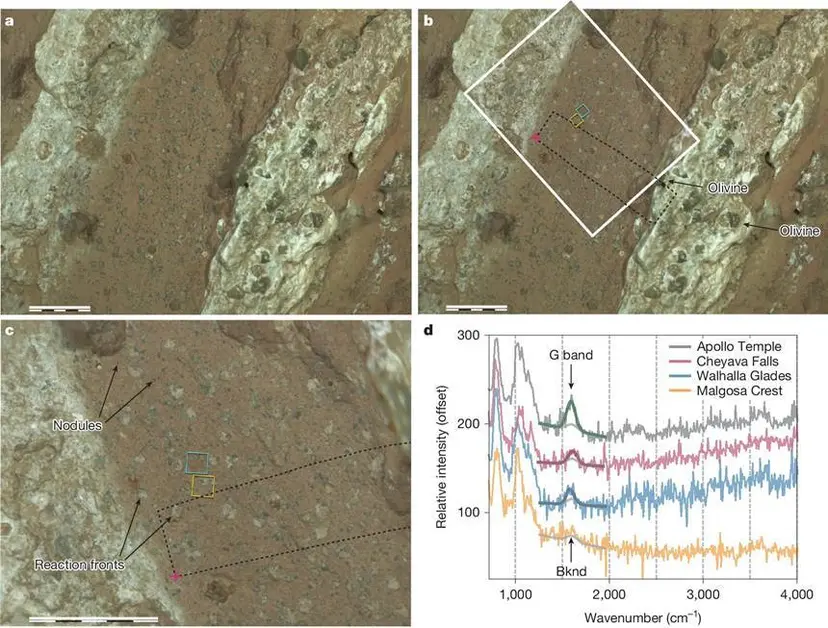
[비즈한국] Perseverance has been exploring a region in Mars' Jezero Crater that appears to have been formed by water overflowing the crater's rim. This area is called Neretva Vallis. A very intriguing rock was discovered here: a stone with a sharp, arrowhead-like appearance, named Cheyava Falls after a waterfall in the Grand Canyon.
Cheyava Falls possesses another interesting feature: round, black, millimeter-sized spots that resemble a leopard's patterns. These spots appear to be composed of olivine. Surprisingly, NASA scientists claim that they resemble early life fossils found on Earth, dating back about 3 billion years. This is the subject of the recent NASA press conference that has been making headlines. If these analysis results are accurate, they could be the most definitive evidence yet for life beyond Earth.
Since its initial discovery by Perseverance last summer, Cheyava Falls has become the most interesting stage on Mars. It raised hopes that traces of life might remain intact, and after a year of thorough investigation, a paper was published in Nature.
The title of the peer-reviewed paper is the somewhat toned-down "Organic Matter Synthesized by Redox Reactions in Jezero Crater, Mars." However, the title originally submitted by the authors was "Detection of Potential Biosignatures by the Perseverance Rover on Mars." One can infer that significant debate took place during the submission and peer-review process.
The most important mission of Perseverance is to systematically store Martian samples in capsules for a future Mars Sample Return mission. When it finds an interesting area, it extends its robotic arm and drills a hole. It then collects rock and soil samples inside small titanium alloy tubes, 15 cm long and 2.3 cm in diameter. Perseverance does not analyze the collected samples itself; instead, it simply collects them for a future rover. There are a total of 43 sample tubes. Out of these, 38 can hold actual Martian rock and soil samples. The others are "witness tubes" included as a control to determine if the capsules become contaminated later. The sample from Cheyava Falls was stored in the twenty-fifth tube.
Full-scale chemical analysis can only be performed long after the samples are safely returned to Earth. However, we cannot simply wait for the follow-up mission. We are utilizing the various analytical instruments on board Perseverance as much as possible on-site on Mars. At the end of the robotic arm, there is the Wide-Angle Topographic Sensor for Operations and eNgineering (WATSON), and the Scanning Habitable Environments with Raman & Luminescence for Organics & Chemicals (SHERLOC), which searches for organic and chemical components on Mars. Fittingly, they are the "Watson and Sherlock" detective duo searching for signs of life on Mars. Unfortunately, the focus mechanism for SHERLOC broke in 2024, so now it requires delicate maneuvering of the robotic arm to achieve focus. Consequently, taking clear pictures is no easy task.
Meanwhile, SHERLOC detects scattered photons by shining high-energy ultraviolet light onto the terrain to identify the chemical molecules that compose it. Interestingly, the graphs show a strong signal in the G-band in every detection. This hints at the presence of carbon compounds; perhaps there are carbon-based molecules, the fundamental ingredients of organic life on Earth. It suggests the presence of a type of multi-carbon bond molecule consisting of several carbon atoms gathered together. If life had lived here in the past, these are components that could certainly be detected.
Perseverance has another powerful instrument called PIXL, which fires X-rays to scan the distribution of inherent chemical components on the rock surface, much like a photograph. The colorful, pixelated map in the previous image is the elemental distribution map observed by PIXL. As the name suggests, it draws the map pixel by pixel. Interestingly, the major chemical composition changes significantly from the outside to the inside of the leopard-like spots. According to PIXL's exploration results, the leopard spot areas are particularly rich in iron and phosphorus.
On Earth, iron is closely associated with biological activity. In addition to hemoglobin, iron-based proteins have been used since the very beginning of life. In the leopard spots, minerals such as iron phosphate, vivianite, and greigite—which consists of iron and sulfur—are commonly found. On Earth, these minerals are frequently discovered at sites where microorganisms decompose organic matter. Furthermore, the phosphorus also found there is an essential component that is absolutely indispensable for the metabolic activities of Earth's life forms, including DNA, RNA, and phospholipids.
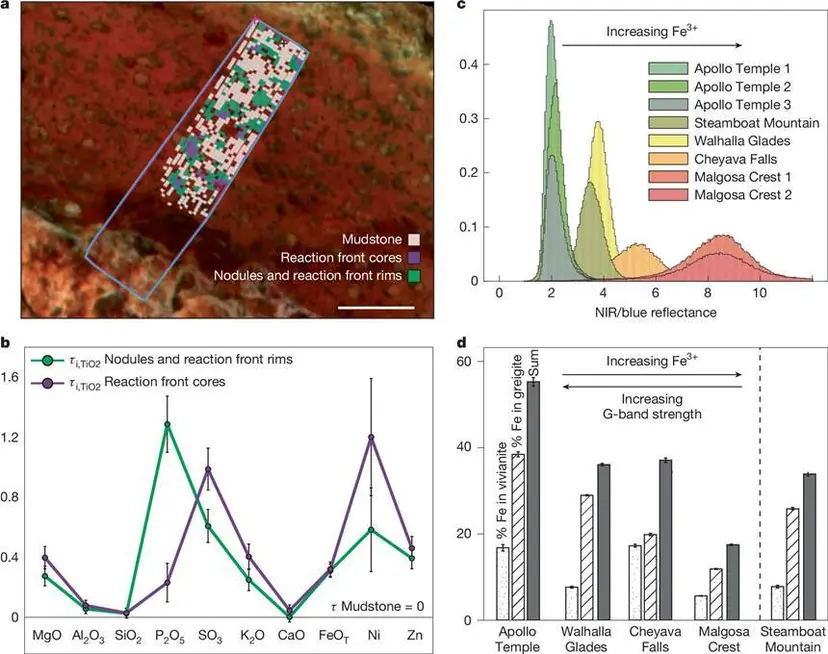
What is particularly interesting is that the G-band signal becomes stronger in areas with less iron ions, while it becomes weaker in areas with more iron ions. Simply put, more iron means less carbon, and less iron means more carbon. This looks as if carbon-based molecules are reducing the iron. It is exactly similar to biological activity on Earth. When organic matter loses electrons and oxidizes, surrounding materials are reduced. The fact that an increase in carbon shows traces of more reduced iron can be interpreted as evidence that carbon-based life forms once lived here, and their life activities caused a large-scale reduction of iron in the area.
In other words, the most positive interpretation of these analysis results is that they could be the traces left behind by microorganisms that once lived on Mars after they finished their "meal." Of course, even without biological activity, it is entirely possible that a mixture of organic matter containing carbon, oxygen, nitrogen, etc., exists. However, the fact that minerals containing organic matter were discovered all gathered together in one spot makes this location even more intriguing. It raises stronger suspicions that some kind of biological activity took place exactly at this site.
For this reason, the authors wanted to publish the paper with the bold title "Detection of Potential Biosignatures," but the reviewer seemed to think that was going too far. To claim that it is a sign of life, one must rule out all other possibilities and prove that it could not be explained by anything other than biological activity.
However, the possibility remains that it is not necessarily because of fossilized life traces. Iron components in minerals can change through non-biological ways under high-temperature and high-pressure environments. In the end, the authors have to prove that even such possibilities are remote. No traces of past volcanic activity were found in the Cheyava Falls area surveyed this time. Therefore, these rocks were never subjected to high-temperature and high-pressure environments. Based on this, the authors argued that this makes it even more suspicious as a sign of biological activity.
As the debate continued, a very long wait was required before the paper could be published. Eventually, during the peer-review process, the reviewers requested to change the title from "Biosignature Detection" to the more objective "Redox Signal," and the paper was finally released to the world with its current title. The controversy has not yet been clearly resolved. To determine whether the organic traces discovered at Cheyava Falls and the surprising correlation between carbon and iron are truly signs of biological activity, we ultimately need to bring the samples safely to Earth for analysis.
The samples collected by Perseverance will be analyzed not on Mars, but on Earth. In 2030, a follow-up mission will land next to Perseverance, receive the collected sample tubes, and launch a small ballistic missile-style rocket from the Martian surface. More than a year later, a capsule containing the precious sample tubes collected from Mars will pierce the Earth's atmosphere and re-enter. Astronomers on Earth will directly analyze the Martian samples contained inside the capsule. Although humans have not yet set foot on Mars, it will be at least a moment when human hands touch Martian soil.
Our understanding of the Moon developed most dramatically thanks to the astronauts bringing rocks directly from the Moon through the Apollo missions. Because we were able to closely examine what minerals were inside lunar rocks, we could draw a clear picture of the secrets behind the births of the Moon and the Earth. Likewise, if we bring samples directly from Mars to Earth, our understanding of Mars will change completely.
Currently, the mission is facing somewhat human and realistic difficulties. The original total budget for the mission was $5 billion, but over time, it has ballooned to $11 billion. NASA also felt a great burden and has tentatively postponed the mission until a detailed plan that can be carried out within the original budget is established. Furthermore, with NASA's overall 2026 budget in danger of being cut significantly, the future of the Mars Sample Return mission has become even bleaker. With US space exploration missions slowing down, there is no small chance that China could take the lead. Of course, since the "advance team" Perseverance is already on Mars, it seems unlikely that the mission will be abandoned entirely, if only for the sake of opportunity cost. I certainly hope that is the case.
The rover's name, "Perseverance," means patience. True to its name, Perseverance is calmly waiting for the follow-up team to arrive. I just hope the Mars Sample Return mission proceeds as planned and that the precious fragments of Mars are safely delivered via "rocket shipping." Whether it contains hopeful news for those who dream of terraforming Mars or whether another despair awaits, we need a little more patience before we know the answer.
Reference
https://www.nature.com/articles/s41586-025-09413-0
Who is the author, Ung-bae Ji? He loves cats and the universe. After watching "Galaxy Express 999" as a child, he developed a dream of sharing the beauty of the universe. He is currently an assistant professor in the Faculty of Interdisciplinary Studies at Sejong University, participating in various science communication activities such as lectures and writing. He has authored books including "Every Day a Piece of the Universe," "Scientists in the Starry Universe," "Cannot Go But Can Know," and "Strange Questions That Come to Mind When Looking at the Universe," and translated books such as "The Hitchhiker's Guide to the Real Universe," "How I Killed Pluto," "Quantum Life," and "Cosmigraphics."