

[비즈한국] Efforts to utilize AI for responding to disasters, such as recurring large-scale wildfires and extreme heavy rainfall, are spreading to local governments nationwide. Jecheon, North Chungcheong Province, has established a response system that uses AI-based flood detectors to preemptively detect emergencies in underground roadways and flooded areas. This method combines video analysis and AI algorithms with real-time water level data from underground roadways to reduce errors and block vehicle entry during emergencies.
The national industrial complex in the "Industrial Capital" of Ulsan is managed 24/7 through an AI-based real-time monitoring system. This follows the recent construction of an integrated control system that links information on surface structures with underground buried assets. It is expected to significantly increase the efficiency of safety management, ranging from monitoring underground pipes to detecting hazardous material contamination, odors, fires, and explosions.
How will public officials work in the AI era? The government, which has adopted an "AI Democratic Government" as a national task, has embarked on research to prepare for a major transition in government organization and administrative methods in line with the spread of AI and big data. It plans to analyze the impact of AI technology adoption on the administrative environment and seek ways to optimize organizational functions and personnel management to meet future demands.

"AI-Based Government Innovation" as a National Task: Streamlining of Organization and Personnel to Follow
According to BizHankook's comprehensive coverage on the 23rd, the Organization Bureau of the Ministry of the Interior and Safety (MOIS) recently commissioned policy research to conduct an in-depth analysis of the direction of changes in organizational and administrative tasks resulting from the introduction of cutting-edge technologies like AI. Through this research, the ministry is expected to predict how government workflows will change following the adoption of AI and formulate strategies for operational efficiency in government organizations, combined with trends in organizational redesign in major countries.
In its request for proposals, the Ministry of the Interior and Safety stated the background of the study: "As the administrative environment is changing rapidly due to the reorganization of the economy and industrial structure following the development of intelligent technologies like AI, research into measures to streamline government functions and organizations to strategically respond to this is necessary." A ministry official stated, "The research is in the basic investigation stage, and the direction for future utilization has not yet been finalized."
This study serves as a preliminary step toward drafting a blueprint for a smarter and more efficient government organization. Through the study, the ministry intends to examine the impact of technological environmental changes on the redesign and operation of our government organizational system, as well as the policy implications. According to the research plan, it must present strategies on how to operate and manage government organizations in line with predicted changes in tasks and administrative demands from citizens.
In particular, the task of identifying areas where public administrative services can be streamlined was explicitly mentioned in the request for proposals. The intent is to go beyond simple ideas and identify specific fields where AI can be applied—"where and how"—to government functions, institutions, personnel, and administrative services.
Such changes are clearly visible in the recent reorganization trends of government agencies and local governments. On the 23rd, the Korea Customs Service completely revamped its existing IT organization to innovate customs administration. To respond to changes in the internal and external technological trade environment, it established an "AI Innovation Team" as the AI supervisory department and a "Data Officer" as the organization dedicated to data, while strengthening the "Information Planning Officer" and "R&D Equipment Team" to internalize customs operations. A "High-Tech Project Management Team" will also operate under the Information Planning Officer to proactively manage various technical risks, including AI.
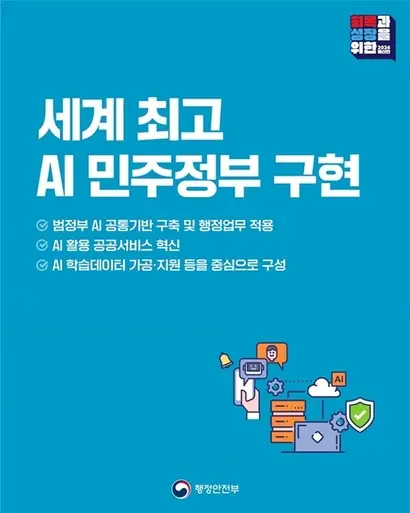
860 Billion Won Budget for Next Year: The Blueprint for an "AI Democratic Government"
This policy research is particularly significant as it is being conducted while the government is pursuing an AI Democratic Government as a national task.
The AI Democratic Government mentioned by Minister of the Interior and Safety Yoon Ho-jung in his inaugural address last July is distinct from the existing "E-Government" (electronification of government tasks and institutional cooperation using IT) and "Digital Government" (processing administrative tasks online). According to data distributed by the Planning and Finance Officer, an AI Democratic Government can be defined as a digital-based government system where data and AI technology are widely introduced into administrative tasks and services, realizing efficiency and transparency in government operations and innovation in services felt by the public.
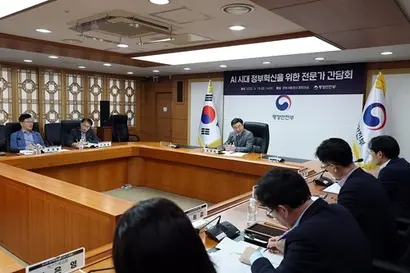
With the AI Democratic Government included in the 123 national tasks finalized on the 16th, related investments and policy support are expected to gain momentum. During a meeting with relevant experts on the 19th, Minister Yoon emphasized, "The AI Democratic Government is a national task of the Lee Jae-myung administration and a future blueprint for the Ministry of the Interior and Safety." He added, "We will not just simply graft AI technology onto things, but bring about fundamental innovation in the way the government works, and we will deliberate and prepare so that these changes can be felt firsthand."
In the 2026 budget for the Ministry of the Interior and Safety, 864.9 billion won has been allocated for the AI Democratic Government and informatization sector. The ministry's plan is to build a pan-government AI common foundation to streamline administrative tasks and to provide full-stage support—"planning-development-operation-upgrading"—for AI services so that the central government and local governments can quickly apply AI without overlapping investments. It remains to be seen whether this research will serve as a rudder, as it is a process of reasonably identifying standards and priorities for policy introduction and reorganization based on domestic conditions and overseas cases.
While the use of AI is expanding, centered on public services such as disaster response or civil complaint management by local governments, some view that there are limits to AI-led administration in high-level administrative functions. Lee Young-beom, a professor of public administration at Konkuk University, said, "While AI systems can quickly replace administrative areas with strong repetitive characteristics, such as execution tasks, it will be difficult to replace roles that require coordinating various interests and reaching consensus, such as coordination or public-private negotiations."