

[비즈한국] Advisor Jang Hyung-jin of Young Poong 000670 and Chairman Choi Yun-beom of Korea Zinc 010130 have recently escalated the level of mutual defamation. Advisor Jang and Chairman Choi have been locked in a dispute over the management rights of Korea Zinc since last year. Amidst this, Korea Zinc introduced a cumulative voting system for its general shareholders' meetings starting this year. The introduction of cumulative voting is seen as increasing the influence of minority shareholders. The intensified mudslinging between Advisor Jang and Chairman Choi is interpreted as an attempt to sway the opinions of these minority shareholders.
Young Poong, led by Advisor Jang Hyung-jin, joined forces with MBK Partners to purchase shares in Korea Zinc. Currently, the Young Poong-MBK alliance holds more shares in Korea Zinc than Chairman Choi Yun-beom's side. However, Chairman Choi successfully defended his management rights earlier this year by forming a circular shareholding structure that restricted Young Poong's voting rights (Related article: Chairman Choi Yun-beom Succeeds in Defending Korea Zinc Management Rights... Young Poong and MBK Get a 'Bitter Taste').
Article 369 of the Commercial Act states, "In cases where a company, its parent company, and its subsidiary, or a subsidiary hold more than 10% of the shares of another company, the shares of the company or parent company held by that other company do not have voting rights." This means that voting rights cannot be exercised within a circular shareholding structure.
Subsequently, in March of this year, Young Poong sold a 25.42% stake in Korea Zinc to YPC, a limited liability company. Young Poong holds a 100% stake in YPC. The restriction on voting rights for circular shareholdings applies only to joint-stock corporations (kabushiki-gaisha). Since YPC is a limited liability company (yuhan-hoesa), Young Poong was able to regain the ability to exercise voting rights in Korea Zinc through YPC.
For this reason, many predict a victory for the Young Poong-MBK alliance at next year's shareholders' meeting. Korea Zinc currently has 19 directors, but 4 of them are suspended from duty. Of the 15 directors excluding the 4 suspended, 11 are supporters of Chairman Choi Yun-beom, and the remaining 4 are from the Young Poong-MBK side. Furthermore, 6 of the 15 directors will see their terms expire next March. Of these 6, 5 are directors who support Chairman Choi, and the remaining 1 is Advisor Jang Hyung-jin himself.
However, even if the Young Poong-MBK alliance wins at next year's shareholders' meeting, Chairman Choi Yun-beom is expected to retain control of Korea Zinc for the time being. This is because even if all 6 positions are filled by nominees from the Young Poong-MBK alliance, directors supporting Chairman Choi will still hold a majority on the board. In essence, the Young Poong-MBK alliance’s takeover of Korea Zinc's management would only be possible in 2027.
Of course, the fate of management in 2027 cannot be guaranteed either. This is due to the variable of the cumulative voting system. Korea Zinc introduced cumulative voting in January of this year. Cumulative voting is a system that grants shareholders as many votes as the number of directors being elected. For example, if 5 director candidates are running, each share gets 5 votes. A single shareholder can choose to concentrate all 5 votes on one candidate.
The application of cumulative voting inevitably increases the influence of minority shareholders. Perhaps because of this, Korea Zinc and Young Poong have recently been focusing heavily on a war of public opinion. On September 15, Young Poong publicly criticized, saying, "The management style shown by Chairman Choi Yun-beom is a textbook example of poor corporate governance and a total degradation of shareholder value," adding, "We will exercise our shareholder rights fairly according to the principles of law and the market until Korea Zinc's governance is corrected."
In response, Korea Zinc retorted, "Since joining forces with the predatory private equity firm MBK to attempt a surprise hostile M&A, Young Poong has been obsessed only with irrational attacks that undermine Korea Zinc's competitiveness and corporate value," and added, "Young Poong is holding hands with MBK, which is embroiled in all sorts of social controversies and the stigma of 'hit-and-run' capital, while calling for superficial governance improvements, all while violating the principle of independent management between the two companies and launching surprise attacks."
Chairman Choi Yun-beom's performance this year is not bad. Korea Zinc's revenue increased by 40.94% from 5.4335 trillion won in the first half of last year to 7.6582 trillion won in the first half of this year, and operating profit grew by 16.93% from 453.2 billion won to 530 billion won during the same period. Chairman Choi is also showing a presence outside of management, such as accompanying President Lee Jae-myung on an economic mission to the United States.
Lee Tae-hwan, a researcher at Daishin Securities, evaluated Korea Zinc, saying, "By diversifying its business portfolio beyond the limits of the traditional smelting business into rare metals, copper, and nickel, it is securing a competitive edge in the process of global supply chain restructuring," and added, "While there is a high focus on non-operating issues, the company is proving the excellence of its business structure by recording solid performance even in a stagnant smelting market."

On the other hand, Young Poong has recorded relatively poor performance. Its revenue decreased by 21.54% from 1.4935 trillion won in the first half of last year to 1.1717 trillion won in the first half of this year. Furthermore, it continues to post deficits, recording an operating loss of 160.7 billion won last year and an additional 150.4 billion won in the first half of this year. From the perspective of minority shareholders, there is no reason not to support Chairman Choi Yun-beom, who has strong performance results.
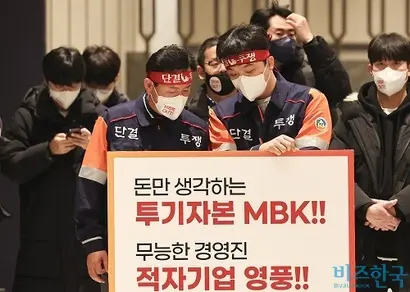
Public sentiment toward MBK is also unfavorable. MBK is being criticized for not fulfilling its responsibilities as the largest shareholder of Homeplus. Homeplus is currently undergoing corporate rehabilitation procedures. There are loud voices of criticism against MBK not only from within Homeplus employees but also from political circles and civic groups. Financial Services Commission Chairman Lee Bok-hyun stated during his confirmation hearing on September 2 that they would "investigate MBK thoroughly with the Financial Supervisory Service." Even in this situation, MBK Chairman Kim Byung-ju drew criticism for appearing to focus on personal matters, such as encouraging scholarship students of the MBK Scholarship Foundation without mentioning anything about Homeplus (Related article: Silent to Homeplus employees... MBK Chairman Kim Byung-ju draws backlash for random student encouragement).
Although the Young Poong-MBK alliance is ahead in shareholdings, they can only realistically aim for Korea Zinc's management rights after 2027. In the meantime, Chairman Choi Yun-beom is also expected to focus on preparing countermeasures. This is why the business world predicts a long-term continuation of the Korea Zinc management dispute.