

[비즈한국] The reason Seoul’s map has become as diverse in color as it is today is due to the massive event of Gangnam development. However, before the name "Gangnam" emerged in earnest as the center leading Seoul’s economy and culture, there was already a region south of the Han River that served as the catalyst for industrialization. That place is Yeongdeungpo.
Memories of an Industrial Zone and the Heart of Seoul's Southwest
In the 1930s, during the Japanese colonial period, Yeongdeungpo was designated as the Gyeongseong Industrial District. It grew into "Seoul’s factory zone," packed with textile, flour milling, and food processing plants. Its inherent logistical advantages—water transport via the Han River and the Gyeongin Railway line—encouraged the concentration of industries. During the 1960s and 70s, following liberation and the war, it was known as the heart of South Korea’s manufacturing industry.
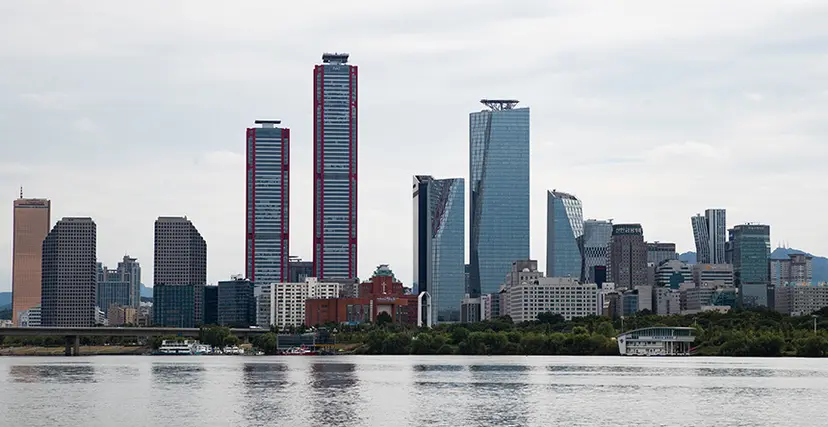
In those days, Yeongdeungpo was a symbol of economic growth and the foundation supporting the lives of ordinary people. The area around Yeongdeungpo Market was bustling day and night with merchants from all over the country, while various factories for printing, flour milling, and metal processing belched out smoke and noise. People used to describe the vitality of this place by saying, "The smoke from the chimneys of Yeongdeungpo's factories lights up Seoul's tomorrow."
However, as the industrial structure rapidly advanced in the 1980s and 90s, these chimneys slowly went cold. Factories relocated to new industrial zones in Incheon and Gyeonggi, and the remaining semi-industrial areas were left with scattered, aging warehouses and small-scale workshops. While its glorious days as an industrial city had passed, the peculiar landscape of having remnants of an industrial zone in the middle of the city became part of daily life in Yeongdeungpo.
During this period, Yeongdeungpo’s residential environment was inevitably left neglected, entangled with the old factory sites. Even with the financial hub of Yeouido right next door, there was a stark gap between residential and industrial areas, separated by the Han River. Compared to the high-end residential areas of Gangnam or the cultural revival of Mapo and Seongsu, Yeongdeungpo was a place where the glory of the past and the neglect of the present coexisted.
This, in turn, was also a potential for new change. As space in Seoul became limited and the old city center went through cycles of redevelopment, Yeongdeungpo’s potential value began to stand out more and more as time passed.
Present-day Yeongdeungpo: A Crossroads of Complex Development and Residential Regeneration
Walking through Yeongdeungpo today, one encounters a landscape quite different from the image of the past factory zone. The most prominent area is, by far, Yeouido. With the National Assembly building at its center, it houses the Financial Supervisory Service, major brokerage and asset management firms, the Hanwha000880 63 Building, and high-rise business and commercial facilities like the IFC and Parc.1. It has already grown beyond the title of "Korea’s No. 1 Financial District" into an international financial hub attracting global capital. Standing shoulder-to-shoulder with Gangnam's Teheran-ro with its densely intertwined residential and business sectors, Yeouido possesses a unique position accessible from all directions in Seoul.
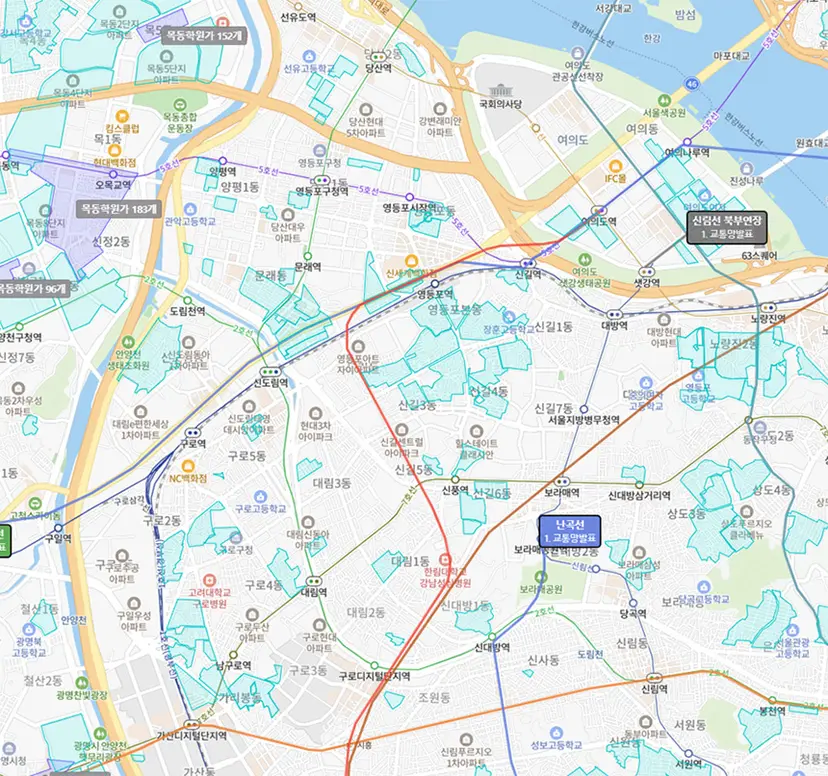
Yeouido's residential market also harbors long-term upward pressure. Large-scale apartment complexes that are over 30 to 40 years old have reached their reconstruction age, and one by one, they are pursuing remodeling or reconstruction. Much like Mok-dong and Banpo, the scarcity value of these large complexes acts as a powerful attraction. Even if regulatory blades reach it, the residential demand for Yeouido will not easily fade until the uncertainty of supply is resolved.
The atmosphere changes again just one stop away from Yeouido. Dangsan-dong is a "double station area" where Lines 2 and 9 intersect, and it is traversed by the Olympic-daero and Seobu Arterial Road. Often called the hub of transportation in Seoul's southwest, it was once considered merely a distribution and commercial center, but the dense area of aging multi-unit and multi-household housing is transforming into a high-end residential area, catching the breeze of redevelopment and reconstruction. In particular, large-scale redevelopment projects around Dangsan Station are attracting investor attention, being referred to as the "second Seongsu-dong." The case of price appreciation demonstrated by the Seongsu Strategic Redevelopment Zone is a valid reference for Dangsan as well.
The transformation of Yangpyeong-dong and Mullae-dong is even more dramatic. Once lined with iron, machinery, and printing factories, the area has rapidly changed into a cultural and artistic district since the 2000s. Mullae Creative Village has gained the nickname "Brooklyn of Seoul" as cafes, galleries, and design studios have moved in. Complex development is also picking up speed in the Yangpyeong-dong area. Once the creation of residential/commercial complexes through the lifting of semi-industrial area designations becomes concrete, the potential for value increase is immense, as it is land with rare large-scale development room within the city center.
Underlying all these changes is "transportation network innovation." With the addition of the GTX-B line, the Shinansan line, and light rail connection plans to the existing Lines 2 and 9, accessibility to the rest of Seoul and the metropolitan area is being strengthened to a degree incomparable to the past. This innovation in transportation networks leads to an expansion of residential demand, which in turn creates a virtuous cycle that once again accelerates the pace of redevelopment and reconstruction.
A Glance Toward the Future: Yeongdeungpo, the Next Protagonist of Seoul Real Estate
The reason Yeongdeungpo is receiving attention is not just about price increases. It is because of its symbolism as the "next growth axis" created by the spatial limitations of Seoul and the policy and economic environment surrounding the real estate market.
First, there is the balloon effect. As core areas of Seoul such as the three districts of Gangnam, Yongsan, Mapo, and Seongdong are tied up as regulated areas, investment demand is naturally moving toward Yeongdeungpo, which had received relatively less attention. Regulatory pressure quiets the market in the short term, but in the medium to long term, it results in dispersing demand to the surroundings. Yeongdeungpo is the beneficiary of this.
Second, the acceleration of maintenance projects. Redevelopment and reconstruction are urban regeneration projects that go beyond simply replacing old houses with new ones; they reshape local living infrastructure and change the demographic structure. In particular, the lifting of semi-industrial area designations and complex development are considered almost the only opportunities to supply rare, large-scale residential and commercial spaces in Seoul’s city center.
Third, the re-evaluation of the "Han River Belt" value. Development along the Han River, connecting Yeouido, Dangsan, Yanghwa, and Hapjeong, is already absorbing demand for high-end housing in Seoul. While the Han River area north of the river has been reorganized into Mapo, Seongsu, and Yongsan, the Han River area south of the river is represented by Banpo, Jamwon, and Apgujeong. Yeongdeungpo has sufficient conditions to emerge as a new premium residential area connecting these two axes.
The points investors should focus on are clear. Yeouido's reconstruction complexes will lead the rise in value of core existing apartment inventory in Seoul in the long term. Redevelopment in Dangsan and Yangpyeong is highly likely to result in new supplies of medium-to-large apartments and high-end residential complexes through the lifting of semi-industrial designations and complex development. The Mullae Creative Village area is a lifestyle complex combining cultural, artistic, and commercial functions, and it is highly likely that both commercial and residential values will rise simultaneously due to the diversification of the demand base.
Of course, the risks are clear. Sharp price increases may be followed by strong regulatory area designations, and delays in permits or conflicts between associations may occur during the redevelopment and reconstruction process. Also, fluctuations in the global economy and interest rates will increase funding costs, putting pressure on investment returns. However, such volatility is also a stage that tests the endurance of long-term investors.
Seoul’s real estate market is always cyclical. Just as the sparks that started in Gangnam moved to Mapo, Seongsu, and Yongsan, the wave of investment demand is once again looking for a new shore. That shore is Yeongdeungpo. Having evolved from the heart of industrialization in the past to a complex city with the tripartite merits of finance, culture, and residence today, it is highly likely to be the "last piece" of the Seoul real estate map.
"The heart of Seoul's southwest is beating again. The industrial zone of the past is becoming the prime city of tomorrow."
This sentence is not mere rhetoric. The future of Yeongdeungpo has already begun. For those who read the changes, this city will not be just an investment target, but a barometer for predicting the future of Seoul.
Kim Hak-ryeol, head of the SmartTube Real Estate Research Institute and famously known by his pen name "Pashong," previously served as the head of the Real Estate Research Division at Gallup Korea. He operates and hosts the Naver blog "Pashong's World Exploration" and the YouTube channel "StuTV." His books include "The Power of Gyeonggi Real Estate (2024)," "Absolute Principles of Seoul Real Estate (2023)," "The Future of Incheon Real Estate (2022)," "Kim Hak-ryeol’s Absolute Principles of Real Estate Investment (2022)," "Future Map of Korea’s Real Estate (2021)," "From Now On, Only Places That Rise, Rise (2020)," and "User Manual for Korea’s Real Estate (2020)."