

[비즈한국] U.S. President Donald Trump has decided to significantly increase the H-1B visa fee, commonly known as the "professional visa," to $100,000 (approximately 140 million KRW) per person, per year. This is 100 times the previous application fee of $1,000 (approximately 1.4 million KRW). The intent is to limit companies from using these visas at low costs, based on the assessment that foreign labor threatens jobs for Americans.
As South Korea and the U.S. are currently discussing improvements to visa systems following the recent detention of Korean employees at a construction site for a South Korean company in Georgia, attention is focused on what impact this measure, which raises the barrier for professional visas, will have.
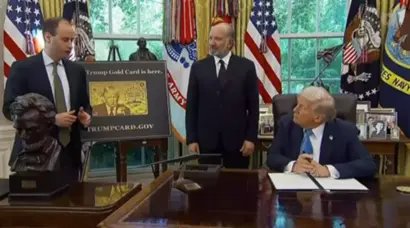
President Trump signed the proclamation at the White House in Washington D.C. on this day to overhaul the H-1B visa program, stating, "We need great workers. This measure will ensure that result."
The H-1B visa is for professional occupations in science, technology, engineering, and mathematics (STEM) fields. It is an employment visa that allows U.S. companies to hire foreign professionals with at least a bachelor's degree. A total of 85,000 visas (65,000 base; 20,000 for those with a U.S. master's degree or higher) are allocated annually via lottery. It permits an initial three-year stay, with possibilities for extension and permanent residency application.
The newly increased fee of $100,000 is an annual amount per person. During the stay, it must be paid and renewed every year. It is possible for up to 6 years at $100,000 annually. To complete the maximum stay of 6 years for this visa, an individual or employer must pay a total of $600,000 (approximately 840 million KRW).
Secretary of Commerce Howard Lutnick said at the signing ceremony, "When renewing or at the beginning, the company must decide if the individual is worth $100,000 to the company and the United States." He emphasized, "This is the core of immigration policy. We must hire Americans and ensure that anyone entering (the U.S.) is top-tier talent. We must stop the foolish practice of letting just anyone into this country on free visas. The President's position is very clear: accept only those who are valuable to the United States."

High proportion of Indian and Chinese nationals... Justification for protecting American 'tech jobs'
The Trump administration maintains that big tech companies and other large corporations have been training foreign workers. The perspective is that the visa system is being abused, suppressing wage growth for Americans, threatening jobs in the technology sector, and ultimately affecting national security. Critics have also pointed out that while the method is a lottery, some companies exploit the system through mass applications.
In the proclamation, President Trump argued that while the visa program was designed to attract temporary workers to perform highly skilled tasks, it has been abused for replacing domestic workers and substituting them with low-wage, low-skill labor rather than "supplementing" the workforce.
H-1B visas have a high proportion of Indian and Chinese nationals. Last year, 71% of all approved visas were for Indian nationals, while 11.7% were Chinese. It is interpreted that the decision reflects the judgment that if companies must pay an additional $100,000 to the government annually on top of existing salaries, the cost burden will increase, causing them to hesitate in hiring foreign talent.
The new executive order goes into effect at 12:01 AM on the 21st. This measure is expected to deal a significant blow to the U.S. IT industry. Large tech companies like Amazon, Microsoft (MS), and Meta have relied heavily on H-1B visas to bridge the shortage of professional personnel like software engineers. Amazon alone had over 10,000 H-1B visas approved this year, while MS and Meta had over 5,000 each.
Big tech in 'chaos'... Will South Korea-U.S. visa negotiations become complex?
Immediately after the measure, global companies responded. According to Reuters, on the day President Trump signed the proclamation, Microsoft instructed H-1B holders via internal email to "stay within the U.S. for the time being." It also urged H-4 (family) visa holders not to leave the U.S. For employees outside the U.S., it said, "We strongly recommend returning to the U.S. by the deadline tomorrow (the 20th)."
Investment bank JPMorgan also notified visa holders via email, "Do not leave the U.S. and refrain from overseas travel until further guidance is issued," and stated, "Those staying outside the U.S. must return before 12:01 AM on September 21."

Attention is focused on how this will affect discussions between South Korea and the U.S. regarding visa system improvements for Korean companies. Analysts suggest that the burden on South Korean companies in the U.S. could also increase as the pool of foreign STEM professionals narrows and costs rise.
However, there are observations that the impact on Korean companies will be limited because H-1B visas are mainly utilized by global corporations within the U.S. Domestic companies with U.S. branches mostly issue L-1 or E-2 visas for dispatched personnel, so the view is that the direct impact of this measure will not be significant.
South Korea and the U.S. have been discussing visa system improvements following the detention of approximately 300 Korean employees at the Hyundai Motor005380-LG Energy Solution373220 construction site in Georgia. With the threshold for H-1B visas being raised, prospects are emerging that the negotiations will become even more complex. Many observers believed that the solution to visa issues between the two countries would include efforts to secure a quota of H-1B visas for South Koreans.
As the U.S. government's policy to thoroughly prioritize national interests according to "America First" becomes clear even in visa matters, there are expectations that it will impose strict conditions on South Korea. Regarding agendas such as creating a new visa for short-term business trips for Korean professionals, there could be significant differences in the viewpoints of both sides.
Bloomberg reported on this measure, stating, "It comes in tandem with a series of fee hikes on work permits, asylum claims, and humanitarian protections outlined in the President's tax bill," and "It is intended to secure funding for new detention facilities, hiring immigration enforcement agents, and expanding the construction of border barriers."