

[비즈한국] President Lee Jae-myung has been pushing for balanced national development since the last presidential election, introducing strategies such as the "5 Poles, 3 Specials" (5-geuk 3-teuk) plan to address the issues of excessive concentration in the capital region and regional extinction. However, despite this emphasis on revitalizing local areas, the financial situation of local governments, which are tasked with enhancing their own regional competitiveness, remains dire.
This is because, even though state subsidies provided to local governments are increasing significantly every year, the expansion of government welfare policies and other factors have led to a surge in mandatory spending, effectively shrinking the budget available for local governments to invest in their own development.
Analysis suggests that these financial constraints are the primary reason why the balanced national development policies pushed by successive administrations have failed to achieve significant results. Consequently, experts point out that the state should increase its share of the burden for welfare spending, allowing local governments to expand budgets for projects tailored to their own regional needs.
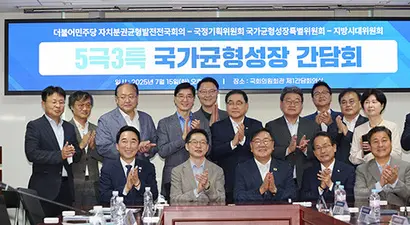
During the election, President Lee proposed the "5 Poles, 3 Specials" strategy as his campaign pledge for balanced national development, and after the election, he appointed former South Gyeongsang Province Governor Kim Kyung-soo as Chairman of the Presidential Committee on Balanced National Development (Committee on the Era of Local Regions) to drive this initiative. The core of the "5 Poles, 3 Specials" plan is to reorganize the country into 5 super-regional areas (poles) and 3 special autonomous provinces (specials) to foster growth hubs in each region and strengthen autonomous authority.
The "5 Poles" plan aims to foster five regions—the Capital region (Seoul, Incheon, Gyeonggi—finance and culture), the Southeast region (Busan, Ulsan, Gyeongnam—marine and future industries), the Daegu-Gyeongbuk region (Daegu, Gyeongbuk—traditional and cultural fusion industries), the Central region (Sejong, Daejeon, Chungcheong—administrative capital and science/technology), and the Honam region (Gwangju, Jeonnam—AI, energy, and agri-bio industries)—as self-reliant growth hubs. The "3 Specials" plan ensures a high level of autonomy for the three special autonomous provinces: Jeju, Gangwon, and Jeonbuk.
While the strategy involves dividing the country into these five poles and three specials to create regional growth strategies and strengthen local autonomy, the proportion of budgets that local governments can invest in projects suited to their areas is steadily declining. Despite every successive administration increasing state subsidies under the banner of promoting local growth, the funds that local governments can autonomously decide how to spend have actually decreased.
According to the Ministry of the Interior and Safety and various local governments, both the amount and the proportion of government subsidies within local government expenditure budgets are increasing every year. In 2017, out of a total local government expenditure budget of 259.4 trillion won, state subsidies accounted for 46.4 trillion won, or 17.9%. This subsidy amount surpassed the 50 trillion won mark in 2018, reaching 65.6 trillion won in 2020, 79.5 trillion won in 2022, and 89.2 trillion won in 2024, before exceeding 90 trillion won this year at 93.6 trillion won.
As the amount of state subsidies has increased, their share of total expenditure budgets has also risen, from 17.6% in 2018 to 19.0% in 2020, 19.9% in 2022, 20.6% in 2024, and 21.2% this year.
The problem is that while the share of state subsidies in local expenditure has grown every year, the vast majority is being funneled into social welfare budgets. Out of the 46.4 trillion won in state subsidies in 2017, 28.1 trillion won—60.5%—was allocated to social welfare. This spending on social welfare has steadily increased, reaching 43.8 trillion won (66.8%) in 2020, 51.9 trillion won (65.4%) in 2022, and 62.9 trillion won (70.4%) in 2024.
Since most of this social welfare spending is mandatory, local governments are not only required to use the state subsidies but must also contribute an additional portion of their own budgets. Furthermore, as they must also cover various administrative and financial operating expenses, the higher the proportion of the budget spent on social welfare, the lower the proportion available for their own local projects.
In fact, in 2017, the ratio of state-subsidized projects to local projects was 49.4% to 50.6%, meaning more budget was put into local initiatives. However, this trend reversed in 2019, with state-subsidized projects taking up 50.6% and local projects 49.4%, and the gap has only widened since.
This year, the proportion of state-subsidized projects has risen to 57.5%, while the proportion of local projects has dropped to 42.5%. A decrease in the proportion of local projects means local governments have less capacity to spend on regional economic development or improvements to residential conditions for their residents. Ultimately, this means that balanced local development is not being properly realized.