

[비즈한국] TMAP, the leading mobile navigation app in Korea, is set to evolve into an AI agent. TMAP Mobility, the company behind TMAP, has revealed its ambition to transform into an integrated mobility platform by incorporating its vast data reserves with artificial intelligence. The plan involves expanding data-driven partnerships while enhancing personalized features, such as integrating a conversational AI agent into TMAP. This foundation is built on daily life data collected from maps, travel routes, and place data, as well as records of payments, electric vehicle charging, and parking.
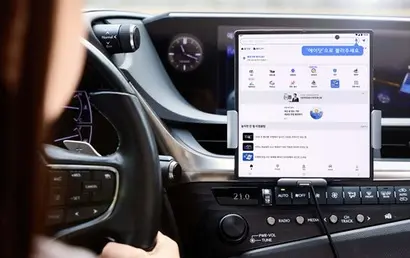
'Conversational Interaction' with TMAP While Driving
On the 17th, TMAP reorganized its in-vehicle voice guidance system by applying "A., (Adot)," the AI service from SK Telecom017670. On the 18th, TMAP Mobility held a press conference to highlight the achievements of its mobility data business and introduce its data business model and the TMAP AI agent. With this update, TMAP moves beyond the previous "NUGU"-based voice guidance to function as a conversational mobility AI capable of flexible interaction with drivers. Currently being rolled out for the Android operating system (OS), the feature is scheduled to be expanded to iOS sequentially.
As a conversational guidance system that understands natural language is implemented, drivers are expected to notice significant changes. This update enables interactions such as: △Requesting routes including waypoints (multi-commands) △Personalized guidance based on frequently visited places △Recommendation of places by theme △Conversational interactions related to traffic and lifestyle information.
Existing navigation voice search or home smart speakers primarily recognized precise, fixed commands. These typically rely on Natural Language Understanding (NLU) technology, but most are rule-based, meaning they often fail if the user speaks slightly differently. This is why current smart speakers have limitations in expanding into "intelligent assistant" services.
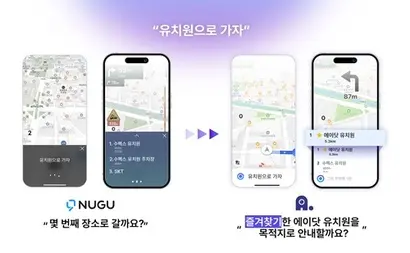
After the update, TMAP users can set waypoints and destinations at once by speaking naturally, such as, "Let's stop by a cheap gas station on the way home," without needing precise commands. It answers questions directly or indirectly related to map apps and driving conditions, such as, "Where is a popular cafe around here?", as well as unrelated daily questions like, "What are IU's popular songs?" Errors in pronunciation are also automatically corrected. The system works by having a Large Language Model (LLM) analyze and judge the driver's speech before presenting search results. Consequently, the company expects a significant improvement in driving convenience.
There are also improvements to the agent regarding traffic information. TMAP has linked its data with the Korea Road Traffic Authority to receive real-time information on unexpected events categorized into five types: disasters, accidents, festivals, and traffic accidents. This information is updated every five minutes, and the company explains that a feature has been introduced where the AI agent proactively alerts users if an incident is detected on their travel route.
In-vehicle AI Assistant: What About Errors like Misrecognition and Privacy?
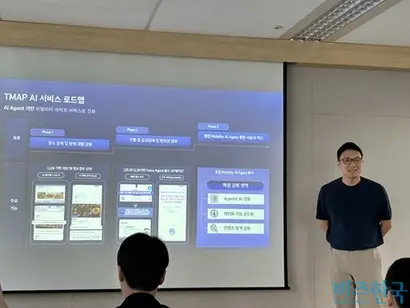
The current implementation can be seen as an intermediate step in TMAP Mobility's vision. Jeon Chang-geun, Chief Product Officer (CPO) of TMAP Mobility, stated at the press conference, "In 2026, we plan to install a 'Chat Agent' within TMAP based on the voice agent," adding, "We aim to provide a user experience that connects pre- and post-drive moments by integrating the voice agent and the chat agent." For instance, a user could listen to news via the voice agent while driving and then request the chat agent to send relevant articles to check later.
The blueprint is to combine over 7.4 billion cumulative movement data points with AI to secure traffic (usage) beyond just navigation and expand into an AI-integrated mobility platform equipped with personalized features. TMAP Mobility is currently accelerating the construction of a growth model based on movement data.
Travel route data, accumulating more than 26 million entries per day, is one of TMAP's core assets. TMAP is expanding its business model by providing various data—such as maps, road networks, traffic patterns, and delivery logs—to industries including logistics, finance, and local governments. TMAP's data business grew by 28.5% year-on-year in the first quarter of this year and by 49.3% in the second quarter.
While the integration of an AI assistant into in-vehicle navigation offers great benefits like improved convenience, customized guidance, and real-time responsiveness, there are points that require careful consideration.
First is the privacy issue. It is pointed out that in an environment where location information, movement patterns, and voice data are all collected, transparency regarding where and how this data is stored and used is necessary. With this update, TMAP maintains a listening mode even after a speech ends to support continuous conversation. In the previous "NUGU"-based TMAP, users had to call out "Aria."
Compared to the "wake-up" call method, which required users to re-awaken the system to ask follow-up questions after executing a command, this can be seen as a technological evolution. While the broad utilization of data is inevitable in the process of expanding personalized services, concerns remain unavoidable.
In natural language recognition systems, where everyday language, abbreviations, and pronunciation can have an impact, error situations such as the AI agent misinterpreting words may occur. CPO Jeon stated, "The correction rate has improved by about 25% compared to before. We have also improved usability by adding a logic that performs a secondary similar search if there are no initial search results."
The company explained that it will further strengthen security performance by adding speaker identification features in the future. Jeon mentioned, "Although this feature is not yet supported, we plan to add it because there is a possibility that the agent might misinterpret conversations if multiple people are talking inside the vehicle."
Park Seo-ha, Head of Data and Innovation (Vice President) at TMAP Mobility, emphasized, "TMAP, possessing overwhelming data, has the most natural and inevitable point of contact as an in-vehicle AI agent. At the same time, as AI technology is incorporated, the use of TMAP data will become even more significant in areas like autonomous driving and digital twins."