

[비즈한국] PCL241820, an in vitro diagnostic reagent developer, is facing the greatest crisis since its founding 17 years ago. The Korea Exchange (KRX) decided to delist PCL from the KOSDAQ market during a KOSDAQ Market Committee meeting on the 5th.
Founded in February 2008, PCL entered the KOSDAQ on February 23, 2017, through a special technology listing process, leveraging its proprietary virus detection technology with patents in 30 countries. During the COVID-19 pandemic, the company recorded 53.7 billion won in revenue and 25.7 billion won in operating profit in 2020, driven by its self-test kits that detect COVID-19 infection using saliva rather than blood.
However, after switching from bulk packaging to individual packaging the following year, the cost of goods sold surged, leading to an operating loss. Since then, the number of competing products has increased, and revenue has declined due to the transition to the endemic phase, causing the scale of operating losses to grow rapidly. Then, in March of this year, the company became subject to a substantive review of its eligibility for listing due to recording less than 300 million won in revenue in the fourth quarter of last year and less than 700 million won in the second half of last year. Ultimately, it received a decision for delisting from the KOSDAQ. Currently, 15,375 retail shareholders, who held 59.17 million shares—67.96% of total outstanding shares—as of the end of last year, are in an uproar.
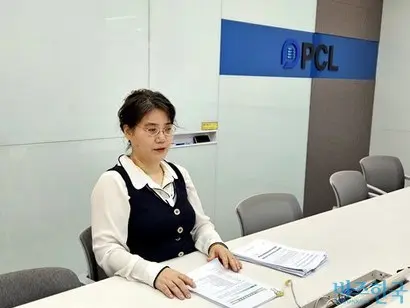
How will PCL CEO Kim So-yeon respond to the exchange's delisting decision? I visited the PCL headquarters in Munjeong-dong, Songpa-gu, Seoul. CEO Kim first bowed her head to apologize to shareholders for the delisting decision. "To normalize the company, when filing the objection, I submitted the resignation letters of all other directors, including myself, to the KOSDAQ Market Committee with a spirit of self-sacrifice," she stated. "We even attached a declaration of non-participation in management, but it was not accepted," she lamented.
She further stated that she would respond with every possible procedure against the Korea Exchange's decision to delist the company without even granting an improvement period. "We have received 'unqualified' audit opinions from auditors, and have never been punished for stock manipulation, embezzlement, or breach of trust. Does it make sense to delist us with a 'one-strike-out'?" she emphasized. "We will file for an injunction in court to suspend the effect of the delisting decision and demand that the exchange grant an improvement period." PharmAbcine208340 also received a final delisting decision from the Korea Exchange on May 27, but the delisting process is currently suspended after filing for an injunction with the Seoul Southern District Court.
CEO Kim also expressed her opinion that it was unfair for the KOSDAQ Market Committee to add new grounds for delisting after initially deliberating and voting on the matter in July. She noted that while uncertainty regarding business continuity due to revenue shortages was the initial reason for the substantive review, uncertainties regarding financial soundness and management transparency were added later. Although they refuted each item point-by-point in their objection, CEO Kim explained that it was difficult to accept that there was no clear explanation as to what was insufficient during the delisting decision on the 5th.
CEO Kim said, "We achieved 3.7 billion won in revenue in the first half of this year, exceeding our target, and the auditor's results showed no disagreement regarding the adequacy of the revenue amount." She added, "We have also clarified that a shipment of blood screening equipment to a Russian blood center is scheduled for the end of the year, and that we are continuously reducing the cost ratio and selling, general, and administrative expenses."
In June, PCL signed a five-year contract with Asta, Russia's largest professional diagnostic service company for blood centers, to supply its multi-blood screening equipment 'HiSU', portable blood screening equipment 'PCLOK II', and reagents. CEO Kim explained that if all equipment at 88 Russian blood centers is replaced over the next three years, expected revenue could reach approximately 100 billion won over 10 years. "The first shipment of equipment and reagents is scheduled for this coming December, and we submitted a statement of deposit for 300 million won—10% of the contract amount—to the KOSDAQ Market Committee on the 3rd, but it was not accepted," she complained. "It is regrettable that the delisting decision was made just as our global business was beginning in earnest."
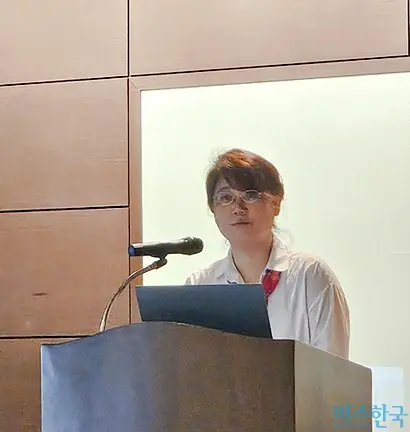
Regarding the financial soundness uncertainty pointed out by the KOSDAQ Market Committee, she expressed confidence that capital impairment could be resolved and liquidity improved through a differential capital reduction. At an extraordinary general meeting of shareholders in August, PCL passed a motion for a differential capital reduction at a ratio of 30:1 for the largest shareholder and 20:1 for general shareholders, transferring 84 billion won of the 88.3 billion won in capital surplus into deficits.
She also mentioned that discussions for attracting external investors are underway to enhance management transparency. On the 3rd, the company signed a lead management contract for a potential sale with Shinhan Securities. "We have been making efforts to transform PCL into an on-device AI company through the acquisition of Tiger Company, etc., and we are currently looking for investors in this field," CEO Kim stated. "We are also exploring opportunities abroad."
CEO Kim also defended herself against the reasons for "management transparency uncertainty" cited by the exchange: being sued for 5.1 billion won in commission fees for a paid-in capital increase by global long-term investment firm GEM, large-scale investment losses in companies like MQurex, and investigations related to clinical trial manipulation. "We pushed for a 30 billion won paid-in capital increase targeting GEM to expand our business as a preventive medicine company, but it did not work out, and the investment was canceled. GEM withdrew the related lawsuit in August, so the case is closed," she said. She also explained regarding the MQurex investment: "I acknowledge that the attempt to generate cash through the investment failed, but if we hadn't sold it and held onto it, the issue of losses from continuing operations before income tax expense would have been exacerbated."
Regarding the investigation into clinical trial manipulation, she countered, "Allegations have been raised and investigations have been ongoing for a year, but has there been an indictment or has any guilt been admitted?" She added, "Law firm Yulchon, which acted as an agent for the diagnostic kit product approval process, even issued a statement to dispel the suspicions."
On April 29, 2022, PCL received product approval from the Ministry of Food and Drug Safety (MFDS) for its COVID-19 self-test kit using saliva. However, during the National Assembly Health and Welfare Committee audit last October, Representative Kang Sun-woo of the Democratic Party of Korea (Gangseo-gu, Seoul) pointed out circumstances suggesting that the clinical trial results for this diagnostic kit may have been manipulated. At the time, PCL explained, "The allegations of clinical manipulation and preferential treatment in the approval process for the diagnostic kit are absolutely untrue," and stated, "It was approved through a normal process." Furthermore, law firm Yulchon issued a statement this February, stating, "Experts with experience in handling the approval and post-regulation of pharmaceuticals and medical devices directly at the Ministry of Food and Drug Safety pooled their efforts and achieved the result of obtaining approval approximately 1 month and 15 days after beginning work."
Finally, CEO Kim emphasized, "Whether I become the second or third largest shareholder through external investment, I will do everything I can as a founder and shareholder to help the company until the end."
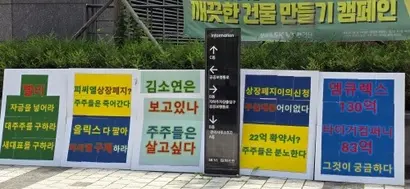
PCL shareholders have shown mixed reactions to the threat of delisting. On the 11th, CEO Kim reportedly communicated future response plans through a shareholder meeting. Among the shareholders who attended, some supported CEO Kim, believing in PCL's technology and capabilities, while many others, expressing distrust in the CEO's recent actions, urged her to take action to save the company rather than just using words.
Some shareholders began a one-person protest in front of the PCL headquarters and research center in Munjeong-dong, Songpa-gu, Seoul, on the 15th. One shareholder complained, "At the shareholder meeting, CEO Kim proudly said she had put 3 billion won into the company to save it, but it turns out she only put in 800 million won in the actual improvement plan, and submitted a conditional letter of commitment to put in 2.2 billion won only if the improvement period was granted." The shareholder added, "And yet she insists she did everything she could and that the exchange is being unreasonable by not granting an improvement period—isn't she just mocking the shareholders?" Other shareholders are also reportedly considering filing a lawsuit against CEO Kim for breach of trust, holding her accountable for failed investments in companies like MQurex and Tiger Company.