

[비즈한국] "Skin boosters that turn back the clock to 20-year-old skin." This is the advertising copy for a skin procedure that has recently hit the aesthetic dermatology industry. ‘Human-derived ingredient’ skin boosters are gaining popularity. However, it turns out that these human-derived ingredients are processed from skin tissue extracted from donated cadavers. Is there no issue with using bodies donated for medical purposes for cosmetic surgery? Under current law, there is no issue. This is because there are no regulations regarding the use of human tissue for cosmetic purposes when it is distributed. Authorities explain that it is difficult to distinguish between cosmetic and medical purposes when transplanting human tissue. However, the ethical concerns remain.
Establishing Human Tissue Banks to Extract Skin Tissue from Cadavers
‘Human-derived ingredient’ means it was actually extracted from human skin. Human-derived skin boosters, which have recently become a craze centering around Gangnam dermatology clinics, utilize transplant materials produced using skin tissue from donated cadavers. It is processed into a powder form, mixed with saline, and injected into human skin. Launched last year, this transplant material is being used as a skin booster (a medical device injected directly into the dermal layer of the skin) for pore improvement, hyperpigmentation, and improving skin texture and density. In other words, it is a material launched for skin aesthetic procedures.
One securities firm evaluated the company selling this product: "Since the launch of the (human-derived) A skin booster, the company has carried out various online and offline academic marketing in the first half of this year. It is being utilized for skin improvement at over 300 clinics nationwide, so sales expansion is expected in the future." The firm added, "As sales of the A skin booster go into full swing, sales could 'jump up' next year. Above all, profitability improvement will also accelerate due to high margins."
As the popularity of 'allogeneic dermis' skin procedures rises, the industry is trending toward developing cosmetic surgery products that utilize human tissue. Pharmaceutical manufacturers that already possess human tissue banks have also recently announced the upcoming launch of skin boosters utilizing human tissue.

Consulting with Plastic Surgery and Dermatology Clinics... Anyone Can Receive the Procedure
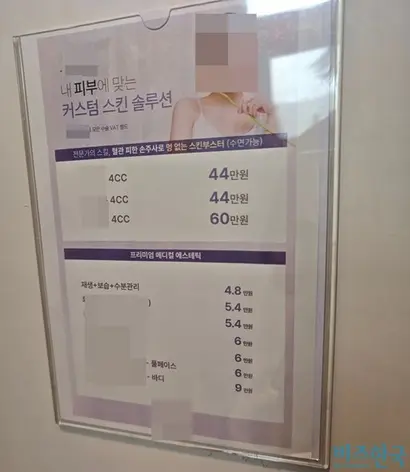
The problem is that it is possible to receive procedures utilizing human tissue for simple skin aesthetic purposes. Some plastic surgery and dermatology clinics are actively promoting skin procedures involving the injection of human tissue. One plastic surgery clinic that offers skin boosters and injection procedures using human tissue advised, "The list price is 880,000 won, but you can receive the procedure at the lowest promotional price of 660,000 won." Other previously sold skin boosters were available for around 440,000 won per session, while human-tissue skin boosters containing actual human skin tissue were available for 660,000 won.
A consultant said, "This is the most effective among all skin procedures so far. If other products were extracted from collagen, this product is harvested from the actual dermal layer of a human face. You are healthily putting in the exact same ingredients as a human face. It is less painful and 2–3 times more effective than other procedures. It addresses pores the best and helps with deep-skin dryness. In short, it’s a multi-injection. It is also effective for discoloration. We mix powder harvested from human tissue with saline for the procedure. You can choose to have it done as a skin booster or as an injection."
If you express interest in the procedure for skincare, you could receive a human-derived skin booster after a simple consultation. Another plastic surgery clinic also explained, "It hasn't been long since we started using it for skin procedures, but since it's an ingredient that has been used in surgeries for a long time, you don't have to worry about side effects. Think of it as being extracted from actual human skin—not collagen extracted from pigs or salmon—and then dried and pushed in with a laser. The side effects are also much lower. It’s 660,000 won per session."
No Regulations Prohibiting Use for Aesthetic and Plastic Surgery Purposes... Ministry of Health and Welfare: "Discussing Indirect Regulatory Measures with the Ministry of Food and Drug Safety"
Under current law, human tissue can only be supplied through domestic or foreign human tissue banks. In Korea, the Korea Public Tissue Bank distributes donated human tissue, and to receive such distribution, one must establish a tissue bank. To donate human tissue, the individual must consent during their lifetime, and after death, the bereaved family must provide consent. Actual donation takes place after the donor is brain-dead or deceased.
The problem is that there is currently no provision in the law that prohibits the use of donated human tissue for aesthetic or plastic surgery purposes. Since there is no set law, there is no way to stop donated tissue from being used for cosmetic procedures.
The Ministry of Food and Drug Safety (MFDS) stated, "There is no separate regulation regarding the use of human tissue for cosmetic surgery purposes under the law," but added, "The donation management and transplantation of human tissue must be conducted in a way that is ethically sound and medically recognized, and must be distributed according to the distribution priority set by relevant enforcement decrees."
However, the MFDS explained that it does not judge whether a 'doctor's prescription' is appropriate. An official from the MFDS explained, "The role of the MFDS is to manage whether human tissue is safe, whether the donor is suitable, and whether it has been distributed. Our biggest role is checking whether the donor has infectious diseases or if there are concerns about side effects. We also look at whether there are side effects when transplanted. However, the appropriateness of the transplant is in the realm of the Ministry of Health and Welfare (MOHW). The use of transplant materials based on a doctor's prescription is not the area of the MFDS."
However, the MOHW also maintains an attitude that it cannot stop the use of human tissue for aesthetic purposes. The MOHW explained that it is difficult to distinguish and define aesthetic purposes from medical purposes.
An official from the MOHW said, "It is not easy to uniformly set where human tissue can or cannot be used. This is because it depends on the situation. Human tissue collected domestically is distributed by the Public Tissue Bank, and the distribution contract explicitly states that it cannot be used for simple cosmetic purposes. Recently, the Public Tissue Bank went out to inspect the usage status of human tissue, and it was found that there were no cases of use for such purposes at that time."
The official added, "However, I have heard stories about human tissue being used for skin procedures, and we are discussing ways to indirectly regulate these parts with the MFDS. While (prescribing for cosmetic procedures) may be morally problematic, it is a situation where it is difficult to regulate legally. We are currently reviewing the situation to find a way."