

[비즈한국] Perplexity, a global artificial intelligence (AI) startup with 22 million monthly active users (MAU), has entered the web browser market, intensifying its rivalry with tech giants like Google and OpenAI. With the launch of its AI browser "Comet," the company aims to shift the current web environment—which focuses on simple information retrieval—into an AI agent platform.
The competition is expected to heat up further, with Microsoft (MS) recently integrating its generative AI, "Copilot," into its Edge browser. Some industry observers suggest that once OpenAI’s browser, currently codenamed "Aura," is unveiled, the web browser market, currently dominated by Google Chrome, will enter a new phase of change.
Searching for a Train Ticket Reservation in ‘Comet’…
An AI browser is a new concept that integrates generative AI into web navigation, supporting everything from page summarization to task automation and personalization. If traditional web browsers are like flat "windows" that users pass through, AI browsers can be compared to "AI assistants" that follow the user around.
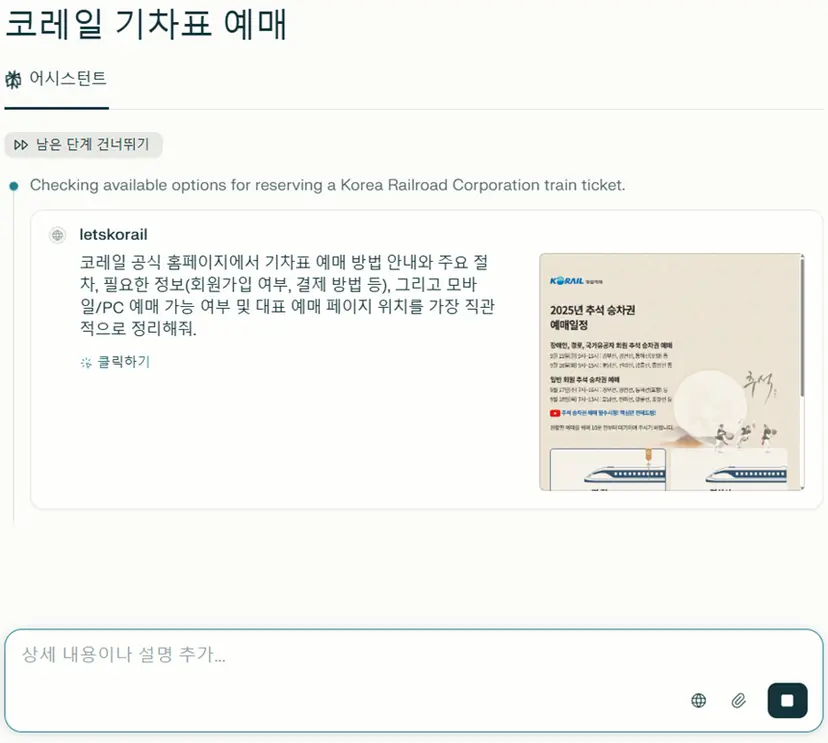
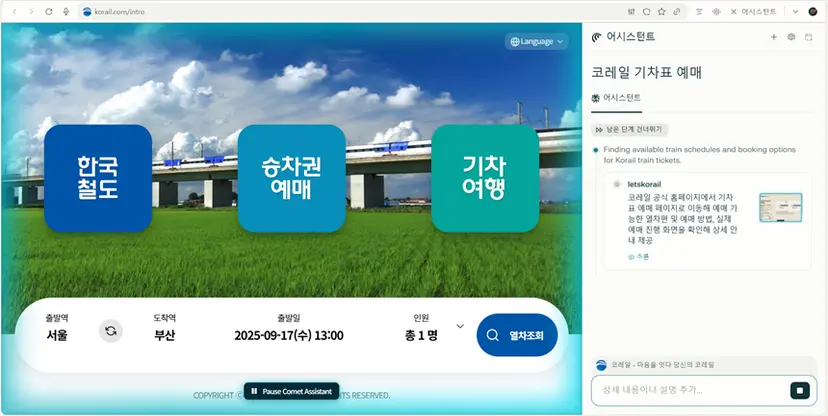
When this reporter opened Perplexity’s AI browser, Comet, and typed "KORAIL train ticket reservation" into the search bar, the agent within the browser automatically began the search process. Upon clicking the KORAIL page that appeared in the results, the browser accessed the KORAIL home screen, navigated through several screens, and finally arrived at the non-member login page. This was a result provided by the agent, which had simulated the reservation procedure and navigation path on the KORAIL main page in real-time, confirming that the process could proceed without a member account.

In the "Assistant" window that popped up on the right alongside the KORAIL homepage, reservation methods and a price comparison for trains between Seoul and Busan were displayed. When asked why it chose the non-member reservation page as the final search result, the assistant explained, "The search query 'KORAIL train reservation' is a direct and practical command indicating a desire to book immediately. I determined that the non-member reservation window, which only requires a name, phone number, and ticket password, was the optimal path most users would choose."
Launched in July, the Comet browser was initially provided to Perplexity Premium subscribers (Max, $200 per month) and some users on a waitlist, before being expanded sequentially to all paid Perplexity users around September. Comet uses Perplexity’s AI search engine as its default and, like most modern browsers such as Chrome and Microsoft’s Edge, runs on an open-source web browser foundation.
Key features of Comet include summarizing search results, emails, and calendars, as well as analyzing the context of web content currently open on the screen. A notable benefit is that users no longer need to repeatedly copy-paste, take screenshots, or switch between tabs to get answers from an AI chatbot. Even when sending an email via Gmail, one can instruct the Comet assistant on the right side to draft and send the email, which the AI handles after verifying the request.
Competition to Launch AI Browsers… Concerns Over Accuracy and Security
The search engine market, where Google Chrome holds a 69% market share (as of August), is becoming a new battleground for Big Tech AI. OpenAI is reportedly preparing an AI browser codenamed "Aura." If the 400 million people who use ChatGPT adopt Aura, it could pressure Google's advertising revenue. Chrome is a key pillar of Google's parent company, Alphabet's, advertising business, accounting for three-quarters of its total revenue.
Above all, browsers serve as a foundation for exclusively securing massive amounts of data by integrally collecting and analyzing web activities such as searching, purchasing, working, and social media usage. Since the start of the year, overseas startups like The Browser Company and Brave have been introducing AI browsers, and Microsoft is transforming Edge into an AI browser by incorporating "Copilot" mode. Google is also enhancing its AI search capabilities by embedding "Gemini" into its browser.
Naver035420 also fully introduced an AI-based "user-customized search" service on mobile on the 4th. The service analyzes individual content consumption patterns to display preferred results at the top, and it has also begun trial operations of an "AI Block" service, where AI gathers and summarizes related blog posts or news articles when a specific keyword is searched. Going forward, Naver plans to upgrade personalized AI assistant services centered on its "Whale" browser and introduce an "AI Tab (tentative name)" that understands intent and context to support everything from reservations to payments.
For Big Tech firms, AI browsers mean more than just "smart search." They offer a favorable position to secure new revenue opportunities related to ad exposure and data-driven marketing. Reuters stated, "Because a browser can access a user's entire web activity, it can become the most ideal platform for AI agents to operate and take direct action on the user's behalf, such as making restaurant reservations."
Last month, Perplexity officially proposed to Google that it would acquire the Chrome browser for $34.5 billion (approximately 48 trillion KRW). The attempt was made to take advantage of the antitrust lawsuit filed by U.S. regulators against Google, but it effectively fell through after a U.S. federal court rejected aggressive measures such as the forced sale of Chrome on the 2nd (local time). The Wall Street Journal commented, "As Big Tech companies compete to build the best AI search tools, access to exclusive data is becoming a decisive advantage."

As the web browser evolves into an "intelligent web assistant," the point of interest will be what kind of differentiation and strategies companies will use to compete against Google.
However, compared to existing generative AI, there are heightened concerns regarding accuracy and security for AI browsers since they operate within a web environment.
Like other AI chatbots, Comet is evaluated to have limitations in tasks requiring high-level contextual reasoning. Problems have been discovered in tasks with complex context, such as travel reservations or filling out complicated forms. In a technical column, the enterprise AI platform "Beam AI" pointed out, "Comet still suffers from hallucinations. If the AI does not properly understand the structure of the web or the nuances of the user's intent, it can produce completely incorrect reasoning."
Privacy-related restrictions are also anticipated. Because Comet requires system access permissions for emails, tabs, calendars, and documents, privacy issues may arise for corporate users or in environments with strict regulations. Hwang Seok-jin, a professor at the Graduate School of Information Security at Dongguk University, noted, "Because browsers accumulate data that can reveal a user's patterns, including browsing history, tastes or behavioral traits could be exposed even if it isn't a direct leak of personal information," adding, "How to manage the data storage, processing, and treatment process is also a critical issue."