

[비즈한국] Rarely has Germany placed such high expectations on the IAA as it did this time. The tide of Chinese electric vehicles is rising, and the economic slowdown across Germany's manufacturing sector is intensifying. Under these circumstances, with the major mobility show, IAA Mobility 2025, being held for the first time following a change in government, domestic expectations in Germany were immense.
The automotive industry, the backbone of the German economy, needed to demonstrate a recovery of confidence through IAA 2025. According to the organizers, this year's IAA was a truly international event, with 748 companies from 37 countries participating, and international firms accounting for 57% of the total. Participation was particularly high from Germany (approx. 322 firms, approx. 43%), China (116 firms, 15.5%), South Korea (58 firms, 7.8%), and the U.S., Italy, and Austria (24 firms each, 3.2%). South Korea's presence was also prominent among the global mobility powerhouses. This IAA saw over 350 world-first unveilings or new technology announcements.
The opening ceremony featured German Chancellor Friedrich Merz, Bavarian State Premier Markus Söder, and Munich Mayor Dieter Reiter standing side-by-side. Merz emphasized, "IAA 2025 will showcase the innovation capabilities of the German and global automotive and components industry at a glance, and Germany will continue to provide the optimal ecosystem to maintain its status as the 'No. 1 Automotive Nation'." Mayor Reiter also lauded the event, stating, "The IAA is a powerful signal for sustainable and intelligent future mobility."
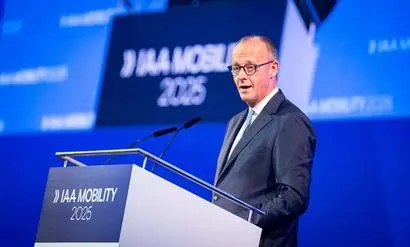
In his speech, Merz declared, "Germany must be the architect of change, not a follower," and vowed to hold a joint industry-government automotive summit within four to six weeks following the IAA, alongside plans for deregulation and expanded investment. It was an explicit declaration of the will to restore leadership from the heart of the exhibition floor, even amidst economic headwinds.
China: A Trio of Technology, Execution, and Localization
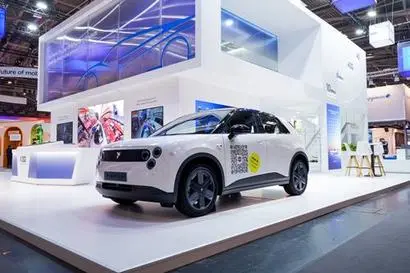
The most attention-grabbing area at the IAA was the booths of Chinese companies. Horizon Robotics, a startup specializing in autonomous driving solutions that stood out immediately upon entering the exhibition hall, put its "data localization" strategy—re-learning with local data at European data centers—at the forefront. Their roadmap to release a one-chip integrated SoC for ADAS (Advanced Driver Assistance Systems) and IVI next year, and the announcement of a chip-centered ecosystem alliance with their Journey 6 lineup covering L2+ to L4, were particularly impressive.
The Journey 6 series is a solution that integrates CPU, GPU, and NPU into a single chip to provide various levels of ADAS and advanced driver assistance functions. Horizon Robotics is currently collaborating on the development of ADAS features and smart driving systems not only with German automotive companies like Bosch and Volkswagen but also with Chinese automakers such as SAIC and BYD. It is a company receiving significant attention in many respects.
The CATL booth was one of the most crowded spots at IAA 2025. Chairman Robin Zeng personally explained the technology to German government officials and key OEM executives; it was perceived as a move to expand influence across policy and industry rather than a simple product display.
The most notable change was in their messaging. Unlike the past, when they boasted about top speeds and efficiency with "Shenxing" or "Qilin" batteries at events like the Beijing Motor Show or InterBattery, in Munich this time, they prioritized safety, process stability, and production reliability. This is evaluated as a strategic pivot to secure trust in the conservative European market. In fact, they displayed cross-sections of liquid cooling structures for thermal runaway prevention and production line CT scanners at the booth entrance, visibly emphasizing their safety and quality control processes.
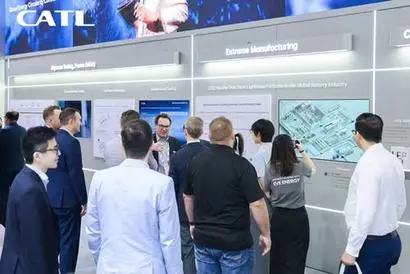
Notably, CATL announced a strategy to expand its external reach from a parts supplier to an energy and charging solutions company, signaling initial mass production in Europe with its Hungarian plant as a base.
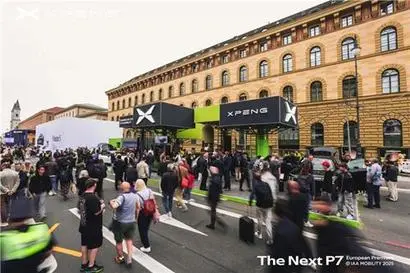
Xpeng showcased a full lineup including the Next P7, P7+, G6, G9, and X9 under the catchphrase "AI-defined Vehicle." The Next P7, in particular, presented a performance record of a 3.7-second 0-100km/h sprint and a top speed of 230km/h, along with an experimental durability record of "driving approximately 3,961km in 24 hours." This was an intriguing case of a mass-production electric vehicle demonstrating both sustainability and performance.
At this IAA, Xpeng announced that it would establish its first R&D center in Europe in Munich. This is interpreted as the first instance of expanding their global R&D network—which previously existed only in China and the U.S. (Silicon Valley, San Diego, etc.)—into Europe, and the first step toward getting closer to European users. Simultaneously, it is read as a determination to accelerate localization by reflecting European regulations and demands into product development based on the European R&D center.
Xpeng's exhibition attempted a frame shift from the image of "China equals low-cost" to "China equals tech leader." Notably, in the open space located in the city, they offered diverse test-drive opportunities to the general public with a sophisticated yet friendly image.
Germany's Big Three Dreaming of a Reset on Home Turf, and Aumovio
BMW dominated the exhibition hall with the iX3, the first mass-production car of the "Neue Klasse," signaling the dawn of "Neo BMW." They designed the experience to allow anyone to experience the reality of the shift to SDVs, including 800V architecture, bidirectional charging, Panoramic iDrive/OS X, and four "Super Brain" domain computing units.
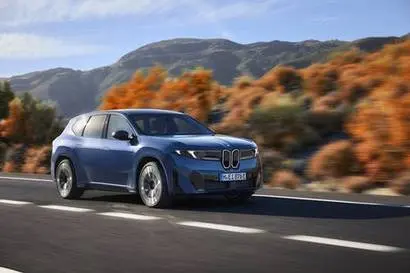
iDrive is BMW's vehicle operating system, and this time, the Panoramic iDrive expands the existing iDrive to the entire front section of the vehicle. Instead of just looking at a center display, the driver and passenger can view and control information simultaneously via a panoramic display stretching across the entire dashboard. The driver can manage necessary driving information like speed, navigation, and safety alerts, while the passenger can handle entertainment or convenience features on their side of the screen. Through this, BMW realized the core UI of an SDV. The roadmap to mass-produce in Debrecen, Hungary, in 2025 and launch in Europe in 2026 was also clear.
Mercedes-Benz presented the electric GLC as its flagship model for the EV transition. German media evaluated the electric GLC as "one of the most important new cars," and focused on Mercedes-Benz's premium strategy in comparison to the BMW iX3. Particularly, because the GLC is a global best-selling SUV, the electrified GLC has become an important indicator to gauge the future of Mercedes.
It is worth noting that they didn't just change the battery; they equipped it with the latest interface, high-speed charging, and an ADAS package. Specifically, they emphasized extended driving range, high-speed charging, and a new design language, making efforts to show differentiation from existing internal combustion engine models. One could glimpse an attempt to expand the definition of traditional luxury and premium to "advanced technology + user experience."
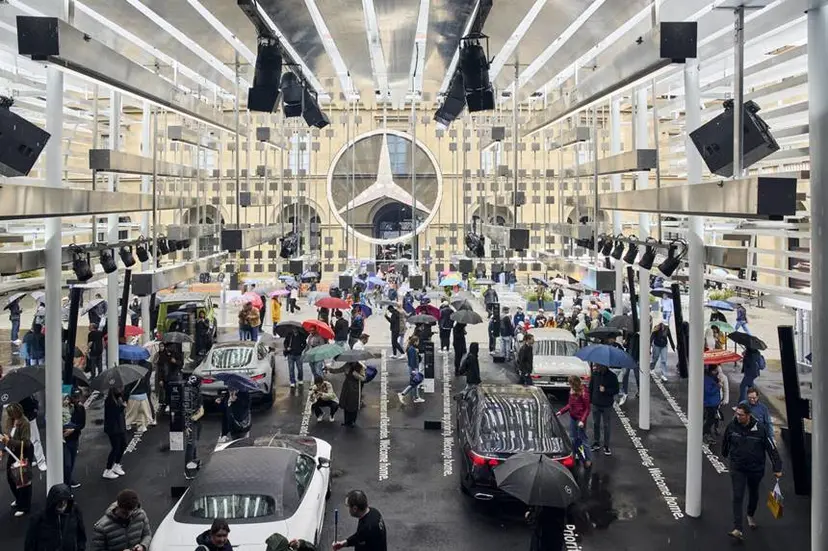
Mercedes put forward the core message of "Welcome home," with the intention of expanding the brand experience from simple vehicle test drives to a sense of comfort like home and a luxury experience in daily life. They implemented this in the Munich downtown open space, structuring the exhibition so that actual visitors could sit inside the vehicles and experience a "space like home."
Volkswagen unveiled a rational electric lineup including the ID. Polo and ID. Cross, and a three-year quality and UI "diet," re-declaring its self-definition as the "True Volkswagen." By leading with four small and compact EVs, they focused on restoring the balance of "price, completeness, and charging experience."
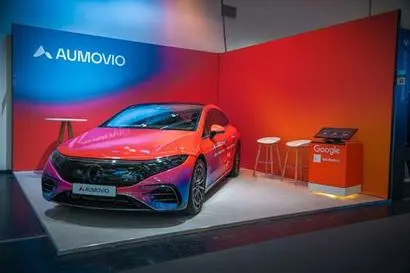
The most notable change in the reset of a traditional company was Continental. Through IAA Mobility 2025, Continental announced that its automotive division had been reborn as an independent company named Aumovio. As of September 2025, Continental's Automotive division was spun off under the new name Aumovio, and the IAA served as the first official event for Aumovio to exhibit as an independent brand.
Aumovio showcased various systems related to SDVs (Software Defined Vehicles). Key products included the Green Electric Caliper, which can increase EV range and reduce manufacturing and assembly costs through weight reduction and lower braking resistance; modular chassis units that integrate driving, braking, steering, and suspension into a single unit; and the Corner Module, which enhances steering, space utilization, and vehicle design flexibility through electronic by-wire structures and the possibility of 150-degree steering per wheel.
What the IAA Left Behind, and What Must Not Be Misunderstood
The return of German premium brands was the most impressive takeaway from this IAA. BMW and Mercedes sent the message that "we are taking back the initiative" in EVs and SDVs, where they appeared to be falling behind. Added to this, Volkswagen seemed to have finished adjusting its weight class with entry-level EVs, seemingly demonstrating once again the brand power of Germany, the home of the automobile. It seemed to somewhat dissipate the gloomy atmosphere that had hung over the German automotive industry since Chinese companies pushed upward in 2023.
However, while in 2023 Chinese automakers primarily showed a remarkable speed of development, this time it was noticeable that China's comprehensive tactics involving chips, batteries, complete vehicles, charging, and distribution had penetrated the heart of Europe.
What was interesting was the asymmetry in German media coverage. While the fierce competition between Chinese and German firms was evident on the ground, exposure in local media and social media was centered on the German Big 3. German consulting firm Prophet analyzed content reported on online portals and social media platforms in major European countries (EU G5), China, and the U.S. during the IAA period from September 8 to 11.
According to this, Volkswagen Group brands including Audi (25%) received the most attention, followed by BMW (11%) and Mercedes (10%) at nearly similar levels. The role of Chinese manufacturers was relatively minor. BYD and Xpeng (6% each) received the most attention among Chinese companies, while Geely (3%) and GAC (2%) attracted almost no interest.
Unlike the palpable tension felt on the ground, the media headlines appeared somewhat skewed. This makes the saying that "Europeans are more surprised when they go to a 'home ground' like the Shanghai Auto Show" resonate.
Let's soberly map the current coordinates of the automotive industry, which was traditionally led by Germany. The IAA confirmed the recovery of confidence for German automakers, but the pressure of supply chain restructuring and structural reforms could be felt amidst the waves of change experienced by Tier 1 and various vendors. The success or failure of this massive transition will ultimately be decided by cost, speed, and policy. This is why, after applauding and watching the splendid stage of German premium cars, I was left with the chilling thought: "Perhaps this IAA was successful, but the real test starts now." For Korean startups, it is time to remember that Germany, which craves innovation more than anything else, can be a destination for mobility startups and to scout for opportunities.
The author, Eun-seo Lee, majored in law in Korea and studied theater in Berlin. Based in Berlin, a city of art and a European startup hub, she leads 123factory, which connects the Korean and German startup ecosystems while growing alongside the city.