

[비즈한국] Companies sometimes make decisions that are difficult to explain based solely on money. If you understand the laws or systems hidden behind them, you can grasp the deeper details. 'Useful Business Legal Tips (Al-Sseul-Bi-Beop)' introduces clues to help understand the flow of business.

Project Financing (PF) refers to a method of raising funds by using the project's viability and future cash flows generated from the project as collateral. It differs from traditional finance, where loans are made based on the debtor's credit rating or collateral value. Commonly referred to as real estate PF, it is a type of project financing that uses real estate development projects as the subject of investment. It raises capital by using future cash flows from the real estate development, such as presale proceeds and rental income, as collateral.
People are highly interested in real estate PF. This is evident from the fact that the media reports on the status of real estate PF on a daily basis. Here, we will look at why real estate PF emerged and what topics are being discussed recently.
Before the IMF crisis, construction companies handled every aspect of real estate development projects. They were in charge of both implementation (development) and construction, and borrowed funds directly from banks. However, when projects failed due to a loss of momentum during the IMF crisis, or when excessive borrowing led to a series of bankruptcies, stakeholders sought ways to reduce risk by dividing roles and advancing financial structures. The details are as follows.
First, implementation and construction are separated. The developer, as the formal business entity, is responsible for tasks such as securing land, obtaining permits, and supervising presales. As seen in the job description, a developer's work is not usually easy as it involves coordinating the positions of various stakeholders, including land owners, local governments, and civil petitioners.
Because of this, developers are required to possess immense capabilities, such as planning skills, an understanding of law and finance, negotiation skills, leadership, and, furthermore, ethical standards. Since not everyone has such capabilities, one occasionally feels a massive discrepancy when meeting people in this field.
Construction is naturally handled by a construction company. Furthermore, they often enter into a "responsible completion agreement," promising to finish the construction. This is done for several reasons, as it is either requested by the lender group in real estate PF or helps with the presale process. Buyers and other consumers expect a large construction company—not just the developer, which is often a mere special purpose company—to take responsibility. Therefore, if a large construction firm makes a responsible completion agreement and advertises it, it tends to be easier to recruit buyers.
Next, instead of the construction company borrowing funds directly, the real estate PF financial technique is used. The developer receives a loan from a 'lender' such as a financial institution. Then, as collateral for the loan, they entrust land ownership, permits, and other contractual statuses to a 'trust company.' The construction company carries out the work with funds secured by the developer, but they also sign a responsible completion agreement promising to finish the project within the scheduled period under any circumstances, unless there is a force majeure event such as a natural disaster.
In principle, PF is based on the project's profitability and cash flow, and the loan is repaid using the project's own cash flow, such as presale proceeds. For this reason, the business owner's credit or assets are not important, so a special purpose company handles the project, and the lender group recovers the loan through priority beneficiary rights. However, in Korea's real estate development business, it is different. Lenders secure both personal and physical collateral by requiring joint guarantees from the developer and individuals, and requiring responsible completion, payment guarantees, and debt assumption from the construction company. Consequently, critics point out that real estate PF is often issued excessively without carefully analyzing the project's viability.
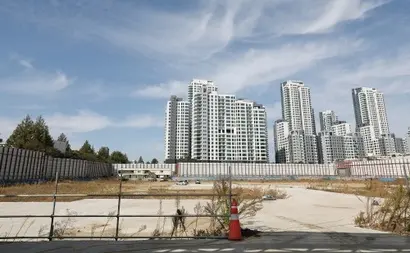
The real estate PF market went through one crisis in the aftermath of the 2008 financial crisis. Around 2011, as unsold properties increased and the credit ratings of construction companies fell, bank runs and a series of bankruptcies occurred at savings banks that had been actively engaged in real estate PF. However, after 2013, the real estate market experienced an unprecedented boom due to low interest rates and increased liquidity, causing the savings bank crisis to be forgotten and the real estate PF market to thrive. It was also from this time that commercial banks and securities firms actively entered the real estate PF market.
However, as everyone knows, the real estate PF market has been worse than before since 2022. While the cost of raising funds increased due to high interest rates, the prolonged economic downturn left the market with little room to absorb the now-expensive real estate. In particular, the insolvency of construction companies that support the foundation of real estate PF is serious. You can only expect real estate PF returns if buildings are actually going up, but since the degree of insolvency is too severe, starting with local small and medium-sized construction firms, the survival of real estate PF cannot be expected.
If a construction company falls, who will take responsibility for the project next? Although it depends on the terms of the contract, the atmosphere is that the ball has been passed to the trust company. Through what is called a 'managed land trust contract,' trust companies have been carrying out real estate development projects as the actual business entity, taking over not only land ownership but also permit titles and construction contract titles. In this case, trust companies welcomed this as they could expand their business scope and earn higher fee income compared to other methods; lenders and construction companies also did not particularly oppose this, given that a trust company, rather than a small developer, was overseeing the project.
The managed land trust method, which was highly popular during the real estate boom, turned into a weapon against trust companies when the economy hit a downturn. According to the managed land trust method, the trust company fulfills the responsible completion obligation according to the agreement, or bears the obligation to repay the loan if it fails to do so. However, in a situation where only the trust company remains due to the insolvency of the construction company, the issue became whether the trust company must actually fulfill all those obligations.
While one might think that if it is stipulated in the contract, they must naturally fulfill the responsible completion obligation, trust companies have their own perspective. Real estate PF is a project conducted through close consultation between various stakeholders, including the developer, construction company, lender group, and the trust company.
Therefore, the lender group should also verify the appropriateness of loan execution, and in fact, many contracts stipulate that the lender group's consent must be obtained for the developer's business expenditures. The main argument is that if the lender group failed to review the appropriateness of loan withdrawal and execution—despite having the ability to do so through funding request forms and project income/expense statements—it is unfair to demand that the trust company repay the entire loan as a responsible completion obligation.
However, the Seoul Central District Court recently rejected the trust company's argument and upheld the lender group's claim in its ruling. The court cited that the trust company's responsible completion system is a common trading practice in current PF finance and development projects, and that the trust company earned high commission income as compensation for trust work that included the responsible completion agreement.
Until a Supreme Court ruling is made, the liability of trust companies for failure to fulfill responsible completion promises will remain a point of controversy. Regardless of which way it concludes, the impact is so great that even mentioning it requires caution. Seeing a condition that no one questioned or took for granted in the past become a major problem makes me realize once again how great the volatility and risk of real estate development projects are.