

[비즈한국] There are many mysteries surrounding black holes, but one of the most intriguing aspects for astronomers is that there is no "middle ground." If black holes were cups of black coffee, our fate when encountering them would be extreme: either the serving is too small to quench our thirst, or it is so large that we might burst. There are only two types of black holes in the universe—those that are too light or those that are too heavy. The elusive, mid-sized ones remain difficult to spot.
In the world of black holes, the light ones are known as stellar-mass black holes. Their mass is, at most, only 20 to 30 times that of the Sun. These are typically formed when massive stars stop fusion and collapse. Conversely, the heavy ones are called supermassive black holes. They harbor masses reaching millions or even hundreds of millions of solar masses and usually reside at the centers of galaxies. Most black holes found in the universe belong to just these two categories. While intermediate-mass black holes likely exist, they are rarely seen.
These missing mid-sized black holes are called Intermediate-Mass Black Holes (IMBHs). Where they have disappeared to, or whether they have even existed throughout cosmic history at all, remains one of the greatest mysteries in astronomy. They represent a crucial "missing link" that remains empty in the growth process of black holes, spanning from small to gargantuan.
Consequently, simply discovering an IMBH is considered a major achievement. Recently, however, astronomers identified another new candidate. Using the Chandra X-ray Observatory, they detected a suspicious source emitting X-rays on the outskirts of the elliptical galaxy NGC 6099, located 450 million light-years away. The Hubble Space Telescope revealed that this source resides within a globular cluster packed with stars. Astronomers suspect this is the elusive IMBH they have been hunting for. Why are these black holes so hard to find? And what does their apparent scarcity tell us about the universe?
Black holes exhibit a surprising relationship with the galaxies they inhabit. When comparing the total stellar mass at the center of a galaxy to the mass of the black hole within it, they show a remarkably clean correlation. The black hole's mass is typically about 1/1000th of the galaxy's central mass. While this is tiny compared to the total mass of the galaxy, almost every galaxy follows this ratio consistently. If a galaxy is twice as massive, the black hole inside it is also twice as heavy. This implies that black holes are intimately linked to the birth and evolution of entire galaxies.
If the central mass of a galaxy and its black hole are so neatly proportional, one might think it wouldn't be difficult to find where IMBHs might exist. As we look at smaller and lighter galaxies, dwarf galaxies, and eventually globular clusters, it feels like we should naturally arrive at IMBHs whose masses match those smaller central regions. In fact, astronomers have been persistently playing hide-and-seek with IMBHs in dwarf galaxies and globular clusters. Occasionally, in some large globular clusters, observations of stellar motion suggest the presence of an IMBH with thousands to tens of thousands of solar masses.
However, perfectly verifying the identity of an IMBH is extremely tricky. Conveniently, we lack a "scale" to measure them. For much lighter stellar-mass black holes, we can now infer their masses quite accurately using gravitational wave detectors like LIGO. By detecting the ripples in spacetime—gravitational waves—spread by colliding black holes, we can determine how massive they were.
But current gravitational wave detectors struggle to grasp the mass of the slightly heavier IMBHs. This is because the wavelength of gravitational waves increases in proportion to the black hole's mass. LIGO is already a massive detector, with each arm spanning 4 km. Thanks to that scale, it can barely detect the tiny tremors left by stellar-mass black holes. To detect an IMBH thousands of times heavier, we would need a much larger, more sensitive detector. In reality, we would need one larger than the Earth, which is practically impossible.
What if we applied the know-how gained from supermassive black holes instead? Traditionally, the mass of a galaxy's central black hole is inferred by observing the motion of stars at the galactic center. By figuring out how fast stars orbit the center, we can determine the gravity of the black hole holding them, thus calculating its mass.
But this method is also difficult for IMBHs. As mentioned, we expect them to be in smaller globular clusters, where stellar density is too high and the size too small. It is hard to precisely measure the motion of stars tightly packed into such a small volume. Furthermore, because the stars are so close together, it creates a complex "N-body problem" where stars exert gravity on each other, complicating the calculations beyond just the pure gravitational effect of a black hole.
It would be a great help if the black hole were consuming surrounding stars and gas. Although the black hole itself does not emit light, the debris from consumed matter forms a brightly glowing accretion disk as it circles the hole. The hot accretion disk emits strong X-rays, and the brightness of these X-rays can reveal the power of the black hole inside.
However, this method does not work well for IMBHs in globular clusters either. Globular clusters are composed only of old stars whose evolution is nearly complete; there is almost no fresh gas left. Even if there is a black hole at the center, it has little "food" to eat. Therefore, any IMBHs in globular clusters likely remain hungry. With little X-ray emission, it is very difficult to capture and estimate their mass through X-ray observation.
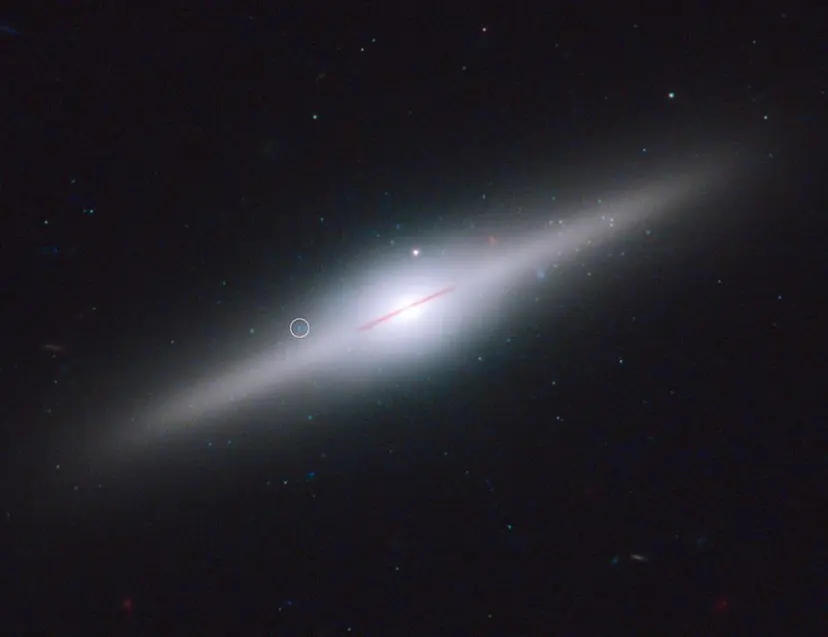
It is generally better to search the outskirts of galaxies rather than the center. Even if there were an IMBH in the center, it would be overshadowed by the far more massive and powerful supermassive black hole living there. Any faint trace an IMBH might leave would be buried by the overwhelming presence of the central supermassive black hole. Therefore, it is advantageous to look for celestial objects emitting strong X-rays at the edges of galaxies.
In astronomy, such objects are called Hyper-Luminous X-ray sources (HLXs). A representative example is HLX-1, discovered in 2009 in the galaxy ESO 243-49, located about 290 million light-years away. There is a clearly emitting X-ray source slightly offset from the disk of the galaxy ESO 243-49, which lies almost perfectly edge-on. Astronomers estimate this object is an IMBH with about 20,000 times the mass of the Sun.
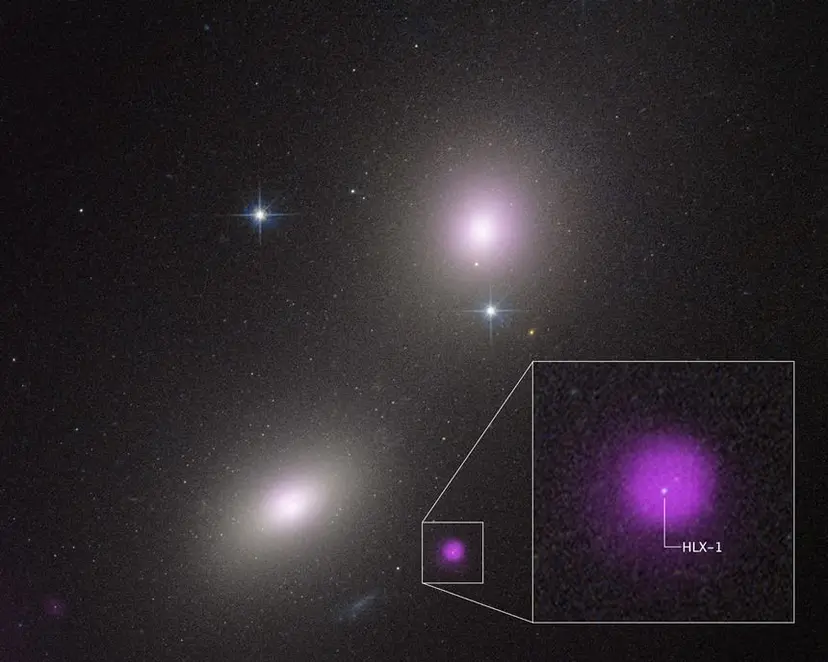
Recently, a similar discovery followed: another HLX-1 found in the galaxy NGC 6099. Again, it was found at the outskirts of the galaxy, away from the center. By analyzing vast amounts of data collected by the Chandra X-ray Observatory from 2009 to 2023, astronomers confirmed that a bright, clear X-ray source was consistently emitting from the same spot. Subsequent observations by the Hubble Space Telescope confirmed that a dense globular cluster of stars is indeed located there. The probability of an IMBH hiding there is very high.
A strange aspect, however, is that the X-ray brightness fluctuated during the observation period. After its initial discovery in 2009, it became brightest in 2012, then grew dim again by 2023. Astronomers believe this happened because the IMBH was devouring a passing star. The star was torn apart and consumed, with the most intense "feeding" occurring in 2012. The IMBH hiding here is estimated to have a mass between 1,000 and 10,000 times that of the Sun—exactly in the range of the missing link we are looking for in the black hole world.
Astronomers who advocate for the black hole growth scenario—which suggests that small black holes congregate to eventually grow into supermassive ones—view IMBHs as an intermediate step. They estimate that the reason IMBHs are rarely found is that their time spent in that intermediate stage is relatively very short. In other words, the speed at which small stellar-mass black holes grow into supermassive ones is much faster than expected. Because they grow so rapidly, it is difficult to catch them in that middle phase. From this perspective, an IMBH is a hurdle that must be overcome to understand how the "seeds" of galaxies—black holes—are born and grow.
We do not yet know for sure if small stellar-mass black holes merge to become IMBHs. However, at least when observing the collision of small dwarf galaxies, it seems possible that IMBHs merge to grow into larger supermassive black holes. If so, the reason IMBHs don't appear in our nearby universe may be because most of them have already finished growing into supermassive black holes in our local vicinity. Therefore, to find more IMBHs, we must search the more distant, ancient past of the universe, where growth is still in full swing.
Of course, as the distance increases, the faint, dim traces left by IMBHs will be even harder to spot. These would be excellent targets for the James Webb Space Telescope to aim at. The "Little Red Dots" (LRDs)—small, blurry red spots captured by James Webb that are emerging as a new mystery in astronomy—might actually be IMBHs of the primordial universe. The excavating work of astronomers to fill in the last remaining missing link of modern cosmology continues even now.
References
https://science.nasa.gov/missions/hubble/nasas-hubble-chandra-spot-rare-type-of-black-hole-eating-a-star/
https://iopscience.iop.org/article/10.3847/1538-4357/adbbee
About the author: Ji Woong-bae loves cats and the universe. After watching 'Galaxy Express 999' as a child, he dreamed of sharing the beauty of the cosmos. He currently researches the evolution of galaxies through their interactions at the Yonsei University Galaxy Evolution Center and the Near-Field Cosmology Laboratory. He is engaged in various science communication activities, including lecturing and writing. He has authored books such as 'The Observatory of Flirting', 'Thinking About the Universe All Day', and 'Stars, the Science of Light'.