

[비즈한국] The "divorce of the century" between SK034730 Group Chairman Chey Tae-won and Art Center Nabi Director Roh So-young is expected to reach a critical juncture this week. This is because there is a high possibility that the case will be discussed by the Supreme Court’s full bench (en banc). Legal experts suggest that if a decision is made to have the en banc court handle the judgment, it may favor Chairman Chey, whereas if the case is sent back to a smaller bench (sub-bench) for a conclusion, it may favor Director Roh.
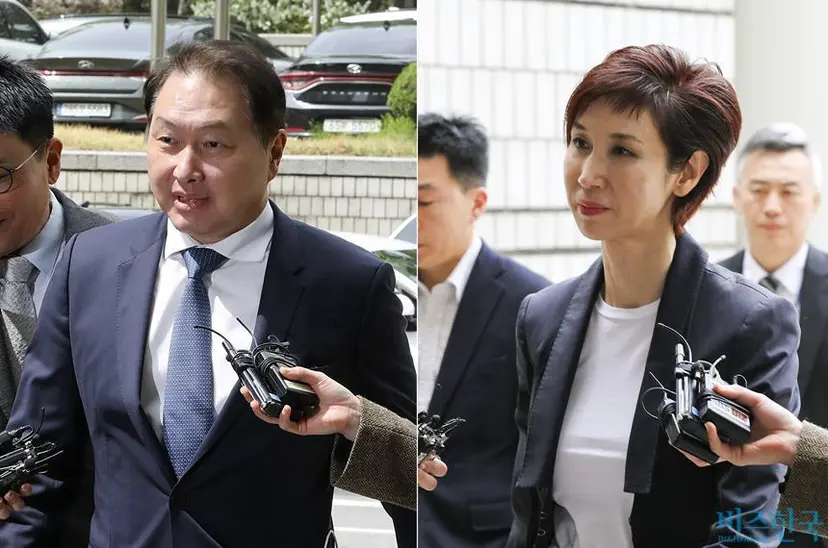
Supreme Court En Banc Hearing Scheduled for the 18th
The divorce case is currently assigned to the Supreme Court's 1st Division (presiding Justice Seo Kyung-hwan). The 1st Division has been reviewing the case for one year and two months since receiving it in July of last year, and a hearing by the en banc panel, in which all Supreme Court justices participate, is scheduled for this Thursday, the 18th. An en banc hearing is handled as a "reported case" to hear the opinions of all justices. However, not every case reported is referred to the en banc panel or leads to a final sentencing.
Nevertheless, the legal community is paying close attention because the decision on whether or not to refer the case to the en banc panel can provide a glimpse into the final outcome. While the first and second trials are "trials of fact" that dispute factual relations, the third trial (the final appeal) only addresses "legal issues." Therefore, while the third trial usually has little room for "dispute," the divorce case between Chairman Chey and Director Roh is an exception.
Previously, in May of last year, the Seoul High Court ruled that "Chairman Chey must pay Director Roh 2 billion won in alimony and 1.3808 trillion won in property division." This overturned the first trial's decision—which stated that the SK shares held by Chairman Chey were not subject to division—and significantly increased the amount to be awarded to Director Roh.
The legal issues currently being contested at the Supreme Court are threefold: whether the (SK) shares that Chairman Chey inherited from his predecessors should be considered subject to division; whether the 30 billion won in slush funds from former President Roh Tae-woo that appeared in the second trial can be recognized as having flowed into SK and, if deemed illegal, whether they are still subject to property division; and whether the errors (corrections) revealed during the drafting of the second trial's ruling warrant a remand.
Does the En Banc Favor 'Chey' and a Sub-Bench Favor 'Roh'?
The legal community suggests that if the case is referred to the en banc panel, it favors Chairman Chey, but if the decision is left to a sub-bench, it favors Director Roh.
The observation is that for the Supreme Court to overturn the second trial’s factual findings and legal conclusions—specifically regarding the recognition of "special property" (assets not subject to division) and the claim that former President Roh's slush funds flowed into SK—a majority of the justices must agree that "the second trial was flawed and needs to be examined in detail." In such a scenario, a referral to the en banc panel would naturally follow.
An attorney who is a former high court chief judge explained, "If it goes back to a sub-bench, it could be seen that a majority of the justices supported the second trial's ruling. If it is referred to the en banc panel, it means more justices believe there are 'many points to be viewed differently.' It is currently unknown whether the Supreme Court will directly judge the recognition and ratio of special property to overturn the ruling, or simply point out errors in the verdict and send it back for a retrial; thus, this meeting on the 18th is crucial."
A managing partner at a large law firm familiar with the case added, "Some judges may find the evidence of the slush fund inflow insufficient, arguing that 'it is difficult to make a judgment based on this level of evidence,' which could lead to a remand. In this case, an en banc judgment is more appropriate. Ultimately, the case was likely reported to the en banc panel because there were disagreements within the sub-bench; if the en banc panel sends it back down to a sub-bench, it means the majority opinion supports the second trial’s judgment."
'Weight' on En Banc Referral?
In particular, if the court deems the slush fund of former President Roh, which served as the basis for the astronomical property division in the appellate trial, as "illegal," there is a possibility that it may acknowledge the flow of funds to SK while ruling that they are not "subject to property division."
Above all, the errors in the ruling revealed after the second trial are considered a major variable. The second trial court initially wrote in the ruling that the stock value per share of SK in 1998, around the time the former chairman died, was 100 won, but revised it following objections from Chairman Chey's legal team. Consequently, the contribution of the former chairman (1994–1998), initially calculated at 12.5 times, increased to 125 times (a 10-fold increase), while Chairman Chey's contribution (1998–2009) decreased from 355 times to 35.5 times (a 10-fold decrease). The court explained that "it was a correction of a calculation error in intermediate facts and does not affect the property division ratio."
However, it is reported that some Supreme Court justices have said in private that "clear errors in a ruling are not mere mistakes, but grounds for re-examining the case." The aforementioned law firm managing partner predicted, "Some justices have said in private gatherings with other legal professionals that 'this is a calculation error, not a simple typo, and thus a matter for remand.' The Supreme Court might avoid specific judgments and focus only on the errors in the ruling, leaving the conclusion open and remanding it back to the second trial. Since the en banc panel can provide guidelines on 'to what extent ruling errors justify a remand,' whether or not it is referred to the en banc panel is a key indicator in this case."
A presiding judge at the Seoul High Court added, "Seven out of ten judges believe this is not a simple typo. If there was a flaw in the judgment itself, it is a clear error, and how much weight the Supreme Court gives to this is something judges are watching closely."