

[비즈한국] Bae Kyung-hoon, Minister of Science and ICT, has proposed three key initiatives for the Ministry: becoming one of the top 3 AI powerhouses, a top 5 science and technology power, and building a South Korea where everyone prospers together, aiming to achieve these by 2030. On the 12th, during a press conference held in Gwanghwamun, Seoul, marking his 50th day in office, Minister Bae stated, "We will contribute to restoring 3% of our growth potential by 2030 through AI," outlining this vision.
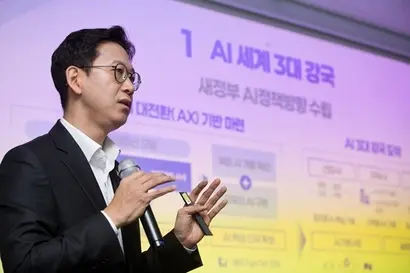
Minister Bae announced his goal to narrow the technological gap with the U.S. to within 0.5 years by 2030. He emphasized, "Rather than simply aiming for 3rd place, it means reaching a level similar to the top two powers, the U.S. and China. This doesn't mean China and the U.S. will hold 90-95% of the AI market while we settle for 5-10%," adding, "While there was a technology gap of about 1.3 years with the U.S. the year before last, the goal is to reduce that to within 0.5 years by 2030."
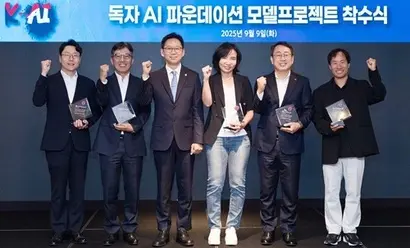
Minister Bae revealed that a large language model (LLM) ranking within the global top 10 is expected to be released within this year. He said, "The project for an indigenous AI foundation model began with a sense of mission that we must create a world-class outcome. Currently, five consortia are conducting AI training, and the first results will be released this year. Next year, we will advance from LMM (Large Multimodal Model) to LAM (Large Action Model)—which can think and act on its own—to build a foundation for physical AI."
He continued, "We will make our foundation model open-source so that people choose Korean AI instead of the U.S.'s Llama or China's Qwen. The goal is not just to create an AI that is somewhat usable in Korea, but one that is at a level where international users can also utilize it." He added, "The reason why the U.S., which possesses multiple Big Tech companies consistently releasing top-tier AI models, is still afraid of China is because they believe China, with its strong manufacturing base, could charge ahead with physical AI. I believe there is an opening for Korea in the field of physical AI."
Regarding infrastructure construction to support this, Minister Bae announced a plan to increase the target for securing cutting-edge graphics processing units (GPUs) from the original 50,000 to 200,000 by 2030. Minister Bae explained, "After taking office, I examined the matter closely and found that the original basis for the 50,000 figure was 30% of the demand required by academia and small-to-medium enterprises, excluding large corporations; I believed that if the government acted as a primer at that level, it would be enough to lay the foundation for an AI-driven transformation. However, AI technology is growing so rapidly that I realized 50,000 is no longer sufficient."
Minister Bae emphasized, "We have also prepared a plan to secure 50,000 units early by 2028," and added, "Although domestic neural processing units (NPUs) still lack the capability to match Nvidia's GPUs, we can create NPUs that are usable for inference. We will ensure that we don't rely solely on Nvidia, but begin introducing domestic NPUs for inference tasks. We are also considering power issues and will foster a 'K-Nvidia' by 2030."
Regarding the AI Basic Act scheduled to be implemented next January, he stated, "We will operate the AI Basic Act in a direction that minimizes the burden on companies. We will defer any penalties that companies are worried about for at least one year and adhere to the principle of minimal regulation that does not stifle industrial growth." The government plans to complete the establishment of enforcement decrees and notifications by the end of December after a legislative notice next month, followed by the finalization of guidelines.
Regarding recurring cyber security incidents at telecommunication companies, such as unauthorized micro-payments at KT030200, Minister Bae stated, "Under current law, KISA (Korea Internet & Security Agency) can only respond once a company reports an incident. I believe we need a legal framework that allows the government to respond immediately if a problem is suspected. We are currently in discussions with the National Assembly to change the system from a report-after-the-fact approach to one that allows for proactive measures."
He added, "As hacking technology utilizing AI continues to advance, we must establish fundamental countermeasures, and I have deep concerns about whether we are prepared. Recently, I met with the National Intelligence Service as well as the Ministry of the Interior and Safety to discuss comprehensive measures against hacking. We intend to form an information protection response task force (TF) led by Second Vice Minister Ryu Je-myung to provide the strongest possible response."